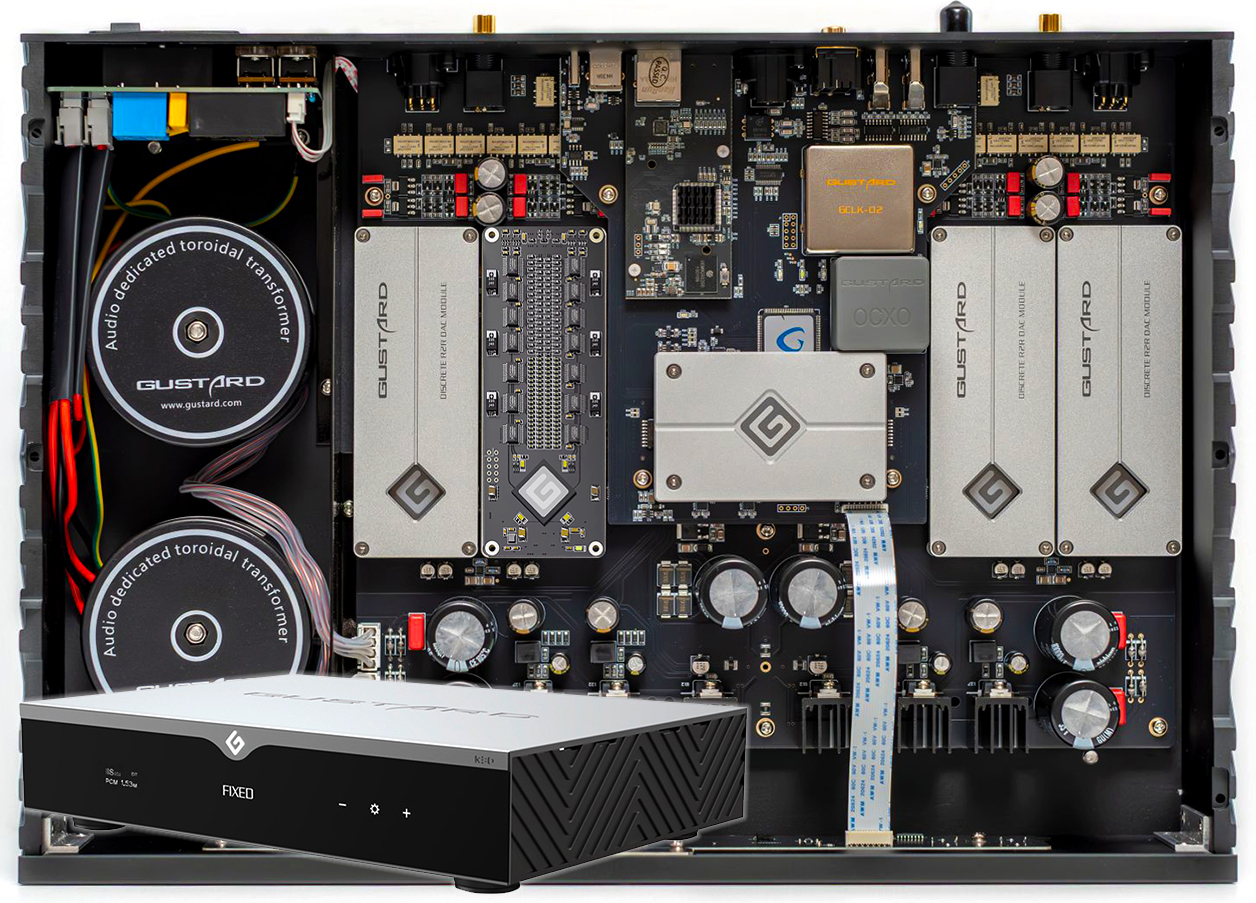
For friends of visual unity, Audalytic's €399 DR70 streaming DAC with 25-bit R2R ladders and native 1-bit DSD supporting up to PCM 768 and DSD512 is the perfect match. It packs Bluetooth 5.0, Roon Bridge, AirPlay, UPnP and NAA. The configuration interface lives at dr70.local, the RCA/XLR outputs offer a standard 2/4Vrms. Hello Gustard baby twins. Come to daddy? Santa had his orders. Consider the time line. My 2017 review of the Denafrips Terminator was one of its first. It marked the year when Chinese discrete R2R DACs arrived to then thrive even in Stereophile's Class A ratings. Eight years later the breed has thoroughly breached the €500 blockade. It now shows up well sooner. FiiO package a discrete R2R DAC with true tube buffer for €379, another with headamp for €319. Gustard's embeds PGA 2311 volume control from 0-100 and a basic setup menu for the digital filters including NOS mode, DSD direct/PCM, display brightness, screensaver, auto off and default restore whilst the output buffer voltage-feedback op-amps are socketed so can be rolled, perhaps with popular discrete Burson or Sparkos issue. Curiously the brand's €599 AH90 companion DAC goes to AKM AK4499EX silicon. Discrete R2R used to be a relative extravagance beyond on-chip converters. That script would seem to have nearly flipped by now.
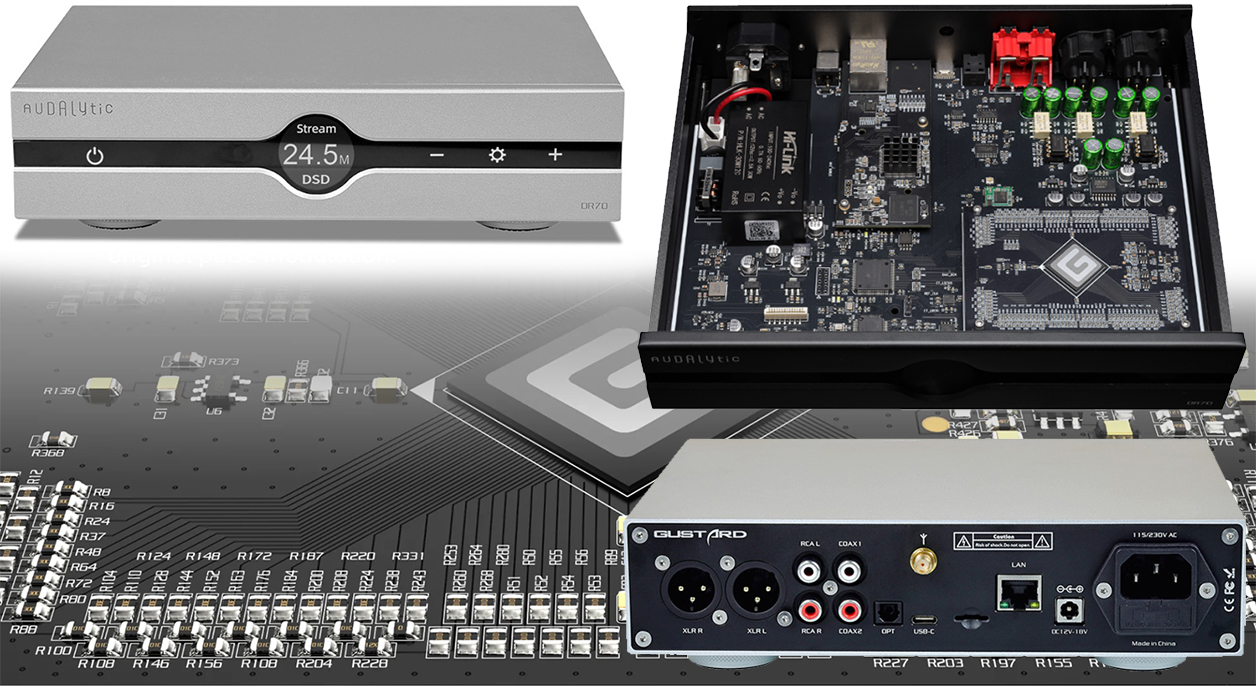
Once again this deck is a party for PSU rollers here with the same broad 12-18VDC acceptance window. My 15V/3.5A €319 iPower Elite from SilentPower could shake hands. There's even a micro SD card slot though the owner's manual makes no mention of its intended use so it likely holds firmware code. For all the S/NR & Co. figures, consult the linked product page at review's end. We already have enough to get sufficiently analytic over this minor audacity called Audalytic.
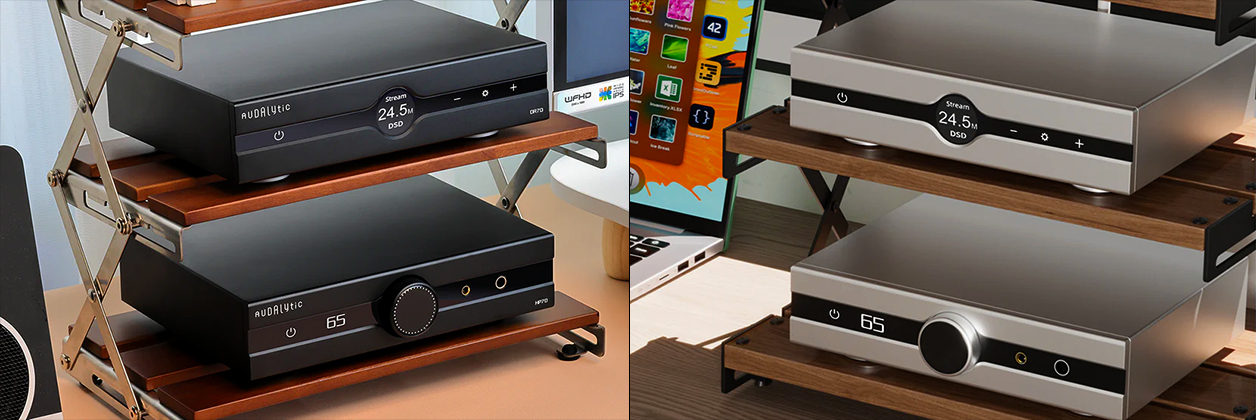
Whenever components seem to lean on them hard enough, hifi chat loves to invoke the laws of Physics. How about the laws of Economics? Without understanding them with a formal degree, it still seems fair to say that what our money can buy us today if we shop smart is quite astonishing. Whilst no hard laws get broken or else brands would go out of business, I still find myself routinely surprised by just how sophisticated select hifi has become at the entry level. It suggests a very nonlinear progression. Where advances at the very high end get ever smaller for increasingly disproportionate cost, the entry level has clawed up vigorously. This squeezes much of the in-between stuff sideways. Once we deduct brand cachet, material luxuries and features to focus on raw performance, today the lower reaches can nip ever harder on the higher heels. To find out just how well-heeled, taking a punt on these silvery twins felt low risk. On my Sino scenic tour¹, I've thus far owned aune, Cen.Grand, Denafrips, Exact Express, FiiO, HifiMan, Kinki, Laiv, LHY, Luxsin, Singxer, Soundaware and Topping. During my tube days I crossed paths with Antique Sound Lab, Melody Valve Hifi, Mystère, PrimaLuna and others whose names I forgot and who no longer trade. Today's Gustard gig adds a new name to my list though their rep in the €1-4K space certainly buttered me up. When we ask what's in a name, the answer can be rather more than nothing. Could a formal Gustard review be in my future? To play in the grown-up league wants €1'150 for the H26, Gustard's discrete headphone amp with twin 50W power toroids and the same OPA LM49720 line stage. But now eight not four pairs of class A output transistors produce a whopping 12wpc/32Ω from a beefier linear not switching power supply. For my desktop needs, the HP70's 2wpc more than suffice. There's a petite punt versus a serious stunt. I know my limits. To test Gustard's responsiveness to end-user inquiries, off a brief email went. Would I hear back? I did, very promptly, from Gustard's marketing director Huang Chengshi who confirmed that "Audalytic mainly focuses on small mini desktop devices while Gustard primarily targets large desktop devices and standard-sized equipment."
_________________________
¹ Regular readers know. Other than loudspeakers, my systems comprise a majority of Chinese kit. Add COS Engineering from Taiwan and Simon Audio Lab from South Korea. Though I live in the western-most part of Europe, my hifi footprint is deeply rooted in the Far East. Whilst designed and managed in the UK, even my iFi iDSD Pro Signature DAC is built in China. So is the iMac. The answer as to why my hardware focus is such should be obvious: better value on a reviewer's sotto voce salary.













Before we proceed, a Capt'n Obvious note. We all season our hifi. We only differ in where and how deliberate we go about it. On my desktop the Polish designer of the Viper monitors very deliberately built in a chunky dense rich bass-saturated tuning whose potency can—and for my tastes does—favour arrow-straight preceding neutrality to not overegg. Call it big-dose seasoning at the very end of the signal path. Hence my choice of Topping B200 amps. As their extreme specs predict, they excel at super-clean very high resolution which could fall short on leaner paler speakers. DACs not deliberately tuned for special effects can still turn the steering wheel but far less so than amps. On that score we'd expect fewer contributions from a DAC-direct connection than inserting the HP70 as an active class A line stage with discrete R2R not on-chip volume. This set the sonic and expectation scene which the baby Gustards parachuted into. But there was more. All my other systems represent higher price points. Those have their own audience. But to remain in direct daily contact with the entry level, I wanted one system to better reflect it even if the desktop's Virtual Hifi Viper speakers, very high value as they are, continue to represent a costlier league. Everything else however—Singxer SU-2 USB bridge, today's budget Gustard, Topping B200 monos, aune SR7000 and FiiO F7 headphones—should reflect the entry level. Why that's important should be self evident. Unless these twins were to make my transition too painful, they would replace my full-width COS D1 DAC/pre and Kinki ¾th THR1 headphone amp to de-escalate my desktop. That was the master plan. Would it come to fruition? Just then John Darko's review on Gustard's €3'590 so big 27-bit quad-ladder R2R DAC with twin power toroids below dropped, KnockOut! award in tow. That poured oil on my hopeful embers. What's more, our man in Berlin finally inhaled deeply on audiophile catnip by way of I²S and DSD512 and called the effect sweet mother of pearl. 2026 kicked off with a bang indeed.