The most striking difference between Emitter and many other amplifiers were the high frequencies. Initially the Emitter seemed quite unobtrusive. Defensive would be too strong a word and convey the wrong impression. Thanks to its seemingly ultra-low distortion, it sounded unspectacular and subdued on first blush but ultimately transformed into fascinatingly natural purity. Where the Audio Analogue and a Musical Fidelity M8s 500S on visit, the latter somewhat more restrained, unleashed sonic firework displays, the Emitter initially appeared to hold back considerably. After a while I understood my suspicion of lacking detail to be unfounded. The Emitter presented an immense amount of information which integrated with such impressive smoothness as to be simply present. This amplifier doesn't create airiness but conveys what's recorded. In this respect the Musical Fidelity sounded a touch more open although I can't say for sure which was truer. The battery power supply and amplification of enormous reserves probably played a role. The "Chant D'Amour I" from Messiaen's Turangalila Symphony [DGG, Myung-Whun Chung, Orchestre de l'Opéra national de Paris] with its massive use of metallic percussion offers an abundance of overtones. I've listened to this many times but after a while always turned it down because it became really fatiguing. With a Naim Supernait for example, it was only enjoyable at reduced volumes. With its purity and smoothness, the ASR superbly unveiled the tonal differences between instruments. After a while of pleasurable listening, I boldly turned it up to true concert levels, much to my delight but dismay of neighbours. If a system can maintain control amidst this clanging, buzzing and rattling, presenting everything with airiness and detail without fatigue in any way… that says it all.
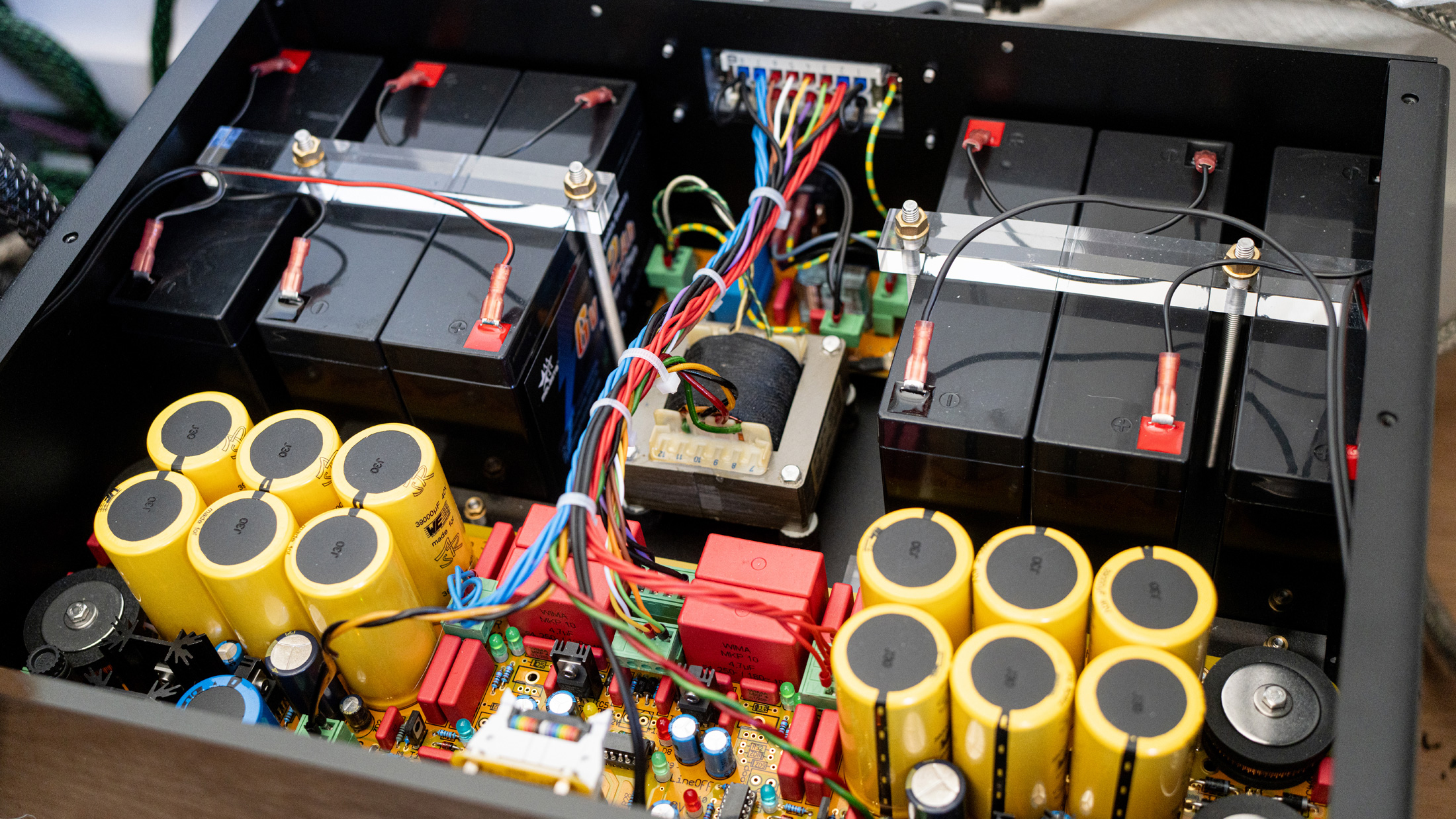 The battery power supply.
In terms of microdynamics, the Exclusive HV was lightning-fast across all frequencies yet so effortless that I initially didn't clock just how fast it really was. Displacement made that easy! Perhaps the most noticeable characteristic then are macrodynamics. Before any distortion, stress or imbalance occurs, an emerging edge doesn't present at full force but rather with a subtle rounding. This happened so skillfully across the bandwidth that you inevitably wonder if this isn't exactly as it should be. All information remained present. The Emitter isn't a show-off but serious banker with exceptional reserves. It also offers a level of transparency I rarely experience – exceptionally relaxed but highly informative. Combined with a superbly stable soundstage, you can mentally walk around the images while listening. The fact that it delivered the highest treble with a certain gentleness personally appealed when I dislike devices that impress at first but then make you reach for the remote to give your ears a break. Otherwise, virtually all sonic aspects dictated by the recording, source or speakers. That said, the bass was a real delight. It's the only range where the Emitter wears a bit of a showman's glittering jacket. But of course in Central Hesse, the glitter is very subtle. Who wouldn't I recommend the Emitter I Exclusive HV to? If you have space constraints or unstable flooring, there are more suitable amplifiers. Also, if you want the sweat and grime of a hard-hitting live concert in a particularly extrovert way, the Emitter can't and won't go there. It'd have to distort or lose composure. Anyone who ever met Friedrich Schäfer knows why the Emitter sounds as it does. For me, my ears, surroundings and music, his Emitter I Exclusive HV is simply the best integrated amplifier I've ever had the pleasure of hearing.








Psych profile for the ASR Audio Emitter I Exclusive HV …
Facts: