Country of Origin

 This review first appeared in May 2026 on fairaudio.de. By request of the manufacturer and permission of the author, it is hereby syndicated from the German original to reach a broader English audience. Ed.
Reviewer: Stefan Gawlick
Analog sources: Transrotor Apollon w. SME V, SME 3012 or Linn Ittok arms and Ortofon Venice, Denon DL 103 or Van den Hul Frog carts
Digital sources: Crane Song Avocet, Merging Anubis, Merging Hapi, Mark Levinson 390S
Integrated amplifiers: Musical Fidelity A1, Accuphase E-213, Rega Elicit
Preamps: Crane Song Avocet; ifi iPhono and Trigon Advance phonostages
Power amps: Abacus 60-120D Dolifet & Ampollo Dolifet
Loudspeakers: Sky Audio Verdade 2.2, Spendor LS 3/5A, Spendor S3/5SE, Wharfdale Super Linton
Cables: Vovox Excelsus drive & Textura & Sonorus Protect, Audioquest Sky, Cardas Clear Sky, TCI Emerald Constrictor, Ensemble, Phonosophie Power Cord
Rack: Phonosophie Classic RackAccessories: Audes ST-3000 AC isolation transformer
Power delivery: TCI Emerald Constrictor, Phonosphie, Ensemble Power Link Silver
Listening room: 28m² with ARD standard, 35m² lightly treated
Review component retail prices: €18'000
 Use mouse-over loupe or right-click to open at full size in a new window.
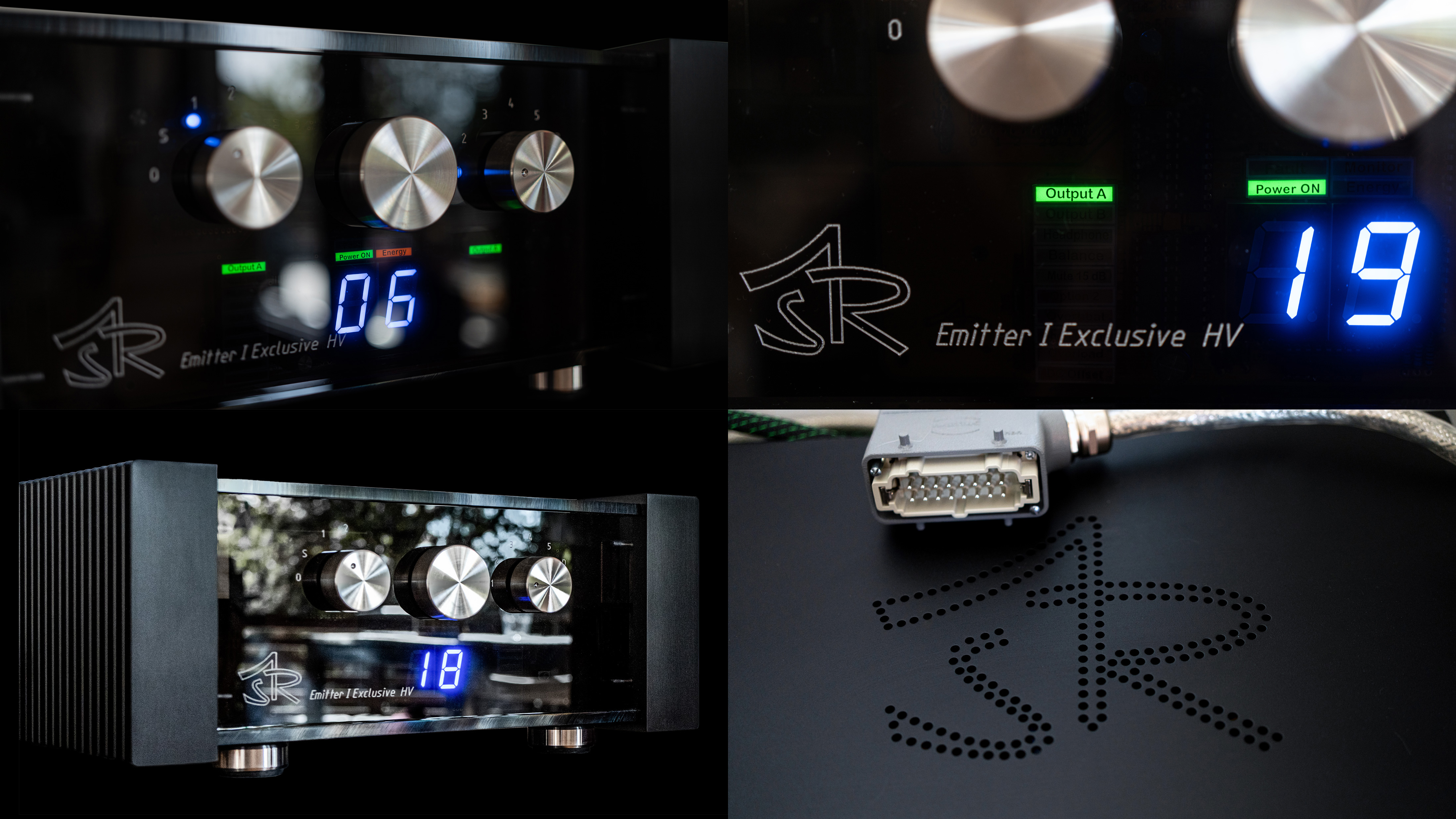
Urgestein. Antediluvan rock. Isn't it somewhat premature to label anything as passing as modern consumer electronics—that's all even a high-end integrated amplifier like today's ASR Emitter 1 Exclusive HV is—with such a weighty and immovable term? Does it preface yet another cliché-ridden review that relies on superlatives right off the top? Such suspicion is understandable even if fairaudio strives to call a spade a spade. So let's take a quick look at the facts to justify the ancient header. The dictionary says: Ur·ge·stein / Úrgestein / noun, a rock of volcanic origin largely preserved in its original form. We concede that the Emitter does retain its original form. External design and technical concept of a variable-output power amplifier where as much interference from the AC as possible is kept away from the signal path with external power supplies, batteries and filtering have remained unchanged since the first version. The term 'primeval rock' carries subtext of old—and rightly so. Early science called rocks primeval if they believed them to have formed at the very beginning of our planet. In this sense the Emitter is undoubtedly one of my personal primeval hifi rocks. The first review of an Emitter integrated amplifier appeared in 1985 so around the time when my own audiophile interests began to explore the world starting with my parents' Dual system. In my world the Emitter has always just been there like Transrotor, Thorens, Nakamichi, Conrad Johnson, Accuphase and JBL. And yes, it might sound banal but rocks are heavies. The ASR Emitter 1 Exclusive HV chassis triplets weighing ~80kg (amplifier 22kg, battery supply 26kg, AC supply 32kg) rock a solidity few competitors can match; apart from its big brother, the Emitter II. When we look at the competition and find astonishingly good-sounding amplifiers which weigh a mere fraction, such material excess must be justified; or at least explained.
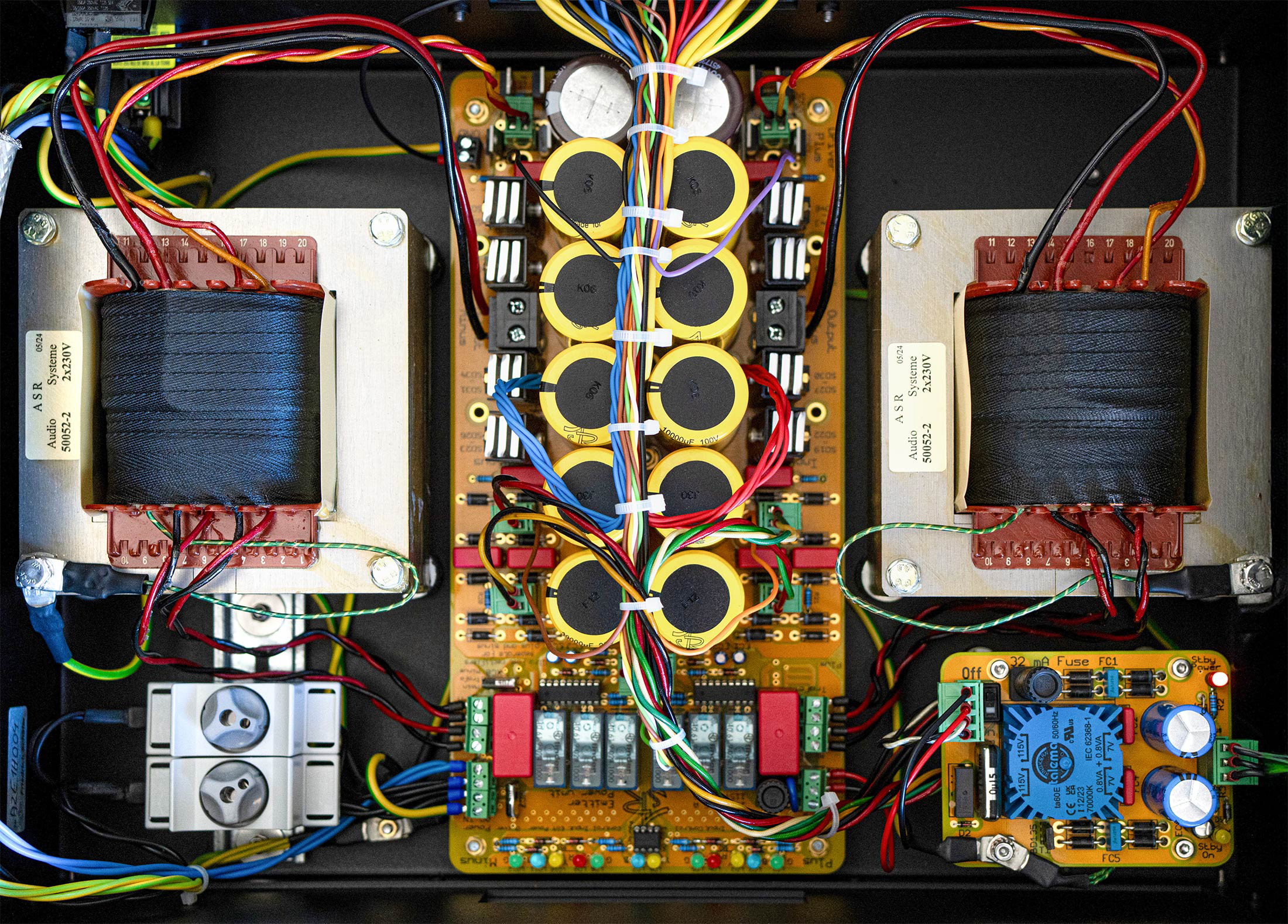 Internal power supply of the head unit with two Philbert skin-cut transformers and 604'440µF filter capacitance. Fuses by Neozed.
All good things come in three. Friedrich Schäfer describes his fundamental idea of an ideal amplifier as follows. The goal must be absolute purity and serenity. In our world, stress and interference are ever-present. They ought to not climb up the narrow steps of the ivory tower of playback. The effort begins quite simply but crucially with the split of one machine into three chassis. Since even elaborate filtering can't fully banish minor mechanical oscillations from power transformers which Schäfer sees as problematic for the signal path, his power generators physically separate from the music section. The impressive industrial Harting connectors linking the two external power supplies to the amplifier have likely been mentioned in every prior review including ours. The linear AC power supply with massive Philbert-type transformers powers the output stages and controller. According to ASR, sophisticated and active mains filtering against RF interference and DC makes add-on filters, filtering power cords or conditioners obsolete. The filtering in this power supply is a quite generous 80'000μF but not sufficient for the overall system. An additional 428'000μF add in the battery power supply; plus 524'000μF in the main unit.







The sense and nonsense of volume controls. The DC battery supply powers the input stage and confirms that like all Emitters from Herborn/Hesse before it, the Exclusive HV is essentially a power amp with volume control. Schäfer takes a different approach by attenuating the input signal via resistors whose relays are not in the signal path then feeding it to a low-gain power stage. Turning the volume control in 1dB steps beyond 51 crosses unity or source gain to add active gain. For Schäfer, the conventional method of using a power amplifier at fixed so full gain fed by artfully attenuated signal from the preamplifier is about as sensible as driving a car at full throttle and regulating its speed with the handbrake. Compared to the standard Emitter I Exclusive, output power was doubled to 250wpc/8Ω by increasing the operating voltage to ensure effortless control over even the most demanding speakers. Pure silver wires are primarily responsible for signal transmission to the binding posts. For those who find this excessive given the already quite powerful output of the base Emitter, let me welcome you to the world of Friedrich Schäfer. For those who crave still more, there's his ASR Emitter II HV. Another magazine measured that as outputting 1'800wpc into 2Ω before their power delivery system shut down. As with the regular Emitters, the Exclusive HV can be tonally adjusted to a certain extent via DIP switches. I saw no reason to change anything. I didn't want to disturb the wonderful default balance of the ASR as delivered.
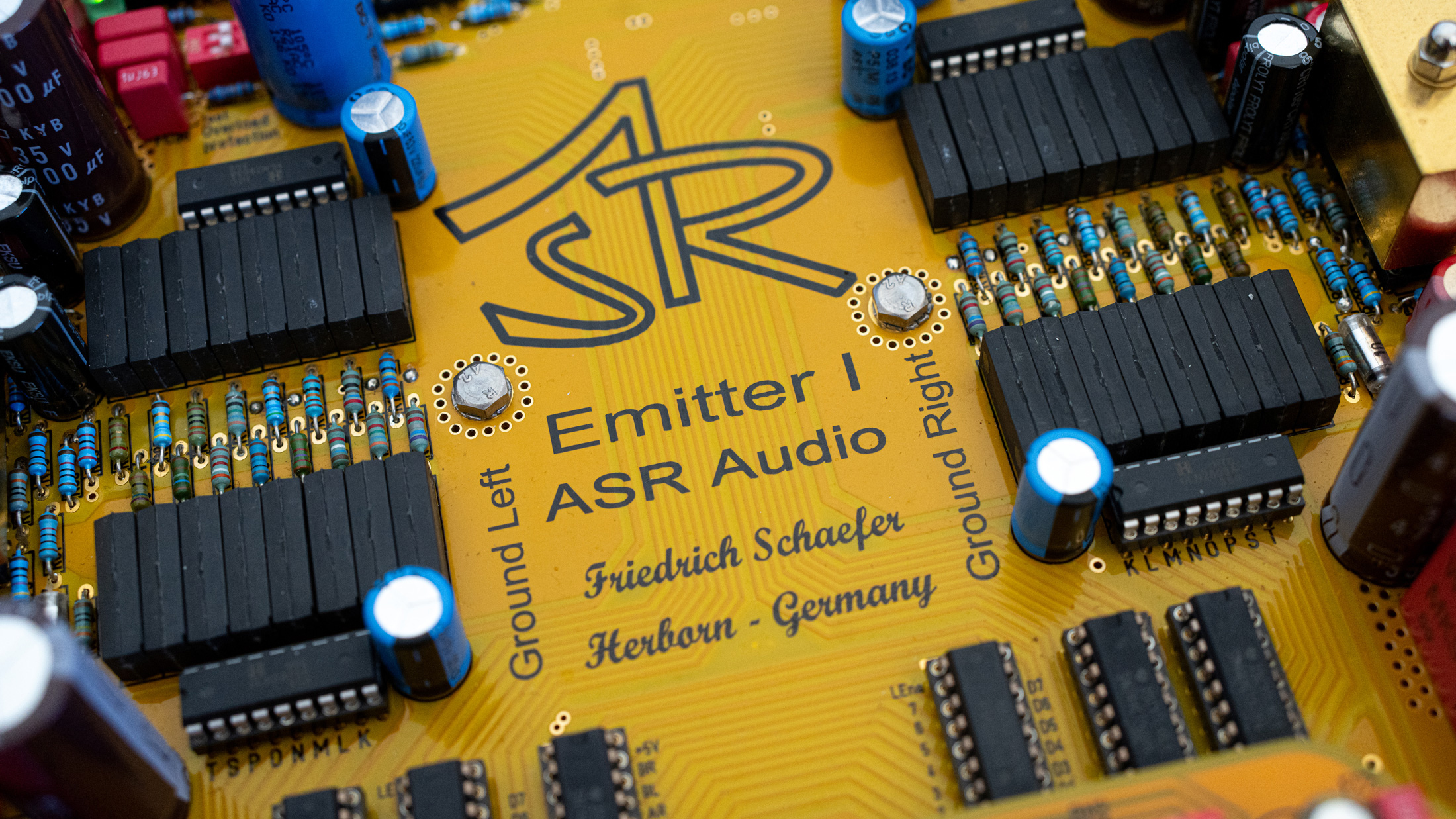 2.5mm thick PCB.
Of course its operating voltage didn't simply double. All relevant parts were reinforced or replaced to handle higher power without premature aging. What was initially intended as stop gap for demanding loudspeakers turned out to be a resounding success when the high-voltage versions sounded more relaxed, refined and precise in every regard. According to ASR, it's why recent sales have almost exclusively been their new HV versions. Listing all available purchase options would become a Chinese restaurant menu. You can have your own amplifier customized in various colours, specify inputs and outputs—XLR or RCA—and many other parameters. My colleague Michael Bruß provides a great first glimpse into the world of ASR customization here. Sonically an ASR Emitter may cause a slightly delayed listener response because it's so relaxed. But this effect is lasting. After the main unit, power supply for the output stage and battery supply for the input stage positioned and connected, source devices and speakers wired up, I eagerly anticipated first impressions. How would the new component present, the system change? What would I hear? That last question answered easily: music and naught else. Given its power supply and very low distortion, the ASR Emitter 1 Exclusive HV performs with such authority that one might initially be disappointed if expecting obvious great things. However, you'll completely forget about special effects within minutes which is my highest compliment for any amplifier. The spatial capabilities of the Emitter only reveal gradually. A consistent feature is a soundstage slightly behind the speaker plane so never frontal. All other vectors remain entirely contingent on a given recording and unconstrained by other limitations. Especially towards the rear, the Hessian unfurled a panorama whose depth I have truly never experienced with any other amplifier.