 What I heard was a form of directness which wasn't a simplification or impoverishment of musical information but rather the opposite. Nuances, colour hues, textural structures and spatial layering all deployed so plain and effortless that my ears and brain only registered natural inclusive immediacy. It was like having the privilege of hearing very knowledgeable charismatic people speak eloquently but maintain understated calm explanations that have us learn and listen with intention and the conviction of a personal bi-directional link being created in the process. The transparent straightforward nature of Protos was well
  embodied also in how it presented bass. Protos had all the means to control the woofers of my Aura but refused to use it to the detriment of musicality as sometimes happens when an iron grip on the low end makes the listening experience feel as though trying not to cough in a concert hall. Bass notes were not merely tight but timbrally legible so of clear pitch, texture and decay all properly proportioned. The low end did not thump then disappear but spoke to me. On well-recorded double bass, I could easily follow the interplay between tone wood and strings. On tympani and kick drums, I virtually saw the membrane tension, surface area and material. On piano, I could follow the left-hand phrasing and subtle touch enveloped by deep-reaching resonances of soundboard and cast-iron frame.
Aries Cerat claims that TriodeFet delivers "the superb midrange and treble, accurate timbre and huge soundstage we expect from big-bottle tube amplification". In my system, the midrange was indeed the amp's calling card not because of being warm or romantic but complete. Where some amplifiers draw the midrange as a line between bass and treble, Protos drew it as a complex three-dimensional surface—continuous, saturated and internally detailed. Vocals had weight without heaviness, instruments body  without blur and that aforementioned sense of purity came across so evidently during my 'critical' listening sessions that it was hard to remain analytical for long as I invariably ended setting aside my notepad as though hypnotized by the music. Treble was as extended and open as an Alpine landscape yet free of edge. Cymbals had shimmer without sand, guitars brilliance without bite. Light without glare is a tricky balance as the easy path to pseudo detail is to highlight the presence region and leading edges. Protos avoided it by conveying high-frequency detail in true resolution and spatial contrast not aggression. As a result, the tasteful embodiment of treble information allowed for long sessions without boredom. Think refinement sans sedation.
 The single-handed naturalness of the tonal spectrum applies also to how musical objects unfolded in space and time. The amp's massive appearance stood in stark contrast to its swift response to sharp transients, whether in the form of big thunderous passages or small nuanced ones. This mobility kept the music interesting and persuasive. I often found myself looking around the room between the left and right side even up and down to follow the movement of the musical focus on recordings like the 1965 Mravinsky/Leningrad reading of Bartok's Music for Strings, Percussion and Celesta which became a cinematic experience, engaging my visual senses to an almost hallucinatory degree. "Drum Boogies" from the Domnérus, Erstrand and Co. Live is Life is an unusually realistic rendition of a drum kit. Its spatial depiction avoids the common elephantine exaggeration yet clearly separates the various elements in the kit, then shows colour characterization of wooden drumsticks, metallic frame rings, high-hats, mylar skins and cataclysmic air-pump capabilities. Protos mastered all aspects and with its mere 20 watts of rated power drove my Aura SE to room-rattling chest-shaking dynamics, making this virtuoso solo drum track an enthralling experience.








Owning tube electronics, I've come to appreciate so-called tube rolling. This can become overwhelming when possible glass combos number excessively but with electronics like Protos or my Riviera Labs AIC-10 hybrid being equipped with a few relatively inexpensive tubes placed in strategic signal-path locations to imprint their sonic character in straightforward fashion, we enjoy the advantages of tube rolling while remaining sane. Protos offers two variables in its main unit: tube bias and changing the TriodeFet tube type/brand. In my system, lower bias provided a more focused airy sound that emphasized the perception of depth while higher bias thickened the sound, enlarged images and emboldened transients. As to tube type, Stavros had sent me EF280 to try as an alternative to the stock 6p-11j. Aside from the obvious higher gain, I appreciated the increase of vividness it imparted, providing a 'pop' effect to front-of-stage information by differentiating it more clearly from the background. The presentation became slightly more raw compared to the calmer more liquid Russian tube but my emotional engagement increased. After some experimentation I ended up using the EF280 with a bias current of ~22mA.
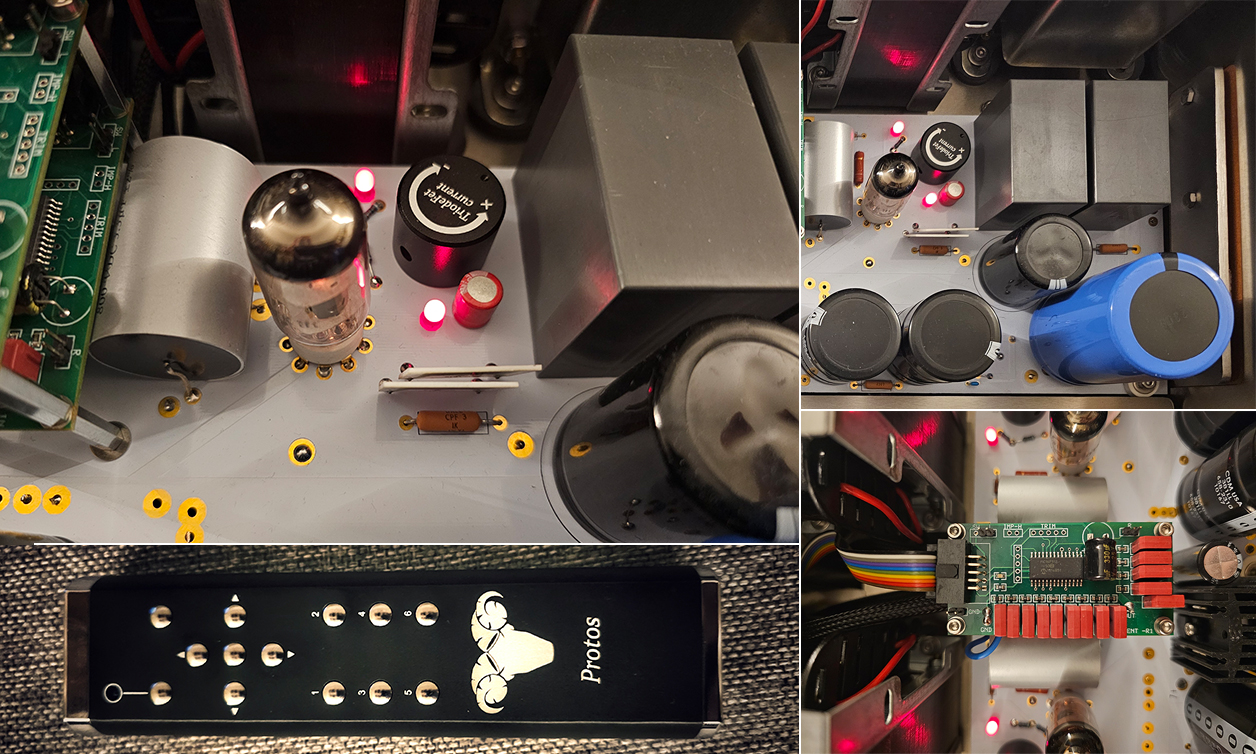 TriodeFet bias trim pots | resistor-ladder volume control module
The XLR4 headphone output requires no impedance matching according to Stavros. That is provocative because it suggests that Protos can treat even high-impedance or current-hungry cans not as an afterthought but a load worthy of its TriodeFet circuit. If you own both speakers and headphones, you may no longer need two separate systems to experience one consistent tonal aesthetic. With Protos, output vs. load variation is similar to solid-state amplifiers so when I plugged in my Immanis via its 8Ω silver RCDI interface, I had to be careful with the volume knob as 20 watts could be disastrous. This pairing produced the fastest most crystalline and impactful sound I ever experienced over headphones. The soundstage exploded around and in front of me and my ears and brain were invested in almost blinding clarity. Bass was lapidary, midrange radiant, treble scintillating. Music felt fresh with a sense of pervasive urgency and exciting tension. Everything was fully exposed and tangible, making listening to high-quality recordings an exhilarating experience. By the same token, tolerance of technically inferior material reduced to a few notes. Protos is an ideal companion for Immanis owners who look to reinforce the core strengths of this headphone rather than tame its exuberances. With my Spirit Torino Valkyria, the expansive presentation of Protos and its feline character helped balance out the darker-than-neutral balance of the Italian dynamics and their slightly closed-in staging suddenly produced a new level of eloquence in midrange articulation and treble extension. With the Nur Harmonia on review loan, Protos offered an especially synergistic pairing, tightening up a certain softness in the low registers, then assisting image projection and resolution at both frequency extremes. Overall, Protos was equally convincing as a headphone and speaker amplifier.
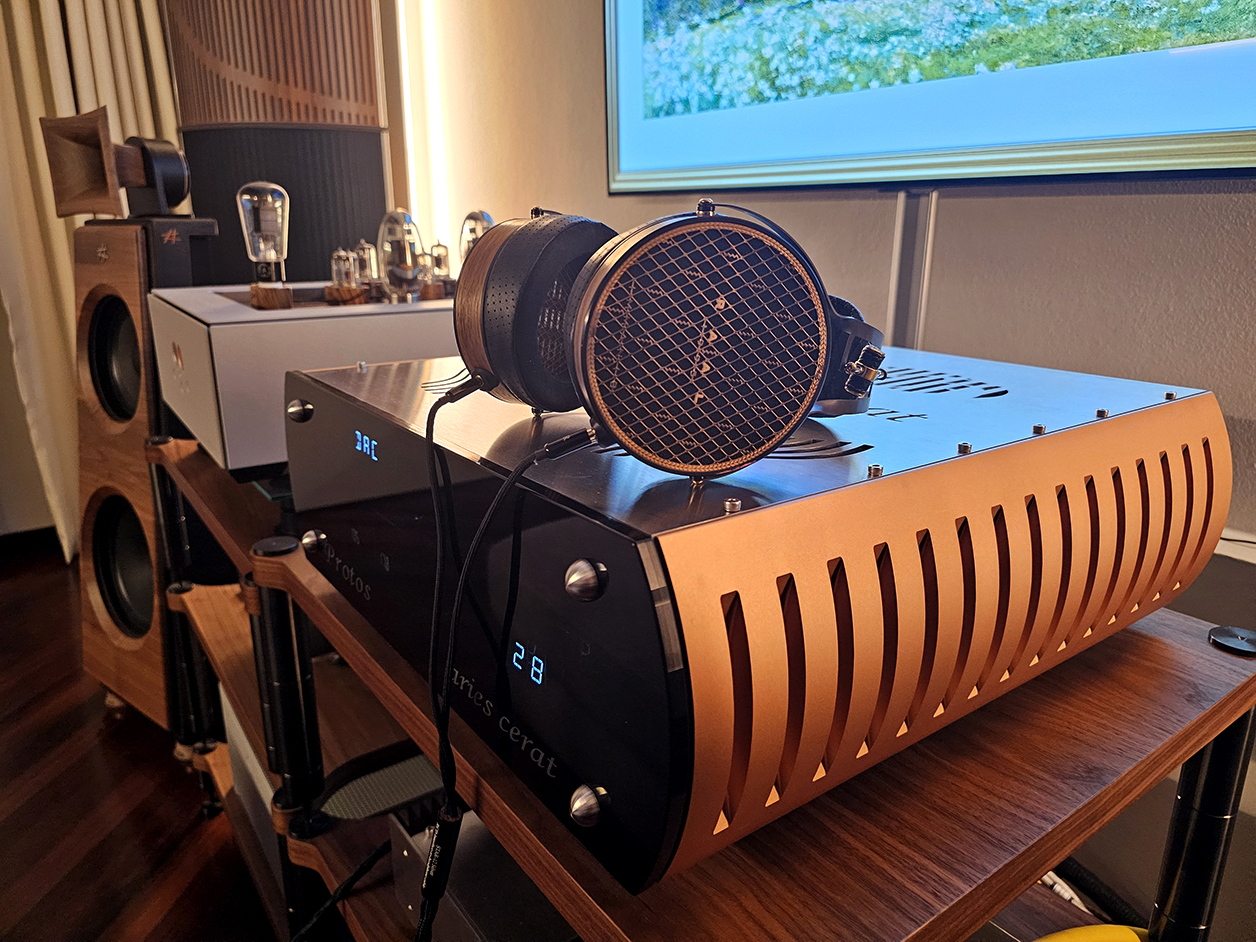
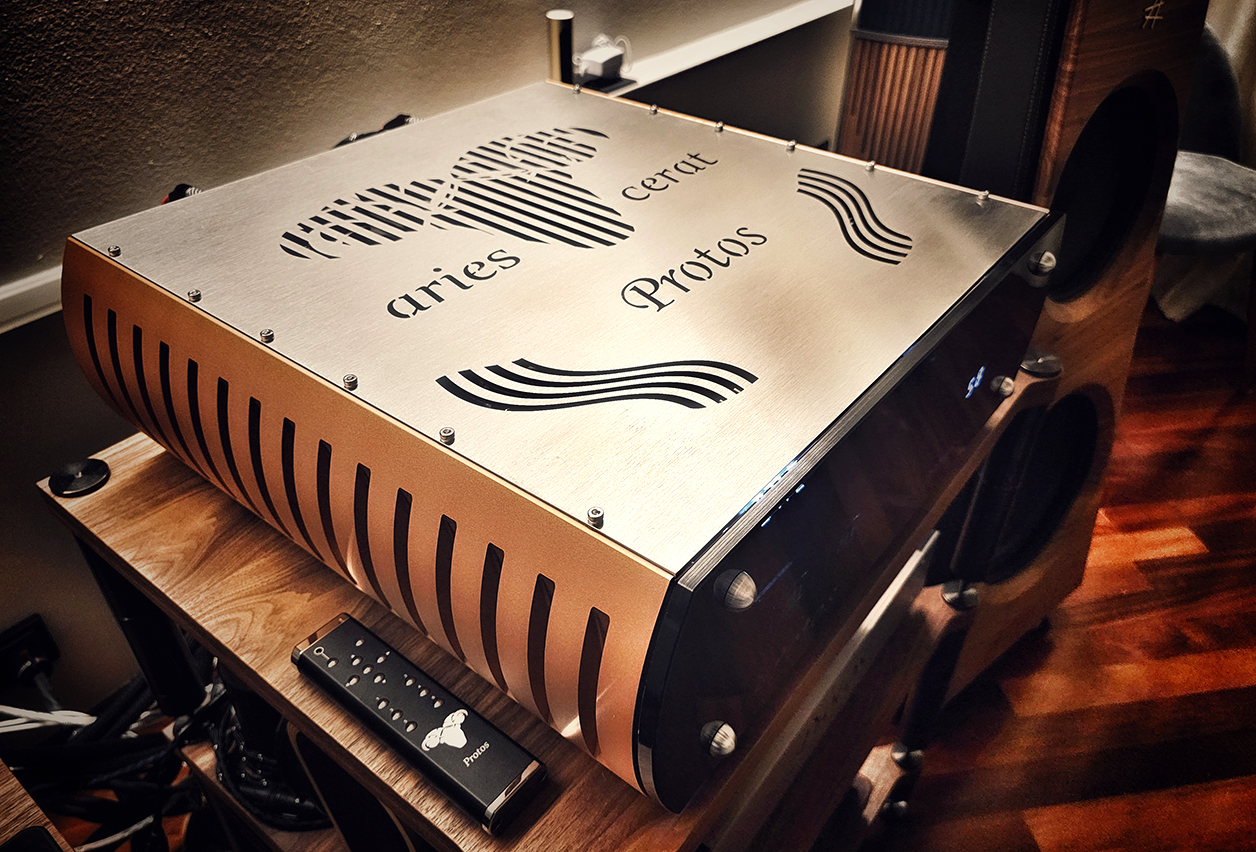
Compared to my Riviera Labs AIC-10, Protos offered technical improvements consistent with its additional expenditure. Aspects like transparency, signal-to-noise ratio, refinement of nuanced resolution, bass articulation, separation and speed all notably elevated. Although the thicker denser midrange of the AIC-10 and its slightly lower tonal centre of gravity still hit a certain soft spot on my emotional trigger meter, the more polyphonic acumen of Protos wasn't analytical or cold. Rather, it solidified the musical texture in front of me, making it feel idiomatic and believable, emotionally communicative and inviting. That kept the advertised promise of blending qualities stereotypically associated with solid state (precision, control, neutrality) and tube electronics (midrange saturation, holography, harmonics richness). Protos can compete with the upper tier of the Riviera Labs lineup so their ~€50K APL-1 AFS-32 combo. When choosing between the different voicing of these brands, the slightly more organic burnished tone of the Italians or the purer more liquid Cypriot become a matter of taste. There is a certain theatre to the Aries Cerat brand. In the intro, Srajan reported my tongue-in-cheek line about the "vaguely satanic logo" and whether it had begun to cast its spell. Joking aside, such visual cues do matter psychologically. We think ourselves immune but are not. The object on the rack is part of our listening ritual and the ritual is part of how we perceive, value and experience. The best products of course go well beyond ritual but ritual is still the entrance. And amongst several amplifiers I reviewed, the Aries Cerat Ianus Protos has been the overall most cogent. It combines stunning visuals, first-rate craftmanship, unique topology and musical virtues into a package whose only significant drawback is its sheer weight. More than ever, seeing it leave my rack left a big empty space both in my room and my pleasure memory.