Every once in a while I encounter an audio brand which under my skin I sense as an embodiment of all the qualities I look for in gear I choose for personal pleasure: a strong and original personality; a consistent design philosophy across the line; utmost attention to uncompromising craftmanship outside and in; bold design language; relentless focus on musical outcomes with firm engineering. This is what all equipment in my personal system shares. Aries Cerat, a Cypriot company founded by Stavros Danos, belongs to the same breed. Prior to this review, my only chance to check whether my intuitive affinity for the brand reflects in its performance was a home audition of their entry-level DAC Helène. This left a profound impression for its organic hefty tone weight and majestic image projections. As I dedicated the better part of the last 12 months to audition amplifiers, I just had to contact Stavros to include Aries Cerat on this exploratory journey. My preference was for his Ianus Protos because it has a headphone port to service both my headfi and speaker listening. Furthermore, being an integrated even if across two chassis would fit my listening room and rack logistics better than other options in the Aries Cerat portfolio. Another reason I was especially interested in Protos is that whilst sitting at the lower end of their range aka the Prestige series, it features one of the most iconic innovations of Stavros i.e. his TriodeFet technology within an intriguingly minimalist single-stage topology. When Stavros agreed to a review, I immediately felt the unmistakable frisson of anticipation combined with concern about handling the roughly 100kg declared weight of the crate to be delivered at my door.
 But let's rewind to the man behind it for proper introductions.
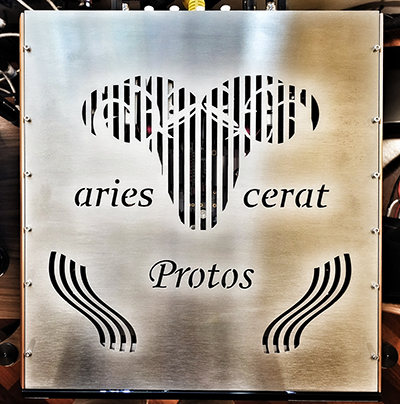
Stavros founded Aries Cerat in 2010. This was shortly after graduating as a mechatronics, robotics and automation engineer from Patras University. The name Aries Cerat combines Greek and Latin to reflect the company's identity and products. Aries is Greek for ram and also Stavros' zodiac sign. Cerat means horn in Latin derived from the Greek keras. This describes the conical shape of a musical horn not an animal's. The combination results in a distinctive logo featuring a ram with musical horns. All Aries Cerat speakers use horns on one or more of their drivers although in very atypical fashion. Doing things different was in fact a recurring theme during my conversations with Stavros who generously spent some time filling me in on his design principles and how Protos embodies them.
Regardless of device, be it a turntable, DAC, amplifier or loudspeaker, Stavros deliberately ignores prior art to not be influenced by what others have done before. This includes textbook approaches. To him that's a prerequisite to be able to really think out of the box rather than tweak existing tech or at best make small advancements with personal contributions. His other foundational design aspect is to refuse dogmatism about single-ended vs. differential, solid-state vs. tubes, driver types and their integration. His only absolute reference is live music and every component, technology and topology is selected and evaluated against that terribly challenging standard. After more than 15 years of intense activity incorporating the experience of his own trials and errors plus customer feedback, Stavros has identified some core design pillars for his electronics including:
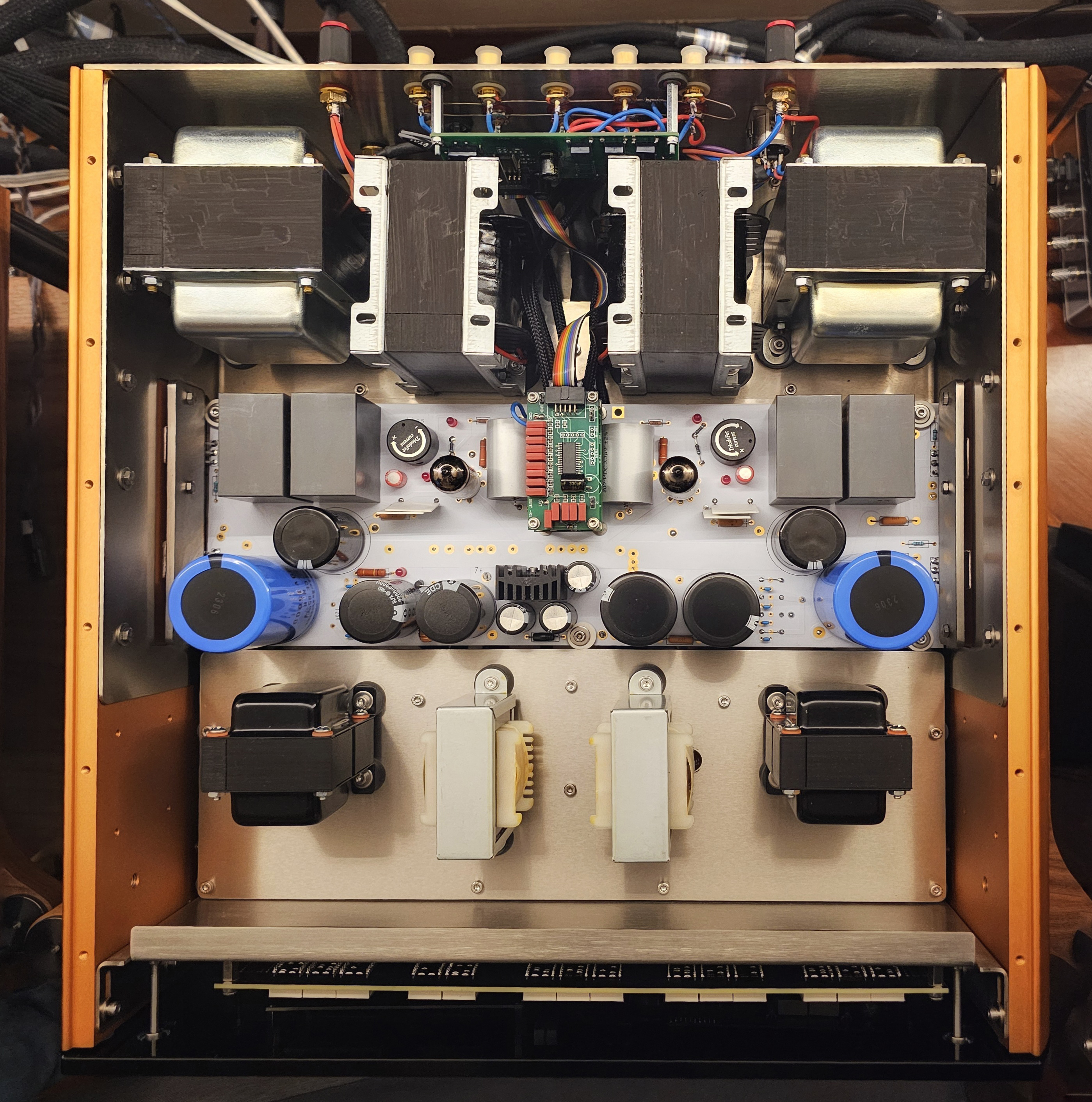
His TriodeFet's 2nd generation introduced in 2020 after 7 years of R&D under the Ianus product family represents a landmark example of these design pillars. TriodeFet aims to combine the virtues of triodes as still the most inherently linear voltage amplification device more than a century past its invention; and those of transistors like high current gain and low output impedance wedded in a compact configuration that acts as a virtual component, a three-terminal active element which can insert into a circuit like a triode or MosFet.









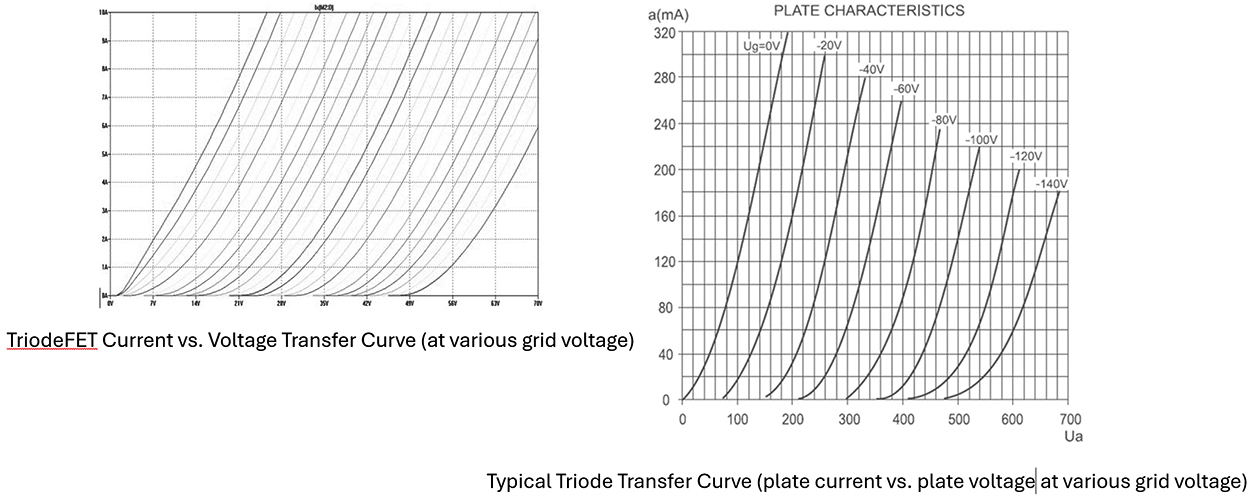
TriodeFet does not have to be viewed as a hybrid in the traditional sense where triodes and transistors operate in series to retain the inferior linearity and less benign distortion pattern of solid state. When measured as a unit like a discrete opamp would, TriodeFet exhibits a transfer curve which almost perfectly replicates triode behaviour but with three orders of magnitude more current, enabling extremely simple circuits that would be impossible with either just tubes or transistors. This is due to significant current and voltage gain which helps reduce the number of gain stages or active parts necessary as well as eliminates the need for local feedback loops due to the gain block's inherent linearity. As with pure triodes, residual distortion is dominated by even-order harmonics decreasing quickly with order so no high-order THD is present to remain inoffensive to the human ear. Stavros conducted a test amongst customers by designing an amplifier with variable feedback and asking them how they used it. The vast majority preferred zero feedback.
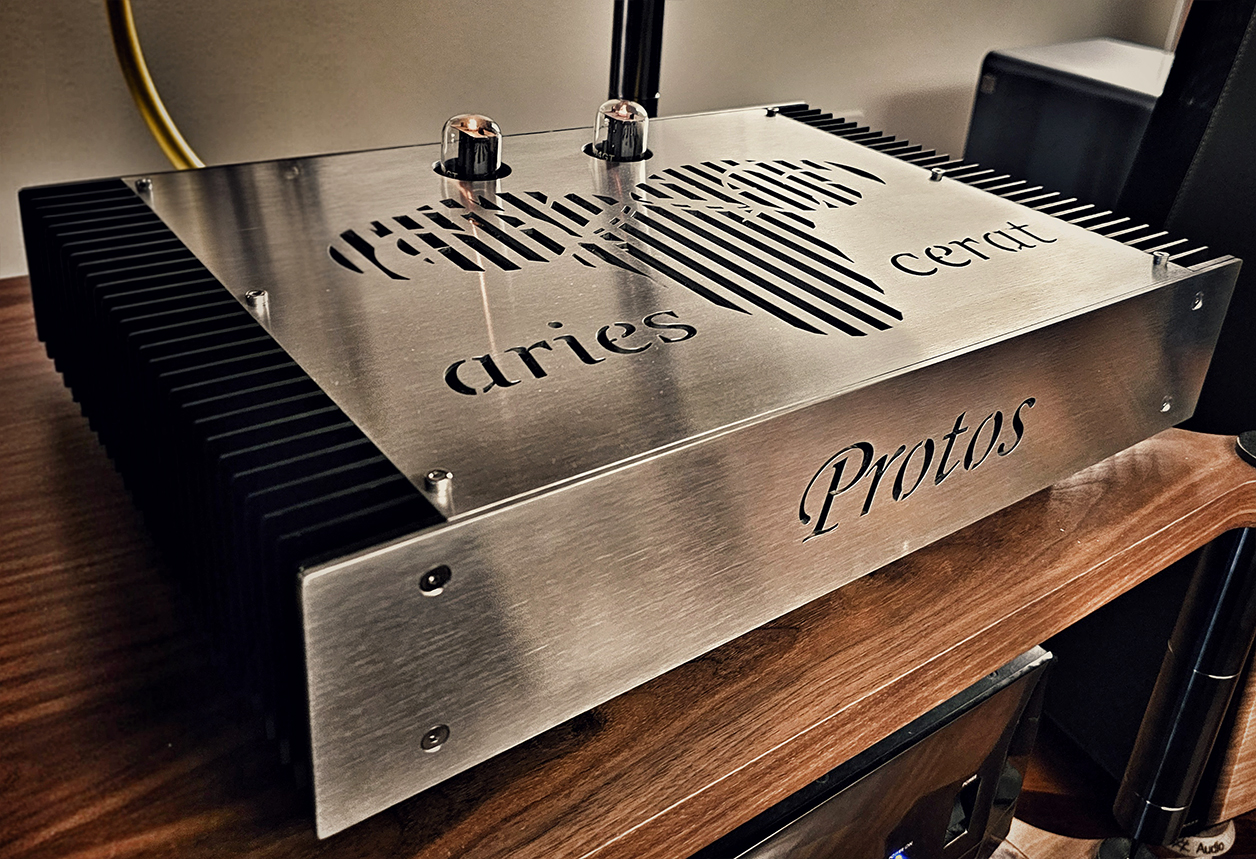
In audio, circuit simplicity is often viewed as the summit of the seven heavenly virtues. Everyone admires the concept, few have the guts to pursue it to the letter. The idea of a single gain stage between input and output is the amplifier equivalent of a clean window. No curtains, no filters, no internal negotiations, just the bare circuit minimum to turn a small signal voltage into a high voltage/current equivalent. The Ianus Protos embraces this notion to the fullest by realizing the most minimal implementation of TriodeFet in an integrated amplifier with a single-stage single-ended topology of one TriodeFet module per channel. Even though it sits at the entry of the Aries Cerat line, it should be an authentic testimony of Stavros's complete design approach. The topology may be minimal but its physical implementation is imposing to say the least. Handling the 100kg gross weight was no joke to require help from a generous friend. Unpacking and installation was not the typical ‘et voilà' affair. However, unearthing what was inside the crate was both physically and visually gratifying. Protos is a 2-chassis amplifier whose power supply lives inside a separate box connected via fixed umbilical. My loaner came with the newly released tube-rectified PSU, a €6K upgrade option which further improves S/NR, current output under peak demand and bandwidth. According to Stavros, the upgraded PSU sounds even smoother with better flow, lower noise and improvements in energy, speed and transparency. The upgraded PSU is twice as big as the standard version and given my rack's dimensions took up an entire shelf. Although its industrial design doesn't match the main unit—Stavros assumes that most users will hide the PSU—I liked its austere industrial appearance and the two tubes sticking out from its lid provided more glowing hues during my dark-room sessions.