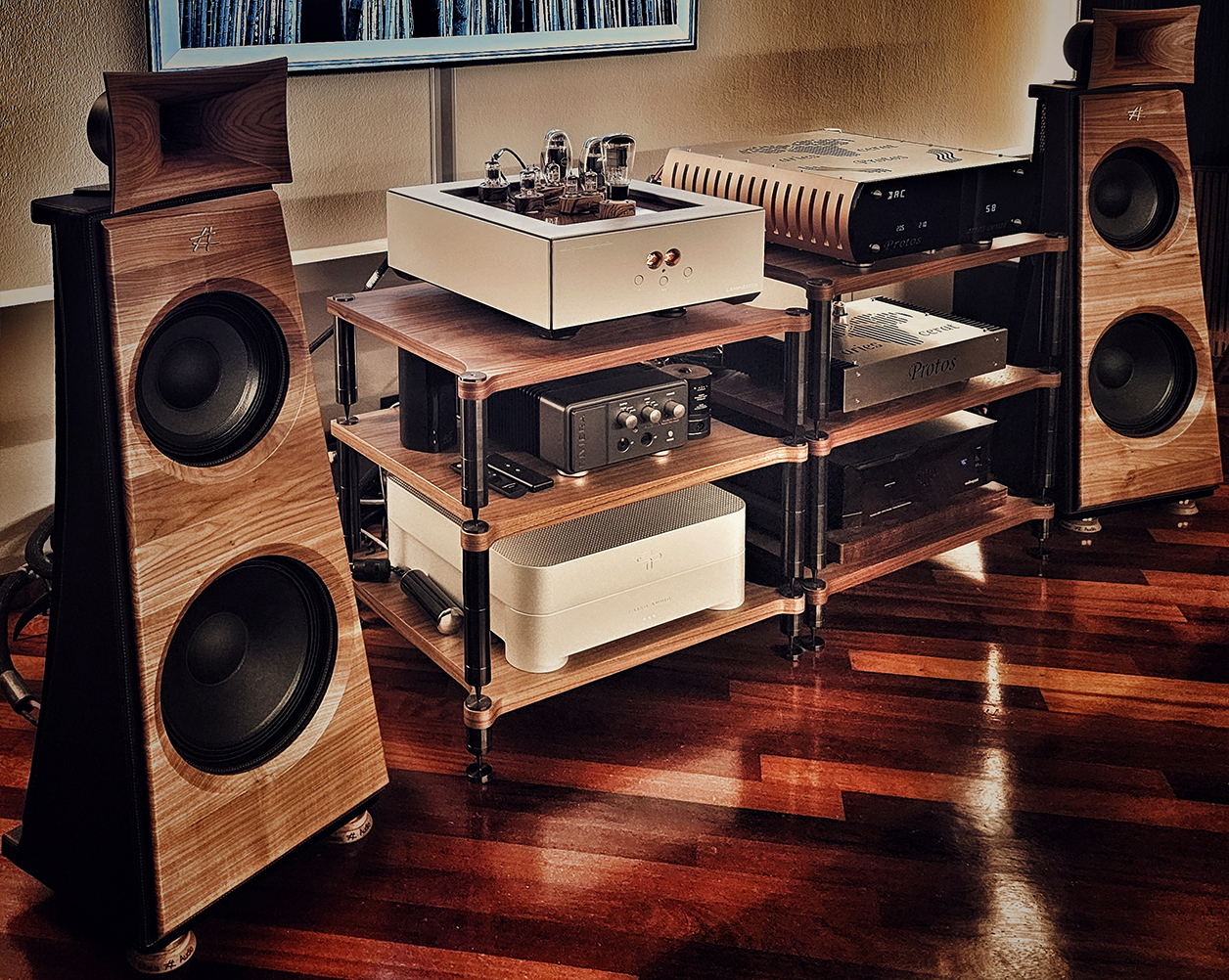
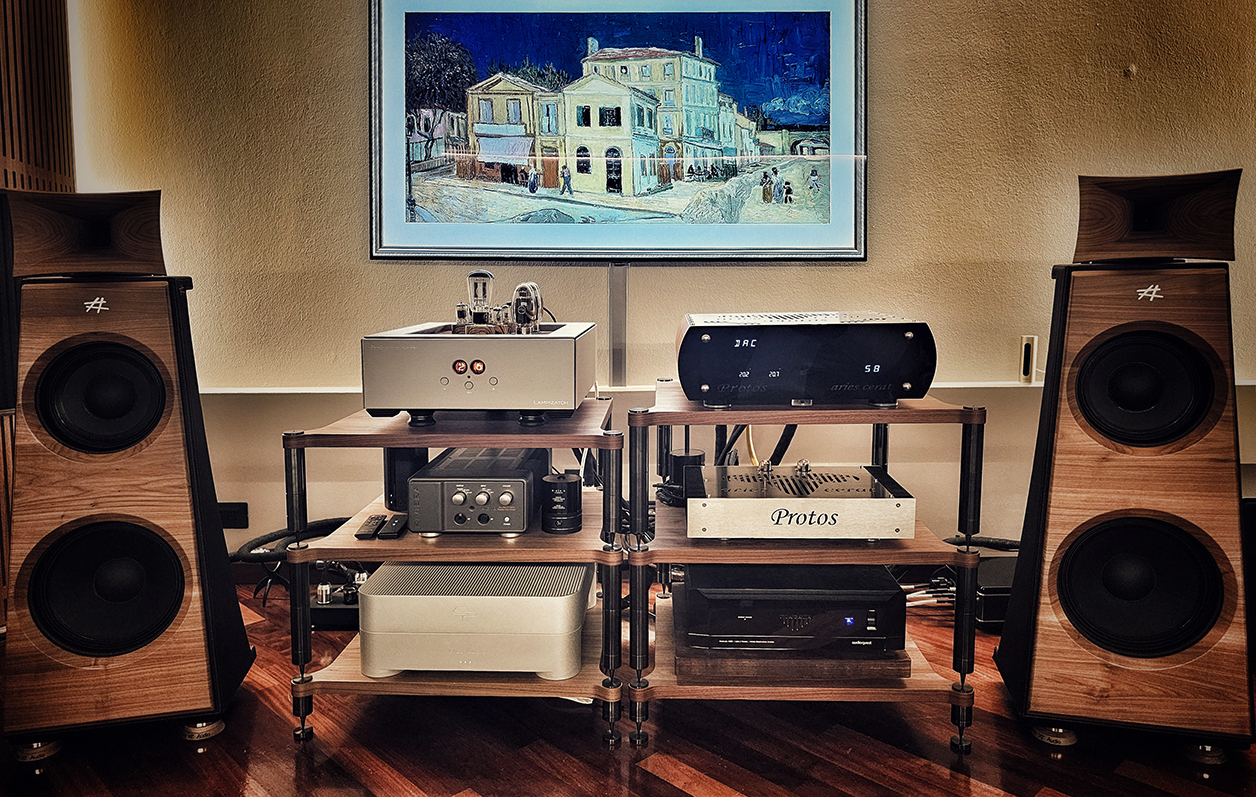
The obvious showstopper is the main unit, 60kg of sheer beauty which engaged me in almost disturbingly sensuous fashion since I first touched the ribs on its aluminium heat sinks. It has that unapologetically sculptural Aries Cerat signature. It asks no permission to be in our room but simply declares itself. The combination of colours and materials, the black glass front panel, copper-anodized bowed cheeks and stainless-steel top are a gorgeous sight to behold which matched the colour palette of my room and other gear, feeling right at home from Day One. Even the remote control combines practicality with rewarding looks and satisfying tactile feedback. It is a thick slender wand of solid aluminium which constitutes the only way to operate Protos given a total absence of knobs or buttons apart from the mains rocker on the PSU's back. The remote allows us to select source, control volume and change channel balance. The attenuator module is a 61-step switched R2R array for high precision, resolution and no channel imbalance even at very low SPL. The volume level displays with LED indicators on the front panel where source, L/R balance and L/R TriodeFet bias show as well. While the former indications can be obscured during operation, the bias information always shows with real-time fluctuations which I found mildly annoying. On the rear locate five unbalanced inputs, speaker terminals and the XLR4 headphone port. Being single-ended, the Protos topology is unbalanced by definition. Providing a transformer-balanced input would have been possible but the uncompromising approach of Stavros did not allow for that mundane concession. Although an XLR input adapter can be ordered, it's not advised when no XLR/RCA conversion is completely immune from sonic degradation. The beauty of Protos continues on the inside. When opening the top lid, the view is both unusual and gratifying. The elegance of the layout, the component quality and generous sizing of various chokes, transformers and capacitors immediately impressed this uncultured enthusiast.
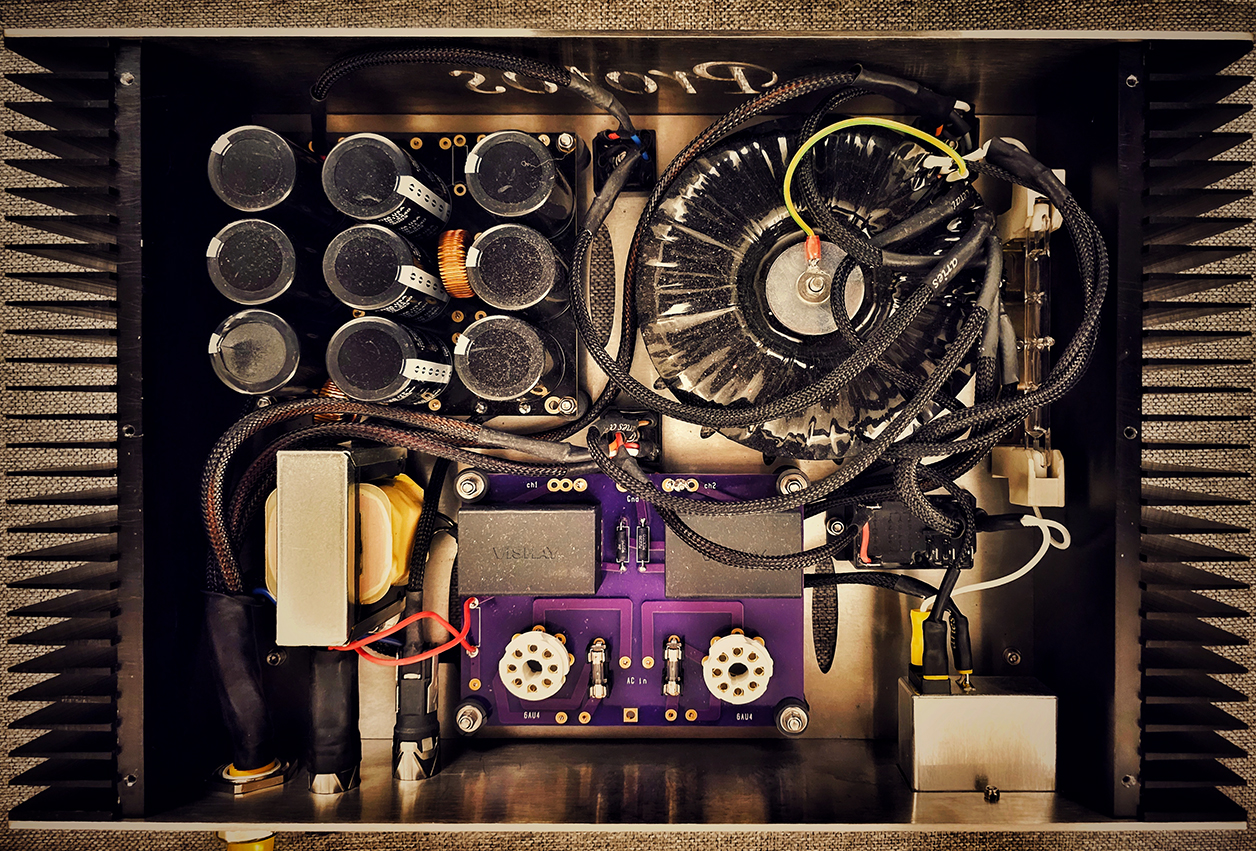
Opening the lid isn't just a matter of satisfying our curiosity. It's a necessary first step as it is the only way to access the TriodeFet's current bias knobs to set them to the desired level. The target value also depends on the tubes installed and I received two sets to experiment with: the standard 6j11p-e and a Siemens E280F alternative. After plugging in the tubes whilst the mains cable disconnects from the PSU, bias is set by slowly rotating the knobs until the indicator on the front panel stabilizes at the desired value between 15-30mA, 20 being a solid start. Changing the bias has subtle but very audible effects which I'll describe later. Real-time bias fluctuations of ±10% are to be expected and normal according to Stavros. Aside from sonic implications, bias current affects heat dissipation and current consumption. As a 20wpc class A design it consumes ~30W at low bias and tops out at ~50W close to 30mA. This level of dissipation with output transformers translates into modest heat which has ergonomic advantages and won't stress the internal components. The output voltage delivers in parallel on the XLR4 and speaker terminals to require disconnecting our loudspeakers when using headphones. Another purist side effect is that the XLR4 locates on the back to influence headphone cable length. The upgraded PSU uses a massive toroidal transformer, a pair of 6AU4GT rectifiers and a substantial array of mid-size aluminium electrolytic capacitors for fast and strong energy storage/delivery. While not as sexy as the main unit, its internals too show great attention to parts quality and layout. Given its gain structure and relatively low 7kΩ input impedance, for best sonic results Aries Cerat recommend driving Protos with a source capable of at least 6V and presenting an output impedance as low as possible. Aries Cerat's own digital sources Kassandra or Heléne are 9-10V/50Ω¹ designs. My early LampizatOr Horizon 360 with roughly twice the output voltage as the current version barely fit the bill at full tilt and on paper its 300Ω output impedance was barely good enough.
______________________________
¹ Thinking folks immediately recognize how in systems whose voltage gain distributes standard (say 2Vrms source, 6-9dB active preamp, ~26dB power amp or ~35dB integrated), the Aries Cerat sources run ultra hot to require copious signal cut not conducive to best S/NR. Within an Aries Cerat chain meanwhile, a source of very high voltage gain becomes the ideal mate for exotic amplifiers of low voltage gain.








The first thing that struck me over my Diesis Audio Aura SE speakers was their almost complete silence even when placing my ears directly on them. This was the quietest amp I tried thus far and Stavros opined that by further separating his main unit from the PSU, I'd gain additional noise reduction. To confirm, I plugged in the most sensitive headphones on hand, the 107dB/48Ω Nur Harmonia. Here too the noise floor was extremely low, better than my Riviera Labs AIC-10 and bested only by SAEQ's Astraeus. Considering that this headphone port applies zero attenuation to the 20W/8Ω speaker feed, this was remarkable. My resident Spirit Torino Valkyria (90dB/64Ω) and Raal 1995 Immanis (84dB/8Ω or 16Ω depending on adapter) exhibited no audible hum even at full tilt. The second thing I noticed when I started my evaluation was having to rethink my system's wiring. As my subwoofer only accepts low-level RCA or XLR signal and my AIC-10 lacks pre-outs, I use the Horizon DAC as preamp driving the AIC-10 in fixed mode via RCA and my sub from LampizatOr's sub out. I assumed I could do the same with Protos but was wrong. When attenuating my DAC to my usual range (40-45/63), its output voltage drops below 1V. While I could still obtain satisfying SPL by cranking up Protos, the sound was noticeably flatter, thicker and duller than with my DAC at fixed gain. My most effective solution would have been a high-level to low-level converter for the subwoofer to drive it in parallel with the speakers but I ended up adjusting its gain manually when needed.
After inserting a new amplifier into a familiar system, we typically expect to notice obvious things first such as changed bass level, treble energy or dynamic slam. Those are the usual headline variables even if also easiest to misjudge because they can be influenced by level matching and short-term excitement. With Protos, the first perceptual shift was not more bass or less treble but the shape of its silence. I'm not implying a lower noise floor in the measured sense though the -90dB spec already off the standard PSU is respectable. I mean silence as a structural musical element which carves out space, implies recording venue, affects how sounds materialize rather than squeeze out of a speaker. With some electronics, clarity implies sharpened edges, illumination by means of increased contrast occasionally to the point where the musical picture renders like a photograph taken under hard studio lighting. Not with Protos. It did not rely on artificial resolution tricks but instead seemed to remove a layer of previously unheard subtle compression, liberating an audible if minuscule smothering of low-level information which also intensified dynamic contrast at quieter playback levels than I'm used to. Consequently, images became more three-dimensional not because they were bigger but because their light and shade were more faithful. A violin is not a line or dot but a body with a cavity, strings, a bow and a moving air column. A human voice is not a midrange but chest, throat, mouth, breath, diaphragm and lungs. Protos teased out those elements with unforced solidity. Unhindered, uncorrupted, intact and pure were adjectives that repeatedly came to my mind as I ran through my usual reference playlist.