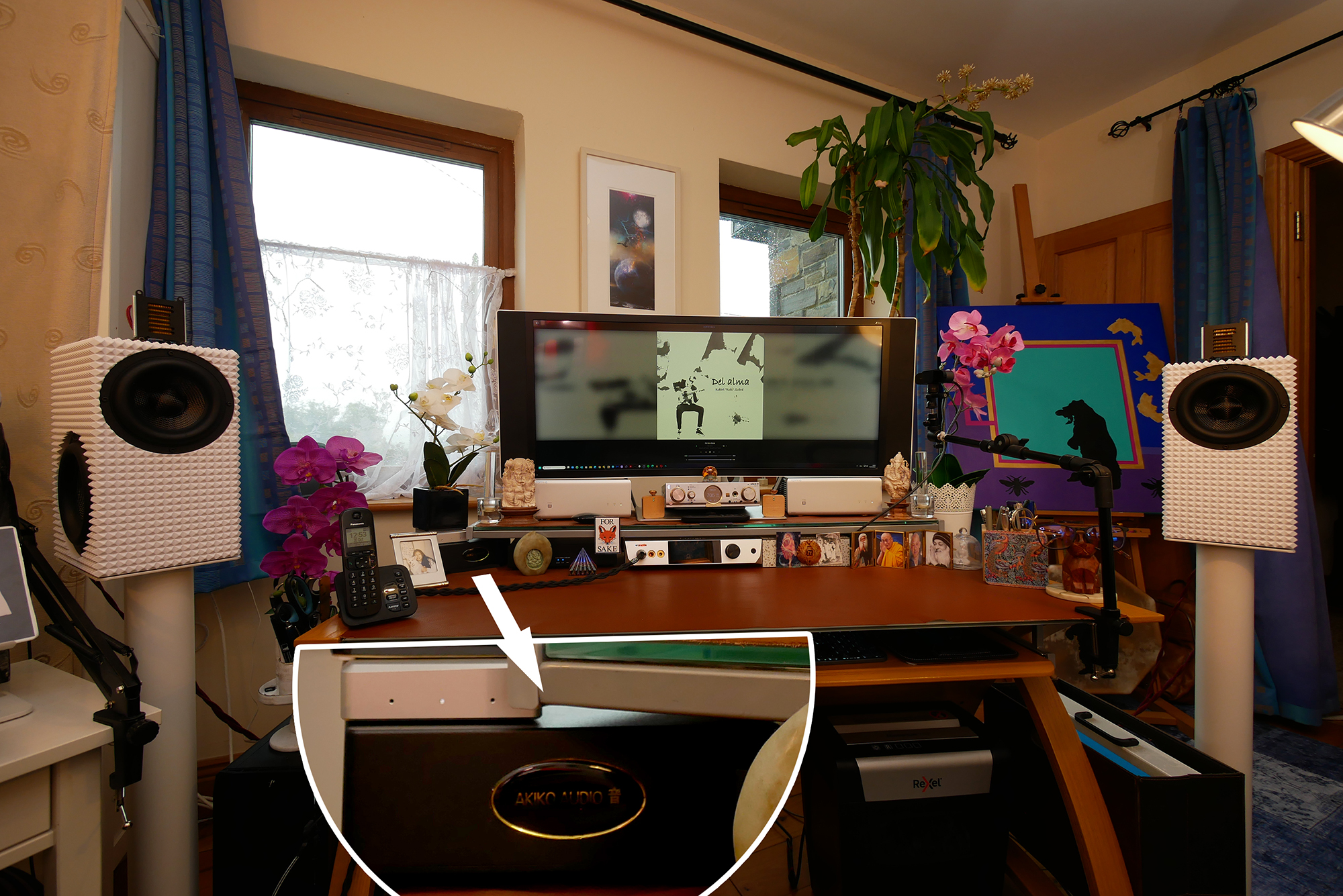
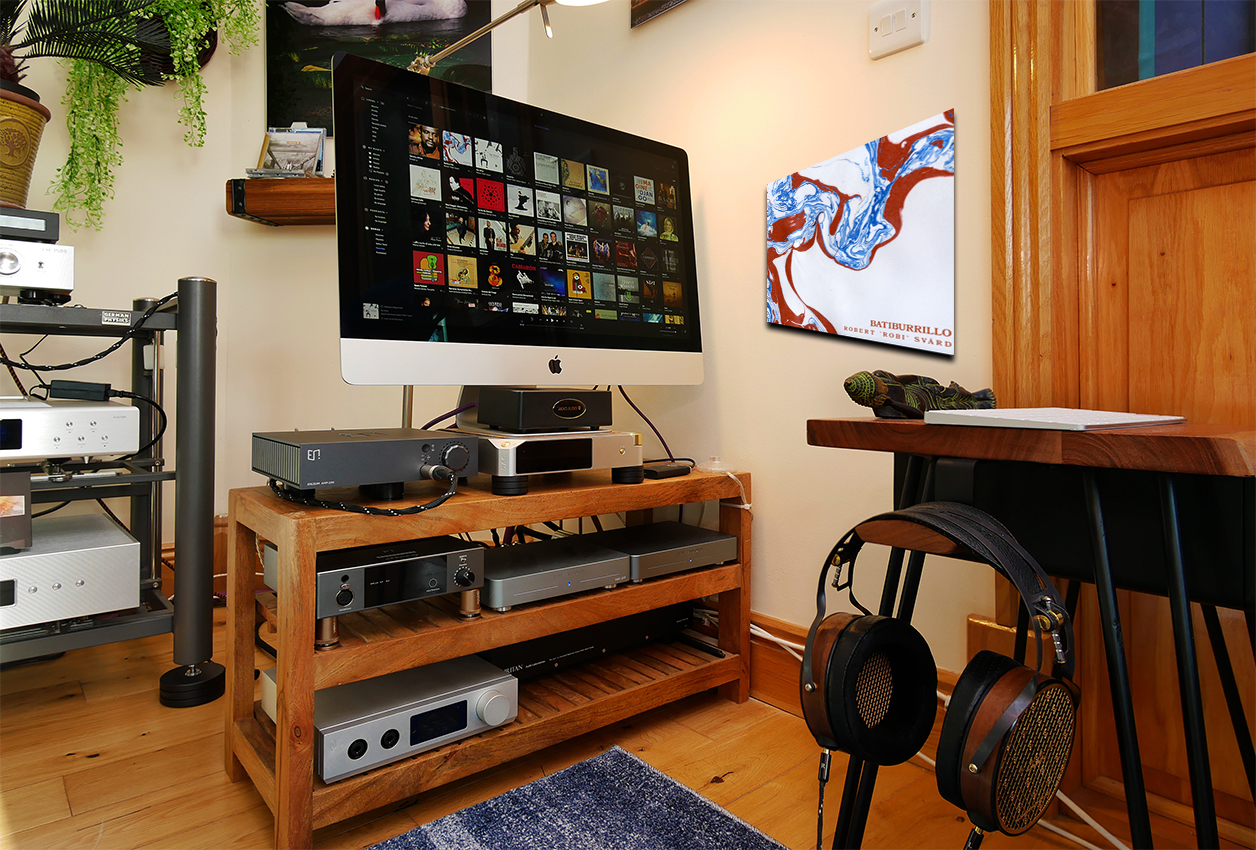
 1st insertion. Snug-tucked into the far left corner of my desktop, the closeup shows how tenaciously tiny the Stack Audio is compared to the already half-sized Akiko. If microsization is your aim, the Brit wins by default. For sonic sizing, one of the albums I spun up in Qobuz was Robert Karl Svärd's Del Alma, a personal Flamenco hit from of all places Sweden. To my ears its compositional interest lives up there with France's Juan Carmona, Poland'sand Spain's Antonio Rey. To my surprise the LAN boxes clearly did not sound alike. The difference came in the HF. This impacted not just the higher fundamentals but broadband harmonics. The active filter sounded like satin even matte, the
  passive like gloss. Other polarity pairs were damped/sparkling, dark/jubilant, calm/energetic. A perfect track to take those temps was the "Lacrimosa" opener from the eponymous 2025 album by Øystein Sevåg filled with orchestral strings, solo sax and bassoon, piano and drums. Both readings were tremendous. The perhaps most applicable or relevant way to distinguish the two is to say that the harmonic profile of the Akiko felt closer to stage where transients pack more overtone fire. The Stack felt a few rows deeper into the venue where textures gain more reverb wash to soften and darken. I'm not talking a front-row centre vs. mid-row balcony offset, just front row versus 7th or thereabouts. Again, this wasn't about soundstage perspective as set up by my speaker/chair positioning. This was about the energy gradient embedded in harmonic intensity and how that overlays other observations. Whenever we alter subjective treble weighting and how harmonics rise on the leading edge, it shifts the relative midrange feel. Other than loudness, it's key for why different listeners pick different seating distances from the performers if ticket availability and pricing aren't the issue. We all have our ideal transient/sustain/decay and bright/dark balance to pick concert seats and hifi components accordingly.
Recording perspective factors, too. Close-up microphones virtually swallowed by a singer capture hyper-realist directness where no listener's ears would ever be. If one didn't grow up with an instrument or singing in a small practice room to be exposed to daily and imprinted by such immediacy, most audiophiles don't fancy it. They favour more distance, more chocolate, honey and silk. Between these two LAN filters, the Akiko played still more to my formative years practicing and later studying the classical clarinet whilst two other siblings played French horn and there was an upright piano in the flat. I stage my comments on such background to clarify that this wasn't about better/worse or correct/false. Unless a performer plays a private function for just one, an audience always occupies different seats in the venue. Everyone experiences particular sonics. All of them are correct as in, equally real. So are personal preferences. I found it fascinating that two very different approaches to UHF noise reduction on the local-area network could be equally effective yet still play musical chairs. In the end I must call these equals, just not clones. Priced within €100, they wink at the same buyer. Which one gains the nod shall depend on size, the 100/1'000kbps speed factor and how much uncut directness a given shopper fancies. Going router direct for contrast flattened out stage depth and got thinner and pricklier. Most objectionable to my ears was what I shall call a certain neon glare and baked-in 'rustiness' – a wiry dirty metallic undertone or subtext. Because both filters removed it, I just dubbed them equally effective. What still differentiated them I already described. Time to traipse into the adjacent listening lounge.









2nd insertion. Here my inner golden ear felt badly tarnished. I couldn't tell my two pathways apart. It's apathy or apoplexy for blood-sports fans wanting a KO to cheer but brilliant news for Akiko. With one box and no power cord, the Dutchies managed what it previously took me two boxes and power cords to do. On one side of this A/B sat series-connected reclockers whose rationale prior to a network card certain commentators question already. On the other side sat a passive black box whose MO eludes the mainstream. That's the definition of a black box after all. Its inner workings are a mystery. Just so, hi tech vs inexplicable showed functional parity, then had the latter emerge victorious on greater simplicity and lower cost. It also created yet more personal confirmation. Akiko's minerals-based approach has the opposite effect of the passive LessLoss FireWall filtering. Where the Lithuanian tech shifts the musical feel into a darker softer more elastic milieu, the Dutch acts more like an accelerator. It's why I'd ended up with the LHY network switches in the first place. They mirror the DC-coupled wide-bandwidth Kinki Studio house sound of my amplifiers.
NetSilence. I appreciate why Akiko named it so. Yet the name just reflects the means not result. When wildly out-of-band noise attenuates sufficiently before the signal hits our digital kit, the sound benefits. That gain isn't just about degree but type. I've heard digital-domain filters which act as mellowing and enriching agents. They work on background atmospherics and mood. Tipple fans might see a rich cognac and how imbibing quickly relaxes. Others act as energizers and quickeners which remove a subtle resistance or drag. Java freaks recognize a ristretto. Akiko's black box belongs to their club. With that it also joins the brand's Corelli Corundum and Castello Solo which work in my upstairs system. Whilst those address the AC and ground lines, the effect is the same. It's why I'm confident to call it out as the signature trait of Akiko's strategic mineral mix. There's no question about what it does, only how—if understanding that is your prerequisite—and to what degree. The degree or delta will depend on a given system and how its overall noise floor and resolution notice and react to UHF noise reduction. Whilst deeper silence might be the enabler, what we really hear is more micro action of reflective halos, recorded venue and directness. If you're sensitive to degrees of musical energetics to always opt for more not less; and if you're currently direct-connecting your router to a streamer/server via a copper CAT5-8 line…investigating what Akiko's NetSilence can do between said router and streamer/server would be time and effort well spent. I experience the primary effect as what trading neon office lighting for golden outdoors sunlight feels like. I hear primary benefits in depth layering, image density and overall substance. Akiko's particular focus I then hear as a magnification of harmonic content, tone modulation and suddenness.

Would you rate those qualities as I do? Only you know. I'm simply confident that if you gave this black box a try, these qualities would—like a dim-sum table tray on a lazy Susan—move into your foreground. Whether you'd help yourself or not I couldn't predict. Sonic flavours are legion, all of us king of our own region. Needless to say, as far as I'm concerned, Akiko Audio have another winner on their hands. That it's a purely passive device with no conventional electronic parts or need for AC whilst passing 1Gbps Ethernet signal is the minor mind-twisting cherry on top.