Country of Origin

Reviewer: Srajan Ebaen
Financial interests: click here
Main system: Sources: Retina 5K 27" iMac (i5, 256GB SSD, 40GB RAM, Sonoma 14), 4TB external SSD with Thunderbolt 3, Audirvana Studio, Qobuz Sublime, Singxer SU-6 USB bridge, LHY Audio SW-8 & SW-6 switch, Sonnet Pasithea, COS Engineering D1, Laiv Audio Harmony; Active filter: Lifesaver Audio Gradient Box 2; Power amplifiers: Kinki Studio EX-B7 monos & Gold Note monos on subwoofer; Headamp: Enleum AMP-23R; Phones: Raal 1995 Immanis; Loudspeakers: Qualio IQ [on loan] Cables: Exact Express Flame, Furutech; Power delivery: 2 x Kinki/Vinshine Tai Hang on amps and source stack, Furutech DPS-4.1 between wall and conditioners; Equipment rack: Artesanía Audio Exoteryc double-wide 3-tier with optional glass shelves, Exoteryc amp stands; Sundry accessories: Acoustic System resonators, AudioQuest FogLifters; Room: 6 x 8m with open door behind listening seat; Room treatment: 2 x PSI Audio AVAA C214 active bass traps
2nd system: Source: FiiO R7 into Soundaware D300Ref SD transport to Cen.Grand DSDAC 1.0 Deluxe with POW; Preamp/filter: Lifesaver Audio Gradient Box 2; Amplifier: Kinki Studio EX-M7; Loudspeakers: ModalAkustik MusikBoxx + Dynaudio S18 sub; Cable loom: Exact Express Earth; Power delivery: Vibex Granada/Alhambra, Akiko Audio Corelli Corundum & Castello Solo; Equipment rack: Hifistay Mythology Transform X-Frame [on extended loan]; Sundry accessories: Furutech cable lifts, Furutech NFC Clear Lines; Room: ~3.5 x 8m
2nd headfi system: DAC: Cen.Grand DSDAC 1.0 Deluxe with POW; Headamp: Cen.Grand Silver Fox; Headphones: Raal 1995 Magna, HifiMan Susvara
Desktop system: Source: HP Z2 work station Win11/64; USB bridge: Singxer SU-2; DAC/headamp: iFi iDSD Pro Signature; Speakers: DMAX P61 Headphones: Final D-8000, aune SR7000
Upstairs headfi system: FiiO R7; Headphones: Meze 109 Pro, Fiio FT3
2-channel video system: Source: Oppo BDP-105; All-in-One: Gold Note IS-1000 Deluxe; Loudspeakers: Zu Soul VI; Subwoofer: Zu Submission; Power delivery: Furutech eTP-8, Room: ~6x4m
Review component retail: €995

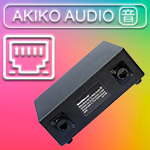
Net. It's what we take home after taxes. It's how some catch fish. Add the word 'silence'. It could mean not to mention our net income to be more polite or less humbling; or that we really caught squat. But for Akiko Audio of The Netherlands, NetSilence is about what happens between the RJ45 input and RJ45 output of their black LAN brick. Net is the Internet, silence the result of passive noise stripping. The slippery catch pursued is high-frequency EM/RF pollution invading our hifi system through our router's Ethernet copper line. In this hobby, less noise always equals more signal. According to that basic equation, noise is another form of distortion so antagonistic to high fidelity. It's not about error correction as though we suffered erroneous 1s and 0s represented by two rapidly alternating voltage states forming a close or vaguely approximate semblance of a square-wave signal. It's about reducing non-signal artifacts to subtract their effects on subsequent D/A conversion. Ansuz of Denmark combat out-of-band noise with Tesla coils and analog dither. iFi and others detour into fibre-optics for galvanic isolation superior to Ethernet's micro transformers. With streaming having become the majority music-delivery format, those who stream old-school wired content connect their domestic hifi bubble to the Wicked Wild West of the wwwNet. Though my phrasing is casual, it's intuitive that no matter how polished we keep our domestic hifi bubble with clean power/ground, mechanical isolators and proper setup, if we open a back door for noise ingress via a generic router, our system should lose some of its shine. This assumes that it sparkles brilliantly already to readily telegraph subtle losses. If we still battle basics, those come first. We can't address subcutaneous imperfections if they're caked in layers of mud. First take a shower and deep scrub to elevate overall resolution that's fit for finer purpose.









When audio first transitioned from physical media to USB, it wasn't long before a new category of device appeared which some quarters unceremoniously dubbed USB decrapifiers. Once streaming was here to stay, digital designers worked their way farther upstream. They soldiered past a DAC's much maligned USB input to attack a streamer's Ethernet port. Today anything considered an audiophile server is expected to contain effective LAN and USB decrapifier circuitry. If effective, naught else needs doing. Enter CAT5-8 or SFP, exit USB or I²S. Done. But what if we haven't caught up with or cottoned to the audiophile server concept? What if we got stuck on a current iteration of legacy PCfi? Now a Windows or Mac computer, laptop or tablet possibly hosting player software like Audirvana, HQPlayer or Roon is our Net hub and graphic user interface. From it incoming digital music data routes out to our DAC. How much decrapitude—or more likely, crapitude—bakes into standard computing hardware which the audiophile police tells us was never optimized for high-performance audio in the first place? If that twitches your shoulders with "not sure", Akiko's NetSilence invites us to find out. Forget a power cord. Forget a switching wall wart that would inject its own UHF noise into your powerline. This is a passive device. There's no direct link to AC. There's no switch, no idiot light, no setting to make. Simply connect the included short CAT6A link from the NetSilence output to your PCfi's network card, your existing Ethernet cable from Akiko's input to your router. You could invert that sequence but typically, filters closest to the end of a line like a counter-top water purifier behind miles of copper or plastic pipe are most effective. So far so obvious. Like other black boxes—this one is 17x12x6.2cm DxWxH—we wonder what's inside. Do we really expect the designer to divulge his IP? After all, those letters don't abbreviate instant plagiarism but intellectual property.
 Lumin's new $11K U2X features Ethernet and SFP ports, USB storage ports, the usual digital outputs, specially filtered USB plus 10MHz clock i/o. Noise filtering builds in.
Given Akiko's familiar MO, we expect piezo-electrically active particle compounds which possibly include corundum and tourmaline. Given the recently reviewed Castello Solo's more than 15 metres of internal wiring connecting undisclosed sections/materials, we expect more than just Ethernet's four twisted pairs embedded in Akiko's powdered material mix. We recall how Acoustic Revive, Audio Magic, DR Acoustics, Furutech, Shunyata and Verictum mint their own compounds to absorb radiated ultra-high frequencies and turn them into heat. Already 2003's US patent 6'545'213 by Caelin Gabriel of Shunyata Research focused on electromagnetic interference in cables, power loss in small conductors and external noise pickup. It details a granular or beaded ferro-electric substance like spherical silica gel beads, Rochelle salts or combinations thereof which surround the conductors to absorb mechanical resonances and disperse UHF noise. The notion of material-based passive noise reduction thus is far from exclusive to Akiko. Other brands work along similar lines. Having acquired my earlier review samples of Akiko's Corelli Corundum and Castello Solo for my upstairs system, consider me an unrepentant fan of their approach.