From designer Marc van Berlo. "What's special about NetSilence? For the first time ever we address Ethernet data transfer whose stability and signal speed are crucial. Looking at it realistically, it's a composite of small power cables, insulation materials and conductors. For us it was crucial that NetSilence achieve speeds up to 1'000Mbps, a value rarely tested in music systems. We'd already gained extensive experience with power cables and interconnects. Now we faced the challenge of housing the technology in a sealed compact aluminium enclosure to effectively reduce external radiation. Internally the LAN wiring is treated in various stages and compartments, resulting in a structuring of the radiation fields under the influence of various crystal lattices combined with the very weak but nevertheless present paramagnetic properties of selected minerals which provide an order and stability not achievable without NetSilence. Naturally we use high-quality copper connections and this Akiko Audio product is PVC and halogen free. The use of black resin fixes and stabilizes the internal circuit with the added benefit of minimizing resonance and keeping prying eyes at bay. We created NetSilence with specialized knowledge acquired over many years. Unfortunately I can't reveal the recipe but it's not simple. We work long and hard on a new product and test it extensively. One must give this one a try with an open mind to experience the benefits of a cleaner signal."
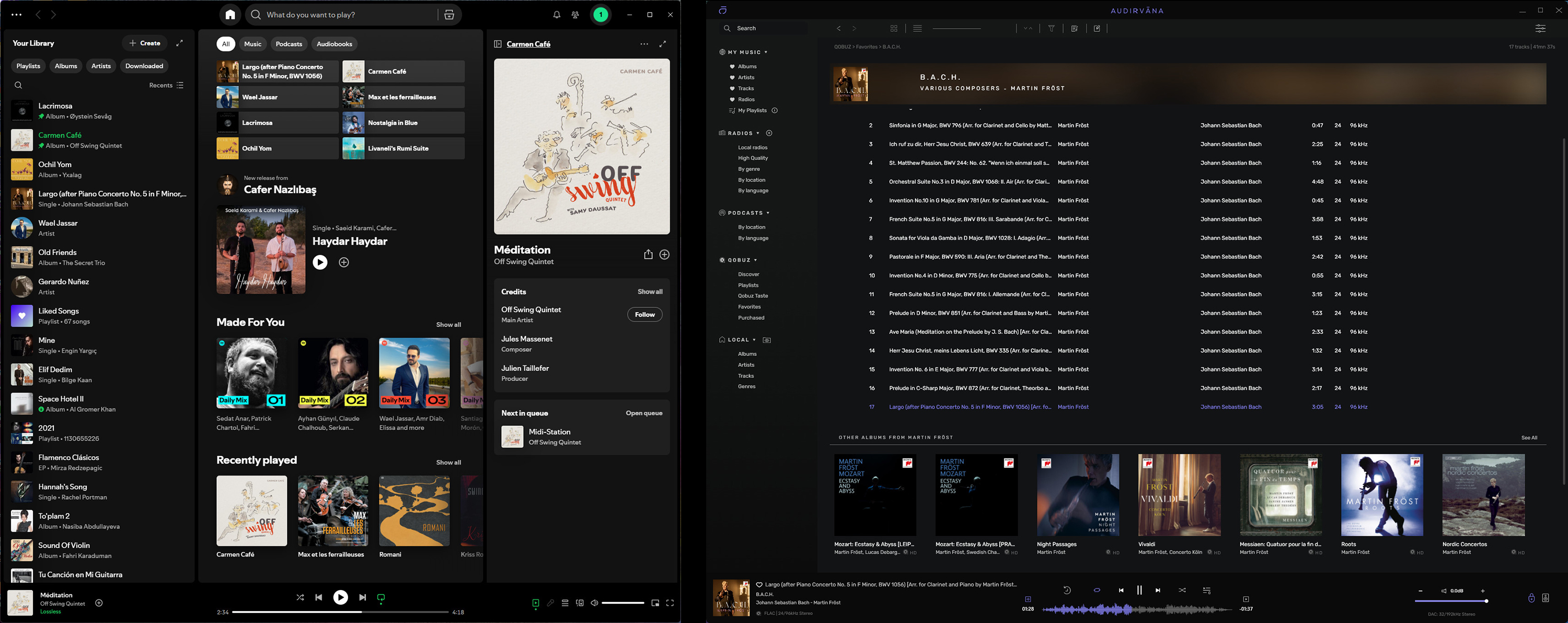 Spotify Premium lossless since October 2nd | Qobuz Sublime hi-rez up to 24/192 embedded in Audirvana Studio
For said cleaner signal, my sonic standard in the main system was CD playback via top-loading Denafrips transport upsampling to 24/176.4kHz. To equal the sound quality of CD spinning for local files, those host on a 4TB SSD then stream out via Audirvana Studio through a dedicated 27" fully loaded iMac with 64G RAM into a Singxer SU-6 USB bridge. Via AES/EBU, that outputs to a Sonnet Pasithea DAC. Meanwhile cloud files piped in via 20-metre CAT8a copper link off my broadband fibre router through a Qobuz Sublime subscription embedded in Audirvana Studio. This likewise exploited the latter's SoX upsampler engine set to x 4. Alas, the local team always outscored the cloudy files. To level that playing field led me to first one then two LHY Audio network switches connected in series via more CAT8a plus a SOtM inline isolator. With those two extra boxes and power cords, cloud streaming finally gained parity with local file playback which already matched CD playback with the noise moat of the super-cap powered USB bridge. Translation? USB streaming of local files needed some help; cloud streaming a lot more than just router to iMac or Windows PC.








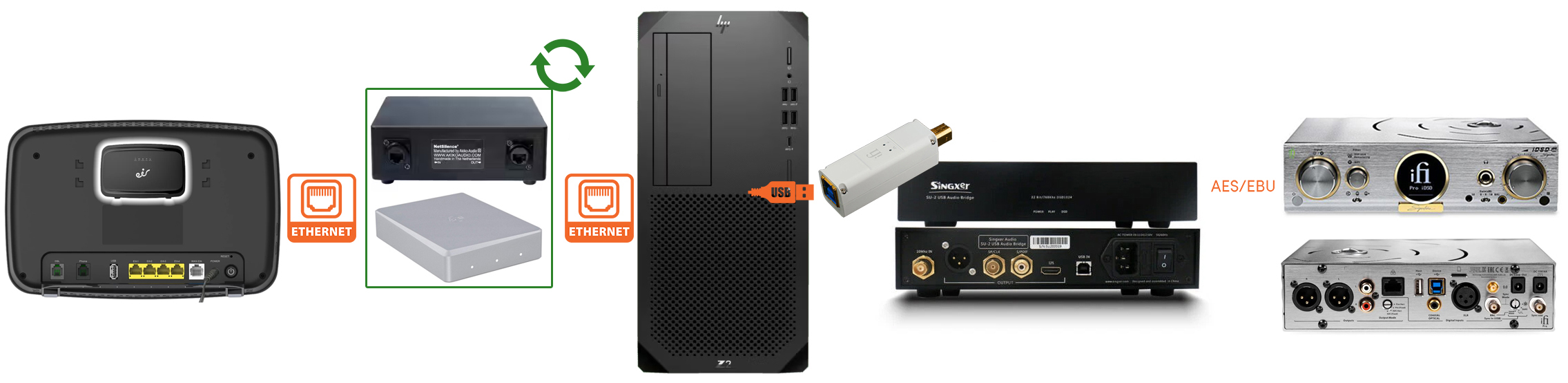
On my office desktop, Stack Audio's SmoothLan Regenerator plays mediator between the same router and an HP Z2 Win11/64 workstation also hosting Audirvana Studio, Qobuz Sublime and lossless Spotify Premium. From there a USB 3.0 port connects to a Singxer SU-2 bridge via iFi USB 3.0 cable plus inline filter. Then still digital data forwards via AES/EBU to an iFi iDSD Pro Signature DAC. The active Stack Audio Ethernet reclocker made a real difference to my office whilst 'dumbing down' my 1'000kbps high-speed Internet feed to 100kbps. That's plenty fast for 24/192 streaming with simultaneous YouTube downloads, WordPress uploads, Opera browsing and email receipts.
Just so, Akiko's NetSilence wouldn't impede the 1Gbps Internet speed I pay for. Neither would it eat up a power socket; nor the two AC ports the twinned network distributors do in my main system. If the passive Dutch could equal the active Brit and dual Chinese, it'd manage with a lower box/cord count against the latter; and without a power cord or the speed limit of the former. Those then were my two comparative test stations to evaluate the NetSilence: replace a very small but potent active filter slash reclocker in the office; replace two active Ethernet distributors in the main system. Whilst LHY Audio have revamped their models since, my two network switches clocked in at $1'388/pr when new. Depending on the £'s daily exchange rate, Stack Audio's device is ~€887. With the Akiko priced in-between, these comparisons cluster close enough to make sense to the same shopper. Context. It's everything when we conduct comparisons. For example, The Abso!ute Sound invokes comparisons not with competing hardware but with acoustic instruments and vocals in real space. I see two issues with that. 1/ what venue, seating distance and position relative to stage stands in for the 'absolute' reference? 2/ auditory memory is notoriously fickle. Comparing playback to a bygone concert is dubious never mind that most concert ensembles and their spacing wouldn't fit into a normal listening space. It's why I prefer and conduct comparisons against competing hardware that's on hand in the actual hear/now.