Country of Origin

Reviewer: Srajan Ebaen
Financial interests: click here
Main system: Sources: Retina 5K 27" iMac (i5, 256GB SSD, 40GB RAM, Sonoma 14), 4TB external SSD with Thunderbolt 3, Audirvana Studio, Qobuz Sublime, Singxer SU-6 USB bridge, LHY Audio SW-8 & SW-6 switch, Sonnet Pasithea, Laiv Audio Harmony; Active filter: Lifesaver Audio Gradient Box 2; Power amplifiers: Vinshine Audio x Kinki Studio Dazzle & Gold Note PA-10 Evo in mono on subwoofer; Headamp: Enleum AMP-23R; Phones: Raal 1995 Immanis; Loudspeakers: Qualio IQ [on loan] Cables: Exact Express Flame, Furutech; Power delivery: 2 x Kinki/Vinshine Tai Hang on amps and source stack, Furutech DPS-4.1 between wall and conditioners; Equipment rack: Artesanía Audio Exoteryc double-wide 3-tier with optional glass shelves, Exoteryc amp stands; Sundry accessories: Acoustic System resonators, AudioQuest FogLifters; Room: 6 x 8m with open door behind listening seat; Room treatment: 2 x PSI Audio AVAA C214 active bass traps
2nd system: Source: FiiO R7 into Soundaware D300Ref SD transport to Cen.Grand DSDAC 1.0 Deluxe with POW; Preamp: Hattor ARP-S; Active analog xover: Lifesaver Audio Gradient Box II; Amplifier: Kinki Studio EX-B7 monos; Loudspeakers: ModalAkustik MusibBoxx; Subwoofer: Zu Method; Cable loom: Exact Express Earth; Power delivery: Vibex Granada/Alhambra, Akiko Audio Corelli Corundum & Castello Solo; Equipment rack: Hifistay Mythology Transform X-Frame [on extended loan]; Sundry accessories: Furutech cable lifts, Furutech NFC Clear Lines; Room: ~3.5 x 8m
2nd headfi system: DAC: Cen.Grand DSDAC 1.0 Deluxe with POW; Headamp: Cen.Grand Silver Fox; Headphones: Raal 1995 Magna, HifiMan Susvara
Desktop system: Source: HP Z2 work station Win11/64; USB bridge: LHY UIP; DAC + Head/preamp: Audalytic DR70 + HP70 both on LHY LPS-80 Dual; Speaker amps: Topping B200 monos; Loudspeakers: Virtual Hifi Viper; Headphones: Final D-8000, aune SR7000, FiiO FT7
Upstairs headfi system: FiiO R7; Headphones: Meze 109 Pro, Fiio FT3
2nd upstairs speaker system: Source: FiiO R7; DAC/pre: COS D1; Amplifier: Kinki Studio EX-M7; Loudspeakers: Virtual Hifi Cobra [on loan]
2-channel video system: Source: Oppo BDP-105; All-in-One: Gold Note IS-1000 Deluxe; Loudspeakers: Zu Soul VI; Subwoofer: Dynaudio 18S; Power delivery: Furutech eTP-8, Room: ~6x4m
Review component retail: €12'500/pr and up depending on finish
Oscar-Claude better known as Monet; what do you know about him? Many years ago Ivette and I made the pilgrimage to his famous garden in Giverny below where he immortalized his water lilies and the curved bridge across the pond.
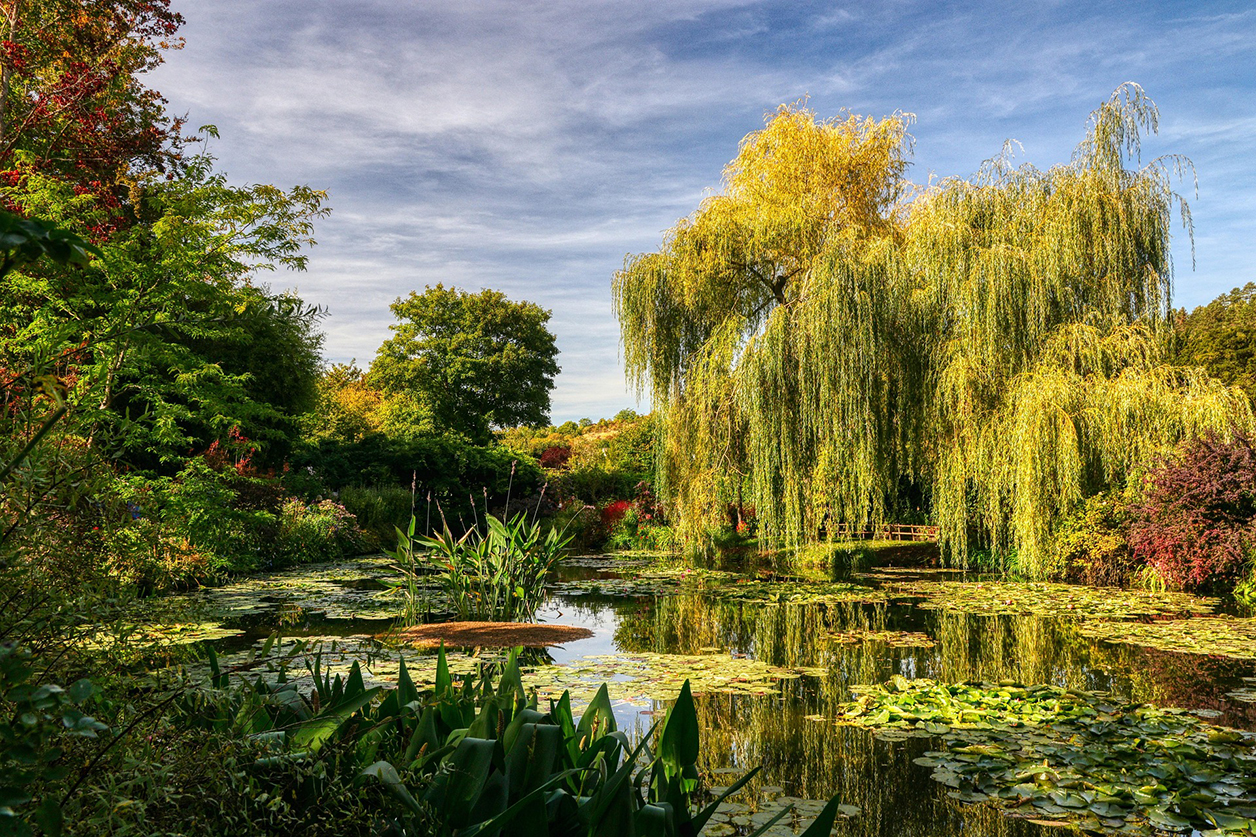
His painting Impression, soleil levant coined the term 'Impressionism'. That and endlessly more is easily learnt about the French painter. Once his name is appropriated¹ for a speaker from the Polish widebander house Cube however, the artistic ideas of Impressionism and Cubism could seem at odds. Designer Marek Kostrzynski held the paint brush on this model.
______________________
¹ Crystal Cable of The Netherlands too were inspired by Claude to name a series of cables in their Art Series after him.







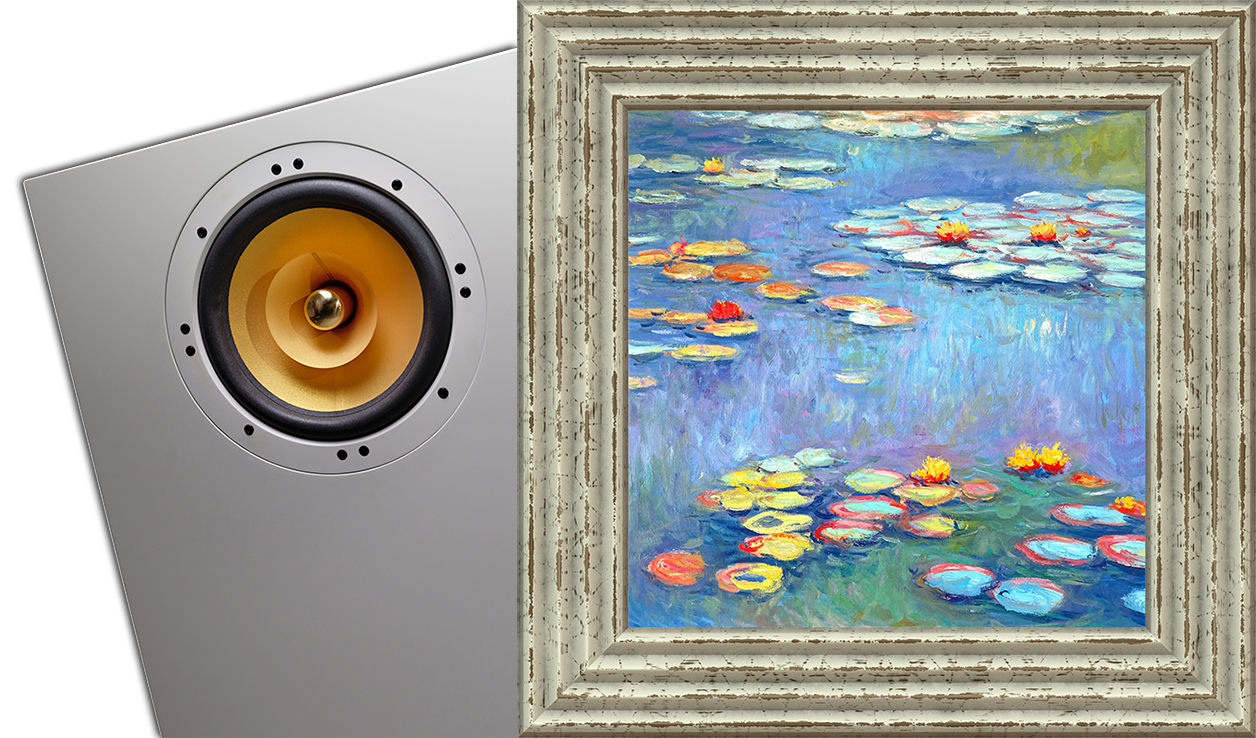
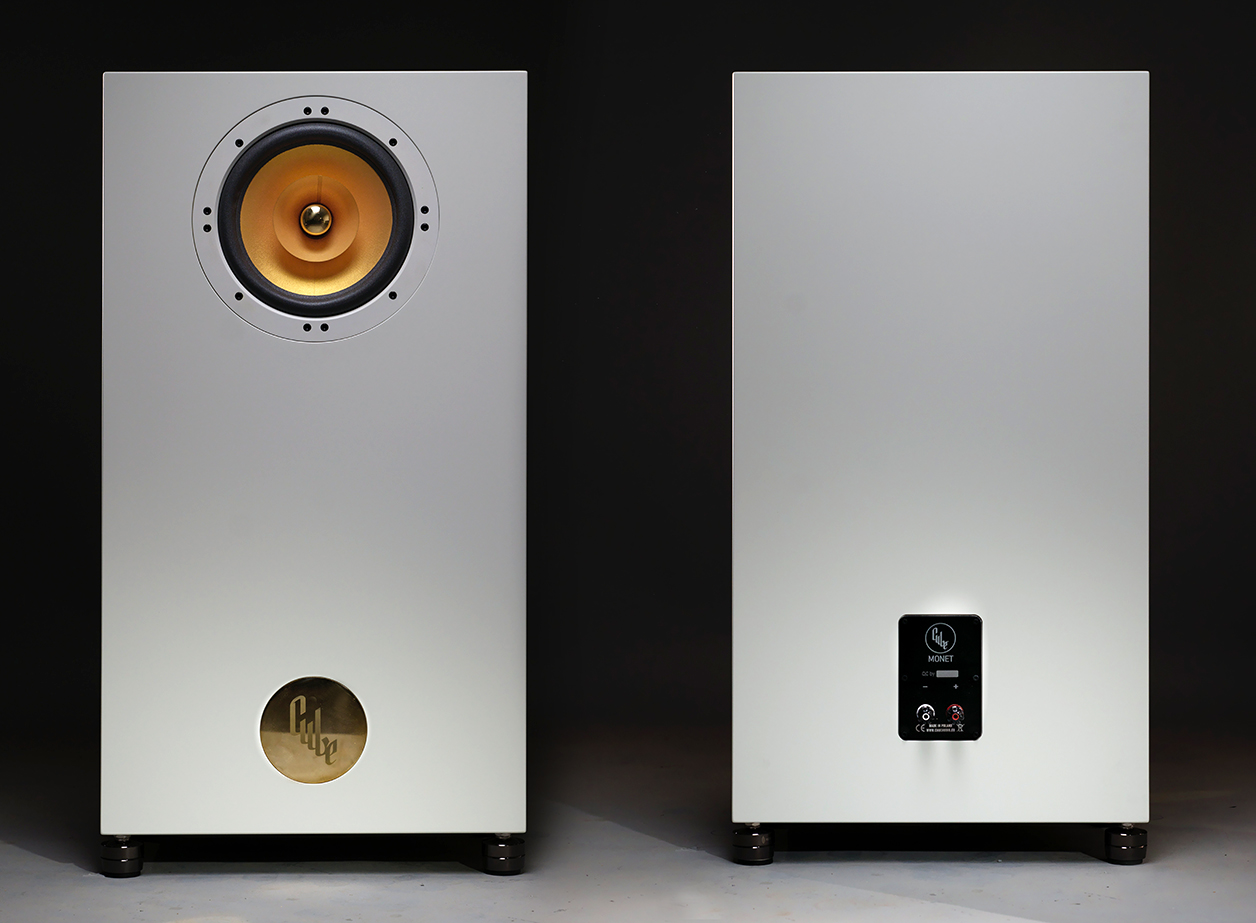
If you're new to Cube, one moment with Monet shows you one driver for the entire bandwidth. The flared collar surrounding the gilded phase plug is known as a whizzer. That attaches to the same voice coil as the main cone so doesn't have its own like a classic coaxial driver from Tannoy or KEF would. It works as a tweeter though this handover is purely mechanical. There are no crossover parts. Our amplifier direct-drives the yellow point-source transducer without dealing with energy-absorbing ringy filter parts. Clean time-domain performance is one upshot. Another is that whatever amplitude nonlinearities this driver suffers can only be compensated mechanically and acoustically in how it and the enclosure interact. There's no baffle-step compensation, notch filter, impedance linearization or attenuation of jagged response sections. How well a widebander does without any of it is down to the driver. At Cube, Marek designs and build his own and has gained an enviable reputation in this micro niche. His most direct contemporary competitors are AER, Lowther and Voxativ though they tend to focus on higher sensitivity ratings than he does. Just so, a similar mandate applies. This type driver of low moving mass and high magnetic flux in its voice coil prefers high-impedance drive to not overdamp and attenuate its LF prematurely.
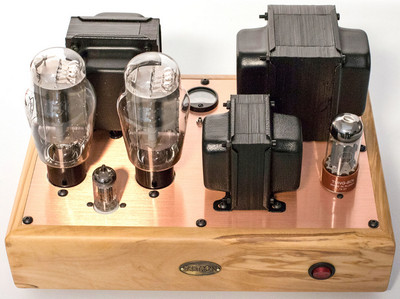 It's why such speakers and zero-feedback single-ended triodes or transistors are a popular combo. Cube have done many a tradeshow with low-power purist Tektron valve amps from Sicily. Where some widebanders exploit rear horns to boost their LF response, Cube thus far focussed on quarter-wave alignments open to the floor. With the French painter arguably most famous for his water lilies, Cube most famous for Nenuphar—that's Medieval Latin's name for water lily—the naming connection seems obvious.
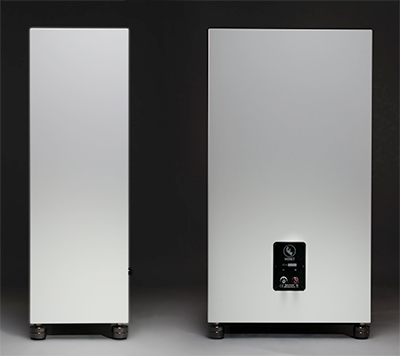 Basic specs are 93dB/8Ω sensitivity from "our lightest diaphragm ever" so 2dB more than Nenuphar v2. This makes it particularly copacetic with low-power SET amplification. Published -6dB bandwidth is from 35Hz to 20kHz with a modified version of the brand's neodymium-powered F10 so a 10" driver. Cab dims are 50 x 30 x 90cm WxDxH, weight is 32kg. The enclosure type is simply described as "a new concept" to possibly suggest a change from the prior TQWT aka Voigt pipe loading? An obvious visual difference is much reduced depth. Monet is far shallower than it is wide. New too is the circular now flush-mounted driver basket with its 12 fasteners. It replaces the earlier square frame bolted atop the baffle. Novel too is the inset gilded decal. Though it could suggest Cube's new range topper, on price Monet actually situates beneath Nenuphar v2 which itself sits below Lotus 10.
To learn more about Cube's evolutionary changes for Monet—the revised more efficient driver, the revised more compact cab—will mean seeing how much Marek is happy to divulge. After all, IP is shorthand for intellectual property, not instant plagiarism. This is particularly apt for the widebander breed. Rather than widely available simulation software, a stubborn designer in this niche works far more with physical prototypes and trial 'n' error. It's one reason why big speaker houses with short product cycles shun this type. It's too labour-intense and pretty much contingent on perfecting then making one's own drivers rather than procuring them OEM from Morel to ScanSpeak, Accuton to Monacor.