
Country of Origin

 This review published in August 2025 on HifiKnights.com. By request of the manufacturer and permission of the author, it is hereby syndicated to reach a broader audience. – Ed.
Reviewer: Dawid Grzyb
Transport: Innuos Statement, fidata HFAS1-S10U
DAC: LampizatOr Horizon360 w. Stradi 5U4G + Psvane Art TIII 4x KT88 / 2x 6SN7
USB components: iFi audio Mercury3.0
Network: Fidelizer EtherStream, Linksys WRT160N
Preamplifier: Trilogy 915R, Thöress DFP
Amplifier: Trilogy 995R, FirstWatt F7, Enleum AMP-23R
Speakers: Boenicke Audio W11 SE+, sound|kaos Vox 3afw
Headphones: HifiMan Susvara
Interconnects: LessLoss Entropic Process C-MARC, Boenicke Audio IC3 CG
Speaker cables: Boenicke Audio S3, LessLoss C-MARC
Speaker signal conditioning: LessLoss Firewall for Loudspeakers, Boenicke ComDev
Anti-vibration conditioning: 12x Carbide Audio Carbide Base under DAC, preamp and speakers
Power delivery: Gigawatt PC-3 SE EVO+/LC-3 EVO, LessLoss C-MARC, LessLoss Entropic Process C-MARC, Boenicke Audio Power Gate, ISOL-8 Prometheus
Equipment rack: Franc Audio Accessories Wood Block Rack 1+3
Review component retail: €23'900/pr as reviewed

Vox rationis. Expectations and reality don't always align. I recently saw this in my Avantgarde Acoustic Duo SD review. Prior to it, my exposure to horn speakers was limited to those I could see and hear during many a Munich and Warsaw show. As interesting and intriguing as horns are, during these events their kind occupied spaces far larger than the 21m² room at my disposal. Knowing this, I was convinced that any horned arrivals in my crib were doomed. Yet Robert, our local Avantgarde distributor, begged to differ. To him, cramming two Duo SD coffins with massive waveguides into my compact cave was good fun and a splendid idea. While he wouldn't mind if I picked something else from his upscale roster packed with Kondo, Estelon, Siltech and the likes, I knew horns only in passing. Robert has sold them very effectively for 20+ years already. Hello? If he considered his Duo SD a good fit for me, pretending to be smarter on the matter was pointless and rather rude. So we moved forward. The 200kg cargo implied backbreaking logistics but Robert's team handled them spot on. What followed outgrew my at best modest expectations by the proverbial country mile. Until then, large horns had struck me as intimidating to say the least and fit only for diehard aficionados. The Duo SD very quickly beat that opinion to a bloody pulp. Along the way it also squashed several not exactly favourable stereotypes. This semi-active—or optionally fully active—effort was extremely approachable, versatile and ambitious. It boasted high-tiered flair all across the board. It also winked at casual listeners with money to spend who fancy owning a high-performance visually modern horn speaker fronted by one compact AiO device instead of a rack busy with specialist hardware. Nicely dressed, easy to set up and friendly to use, Duo SD would cater to a broad audience without a miss. In a way it also defied its own non-mainstream pedigree. At the end of our time together, I saw it as the perfectly domesticated horn design that climbed to the top of my performance roster. I hadn't seen that coming. The Duo SD only didn't nab our award because it was the first proper horn I'd ever sampled. But it still accomplished something else. It opened my eyes and ears to a subject very much relevant to today's story.
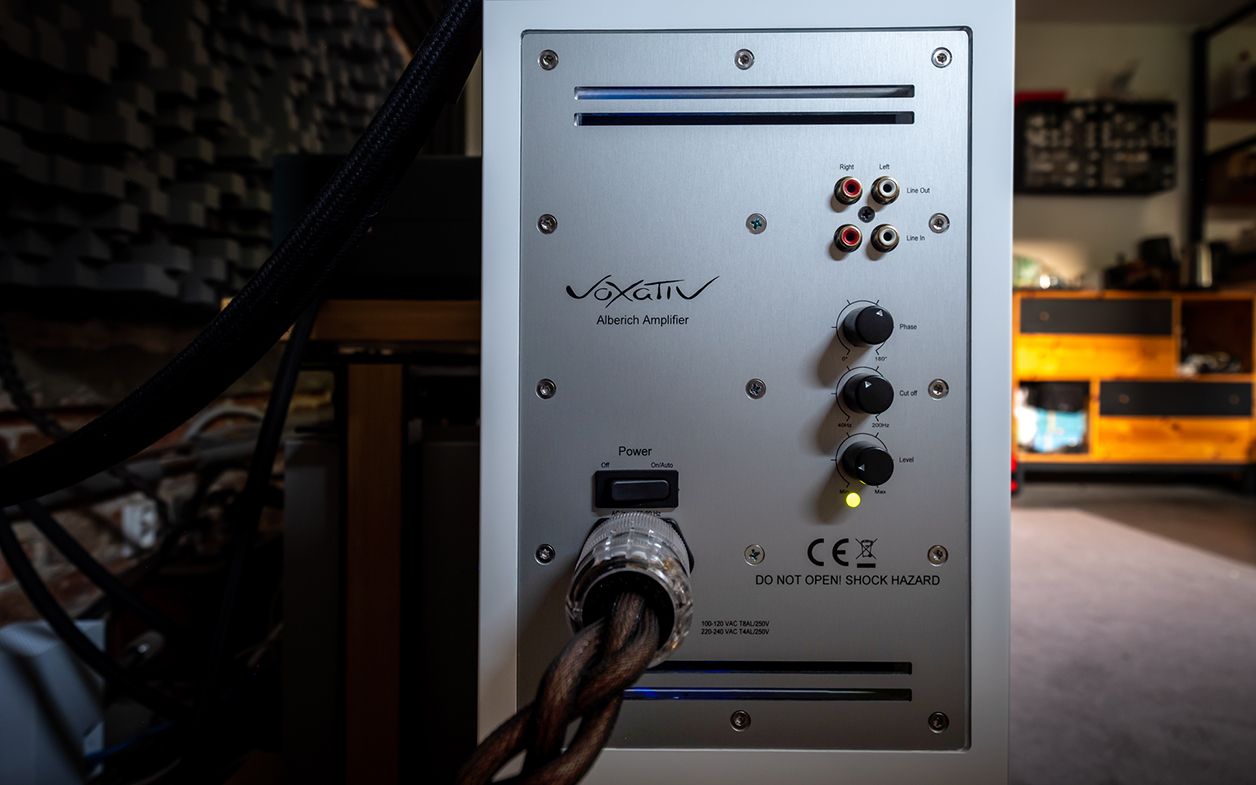
The Duo SD's brilliant sonics were largely a by-product of its actively powered, sealed and configurable subs. Once their in-room tailoring via handy software was in the bag, one 12" woofer off 500W class D per channel dug into the infrasonic realm and produced wickedly powerful, extremely punchy, effortless and very clean output even with my dynamically fiercest most bass-intense fare. These were most likely the best lows I'd ever heard in my digs. As much as I enjoy passive speakers, the active/passive labour division unlocked such superb results as to really seem the most sensible choice. My takeaway was painfully obvious. If speakers larger than Duo SD aren't 'on', active bass is key. That their horn-loaded drivers welcomed low-power amps at my disposal was merely the cherry on top. I also learnt something about myself in the process. Horns stole half my heart; active bass took the other half. I so hadn't expected this Avantgarde Acoustic to be what it turned out to be. I simply had never experienced anything quite like it before. Today's Voxativ Alberich² meanwhile belongs to the rare widebander club which I'm very much accustomed to. Over the years I've hosted a dozen of its members. The RDacoustic Evolution, Voxativ Zeth, Camerton Binom-1 and Cube Audio Magus, Nenuphar and Nenuphar Mini were all purist passives with a single unfiltered driver. The one in Zu's DWX Supreme was assisted by a conventional tweeter. The small Enviée widebanders in my sound|kaos Vox 3afw monitors run open on the bottom yet see a 2nd-order low-pass on top and enjoy support from Raal ribbons and side-firing woofers. Sven Boenicke's 6" drivers with wood cones in his W11 SE+ floorstanders run open on top, with a 1st-order high-pass below then help from other cones. PureAudioProject's Trio 10 was an open baffle with unfiltered Voxativ AF-1.5 driver and filtered woofers. Rethm's Aarka and Maarga were the only two semi-actives with sealed bass and their makers' own filterless widebanders. This list shows how the ways of implementing such drivers are many. While team Voxativ are familiar with all of them, they've been focusing on semi-active and purely passive single-driver designs.








Founded by Marie Adler in Berlin during the 1990s, Voxativ are known throughout the industry for boutique full-range drivers and speakers which use them. This brand in particular made an early point of just how much a solitary rear-horn-loaded high-efficiency driver can achieve in a sufficiently voluminous enclosure. The most affordable such model in today's portfolio is Hagen² at €7'900/pr. It makes ~50Hz, is 95dB sensitive and styled like a compact monitor. The most expensive Ampeggio Due boasts 110dB efficiency and 25Hz reach. It also parks 80kg on the scale, measures 120x140x19cm WxHxD and demands a royal €100'000/pr. In both cases we pay for two enclosures with slot openings and two drivers wired directly to their binding posts. That's it. The Voxativ Andagio, Ampeggio, Zeth, Hagen Tower and Pi follow the same MO. Folks unfamiliar with the breed may consider them insane expenses given the few parts involved. Should we argue that the same coin easily buys far more elsewhere, designing a single driver to successfully cover the full bandwidth is tough. Yet to work as intended and make sound unlike any other, passive Voxativ models want for nothing but one driver fronting a folded rear horn. Anything more would be counter-productive excess. Such designs really sing as they do because they eschew crossovers and are finessed point-source propagators of high efficiency and unique qualities. They're particularly brilliant on vocals and acoustic instruments, spatially liberated and extremely gifted on quickness, immediacy, articulation, precision, directness and responsiveness. With well-matched companion amps, they also ace tone, fruitiness, viscosity, persuasiveness and suchness. Over the years I learnt that the vast majority of conventional multi-ways can't compete on these counts, let alone outclass them. This in fact is the driver type I cherish most as a reviewer and enthusiast. Passive Voxativ models are for well-informed buyers who really believe that less is more when executed correctly; and that quality trumps quantity. For many of them, regular two- or three-ways on beefy amps proved to be stop gaps towards low-power SET magic, high speaker efficiency, simplicity and unique sonics. I fully appreciate the appeal of this route and am not surprised that some veterans consider it their end game. Feeling 25Hz from a single 7.5" driver inside a large box connected to a flea-power amp is a very special sensation and impressive party trick to boot. However, should we want to tap room-shaking bass, the Voxativ Ampeggio Due bluntly reminds us about how large the internal horn and enclosure housing it must be. Not small. Ditto wallet depth. Therein lies the rub. Not many shoppers can accommodate such extremist efforts. Few understand them to begin with. Not many connect their potential with the high-tiered simplicity they champion. To fully appreciate this unorthodox speaker type, you have to be in the know. Voxativ understand this. To spread the religion with an olive branch at greater domestic appeal, their portfolio has grown to include more compact hybrid actives. It's where today's tale gets properly saucy.
At Voxativ, semi-activism doesn't diminish prestige. It enhances it. The two-box 9.87 system had its official debut at High End Munich 2015. It comprised a standalone Pi monitor atop an active Pi-Bass module of very niche RiPol pedigree we'll get to momentarily. Pi on top was a passive filterless so purist widebander. The visually matched sub simply extended reach on the bottom; by a lot. The 9.87 proved that achieving unfiltered widebander traits plus deep bass from a visually classy reasonably sized speaker was possible. I heard this handsome devil at that event and enjoyed it immensely. By October of that year Srajan had reviewed it with his Blue Moon award for a Top-class full-bandwidth speaker of high efficiency. In the years following, the 9.87 system evolved into the three-box 9.88 affair which slotted a rear-ported mid-bass coupler between Pi and RiPol sub. Crossovers added, too. Priced at €79'900/pr, this remains the brand's semi-active top dog. Today's Alberich² follows the same two-box hybrid protocol as the 9.87 but does so at much lower cost and size. Now let's tackle RiPol bass. Widebanders tailored for horn loading without crossovers are speed freaks. Their extremely light cones, powerful motors and direct amplifier connection make it so. During the design stage of the 9.87 system, Marie Adler deemed conventional woofers too slow for her 99dB-efficient Pi monitor. The efficiency gap had to be bridged. A much quicker bass loading based on the RiPol principle patented by Axel Ridthaler became the solution. If we fold an open baffle with two side-by-side woofers such that the woofers face each other whilst leaving a slot opening in the front for their front wave to exit and a rear slot for their rear wave, we effectively end up with a directional velocity converter that radiates semi cardioid; in phase out the front, somewhat attenuated out the back in anti phase. The resultant lateral phase cancellation typical also for classic dipoles reduces room gain and its time-delayed reflections. Bass from such an open box interacts with our room far less than typical subs do which work as omnidirectional pressure generators. Less room interaction equals cleaner bass. Additionally, woofers inside ported and sealed enclosures fight more against trapped air to raise box talk and driver stress. RiPol loading is open so the generated energy is released not stored as cabinet resonances. RiPol loading increases self damping and lowers its woofers' resonant frequency to welcome small enclosures. Whilst working as bass makers, those in the know would argue that RiPols short for Ridthaler dipoles constitute their own thing and aren't classic subwoofers.