Let's now revisit the 9.87 project. Two customized 12" pro-audio woofers of 96dB efficiency in a RiPol H-frame allowed Marie to create a bass bin packing all the traits just explained, remove reactive box talk and net 99dB efficiency to match the monitor. The internal 250wpc class-AB plate amp did the hard work. No wonder this 9.87 system won Srajan's award. Not only did it solve the widebander breed's Achilles heel of low controlled bass, it managed in décor-happy style. As far as I can tell, this was the first commercial effort to combine already niche widebanders with even more niche active RiPol bass. Until recently it was also the only one. Other brands with this bass loading are far and few between, probably fewer than a dozen in total. Why I haven't a clue. The Axel Ridthaler patent expired years ago and Srajan has been an avid if lone RiPol enthusiast for many moons. After hosting the Alberich² system for several very enjoyable weeks, I think I now know why. This review kicked off with the Avantgarde Duo SD as the spark which irreversibly altered my view on semi-active speakers. Alberich² with its single-driver RiPol bass and widebander instead of horns and sealed woofers represents an effort very much up my alley. Beyond Voxativ there's as yet nothing like it to market. Srajan recently awarded Alberich² with his Lunar Eclipse award which only happens once every few years. Then Marie proved game to forward his loaner set my way. Happy days. The cargo from Ireland comprised three boxes on a pallet. Hagen² monitors between foam liners shared one cardboard, each sub enjoyed its own. Unpacking and putting these contents together was an easy one-man job. Accessories limited themselves to eight spikes to be mounted atop the bass bins. On-site specs list 20Hz–33kHz response, 20x105x30cm WxDxH and 46.6kg per stack. Sensitivity covers 93-98dB (@1W/1m) depending on chosen widebander. The Voxativ AF-1.9 is 95dB, the AF-2A/2B units are 93/98dB respectively. Since Srajan's review a month ago, the price has increased by more than 10% likely in response to Trump's tariffs. Now Alberich² with AF-1.9 sells for €19'900/pr and AF-2A/2B drivers add €3'000/8'000. Gloss black finish is standard, gloss white adds €1'000, any other colour €4'000. Quick math tells us that the loaners in gloss white with AF-2A drivers hit €23'900/pr. While that's plenty posh already, Alberich² dressed in raw, polished or anodized aluminium with AF-2A drivers hits €36'900/pr. But there's more. The 101dB Alberich² Array system docks up to four (!!!) Hagen² atop a single RiPol sub to become a €60'900/pr expense. Should we think these prices steep, they are. Then again, Voxativ are and always have been a luxurious boutique brand who hand-craft their own drivers out of Berlin.
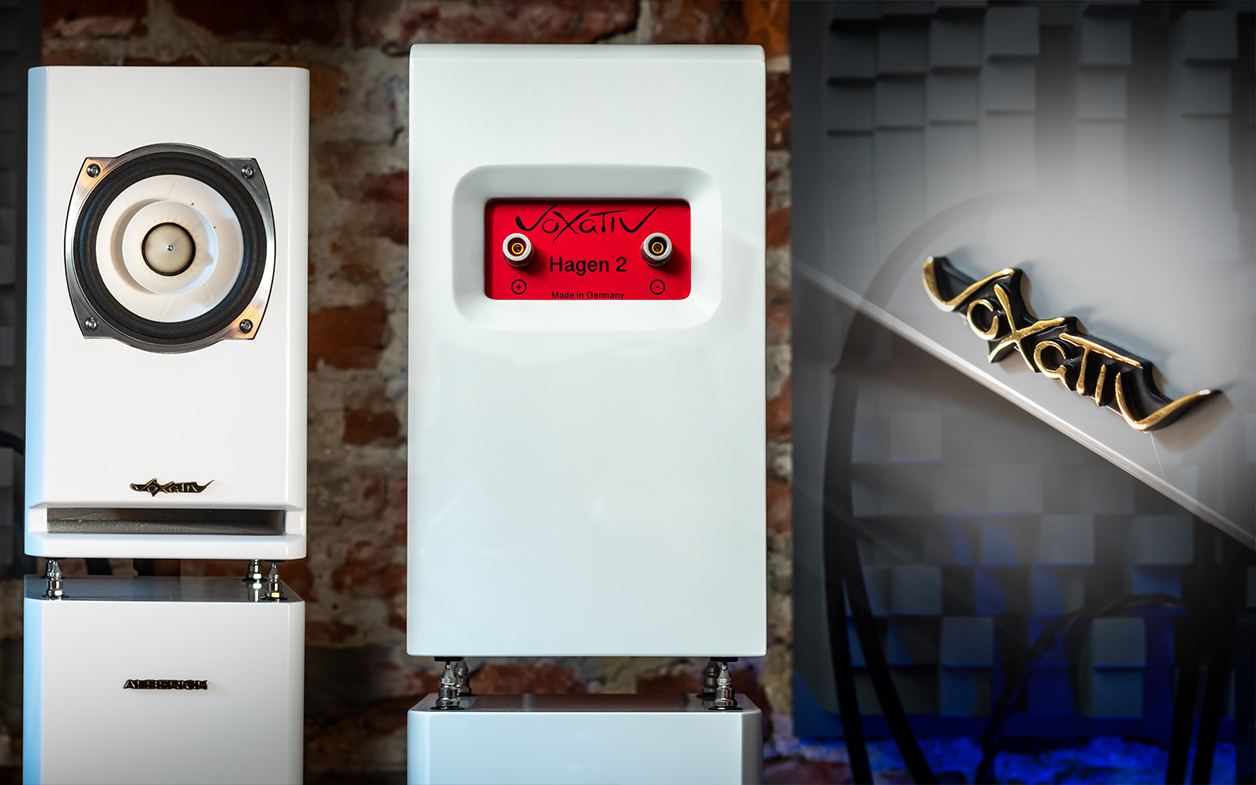
The standalone Hagen² monitors aren't the same as what's in Alberich². The stack's monitor modifies the faceted internal rear horn to cut off at 90Hz and boost the 100-300Hz range to better integrate with the active sub and improve overall sound quality. Why bother and oftentimes struggle with a widebander's bass extension if the bin below does a better job of it? I also imagine that the AF-2A drivers rolled off mechanically cruise rather than bruise. That should benefit their linearity and distortion. Hagen²'s rear horn with Acoustic Stealth Technology eliminates line resonances via precise calculations and alignment of the angled panels which form its internal tunnel. As for the AF-2A 5" driver, it combines a paper cone, paper whizzer and rare and costly AlNiCo motor. Each RiPol sub runs a single 12" woofer off a custom 500W class-D plate amp with on/off mains rocker, fused IEC inlet, RCA i/o and three rotaries for 0-180° phase, 40-200Hz cut-off and volume. Marie advised that an 85Hz low pass and 90° phase would be a good start. My final settings indeed were in that ballpark. The volume knob proved very hot so going mildly above the lowest setting already produced very high output. I don't know whether this was intentional behaviour or not. Perhaps in rooms larger than mine the excess headroom would be of use. In mine anything past 1/5th was redundant. Those who understand how unusual the means are which combine in Alberich² may agree that its dress code is a key attractor. In the cosmetic sense, this is a perfectly normal-shaped and -sized speaker. Pondering the notion of augmenting a small purist widebander with RiPol bass is one thing, bringing it to life in a compact form factor quite another. The 9.87 system was far larger. Alberich² being more compact and cost-effective scores even higher on domestic appeal and accessibility. Subtly curved surfaces on the upper and lower MDF enclosures are very nice to look at. While the bass bin is a bit deeper, its sloped top nicely offsets the difference and connects the stack into a visually attractive coherent structure. The four knurled spikes that thread into the sub to float Hagen² are too tall for my taste. I'm not a fan of what spikes generally do to sound either. On the upside, these bass bins can easily accept stubbier spikes or even ball bearings. The two cabinets arguably do look better with some space between them and the stock separators get us there. The rest is in the eye of the beholder. Since we're styling, I particularly fancied the beefy outriggers and how they anchor the stack. The shiny footers with dull spikes underneath don't provide any height adjustment so early wobble was a thing even on my concrete floor. I sorted that by using four tiny adjustable sound|kaos Vibra30 wire suspenders under each sub. Voxativ are aware of the issue. The brand is known for perfect paint jobs and while Alberich²'s outer skins are no exception, the slotted horn mouths and woofer openings diverged a bit. From the seat this didn't show but did close up. Shoppers sensitive about details could want some grill inserts for these openings. Lastly, RiPol subs with face-to-face woofers as in the 9.87 system are known as BMS. The DMS version in Alberich² uses just one but operates the same. Whilst raw output is lower than dual woofers, the enclosure can be narrower. Considering how compact Hagen² is, a DMS RiPol was the ticket. Besides, its bass prowess proved beastly already.









First things first. Positioning, suitable amplifier mates then listening were on the docket and in that order. To exploit their directional radiation pattern, RiPol subs don't want to glue to the front wall. I had zero intentions to do so anyway. In general, the greater the distance between speakers and front wall, the more they develop soundstage depth. It's why I position my Vox monitors almost in the middle of my room toed in aggressively to cross on my head. Now I enjoy headphone-like imaging that locks me in a spatial bubble of sorts. While the paper cones of these Swiss minis allow for that, there's an extra factor. The sound|kaos are shorties. Their Enviée drivers sit a bit lower than my ears and fire at them from down below. Alberich² is a much taller speaker set. I'd have to sit much higher to use it like the Vox and tap into the same spatial envelopment. Neither had I a bar stool nor larger room to do that. No matter. While my photos don't show it, I set up the Voxativ about two meters from the front wall and crossed roughly at my seat. That worked a treat. Alberich² was amazing on spatial qualities, period. But it also did very well barely toed in one meter closer to the front wall. Most listeners would be very happy with that more conventional location. I however have habits which die hard. If a chance of tapping into that bubble-like soundstaging presents, I'll gladly pursue it.
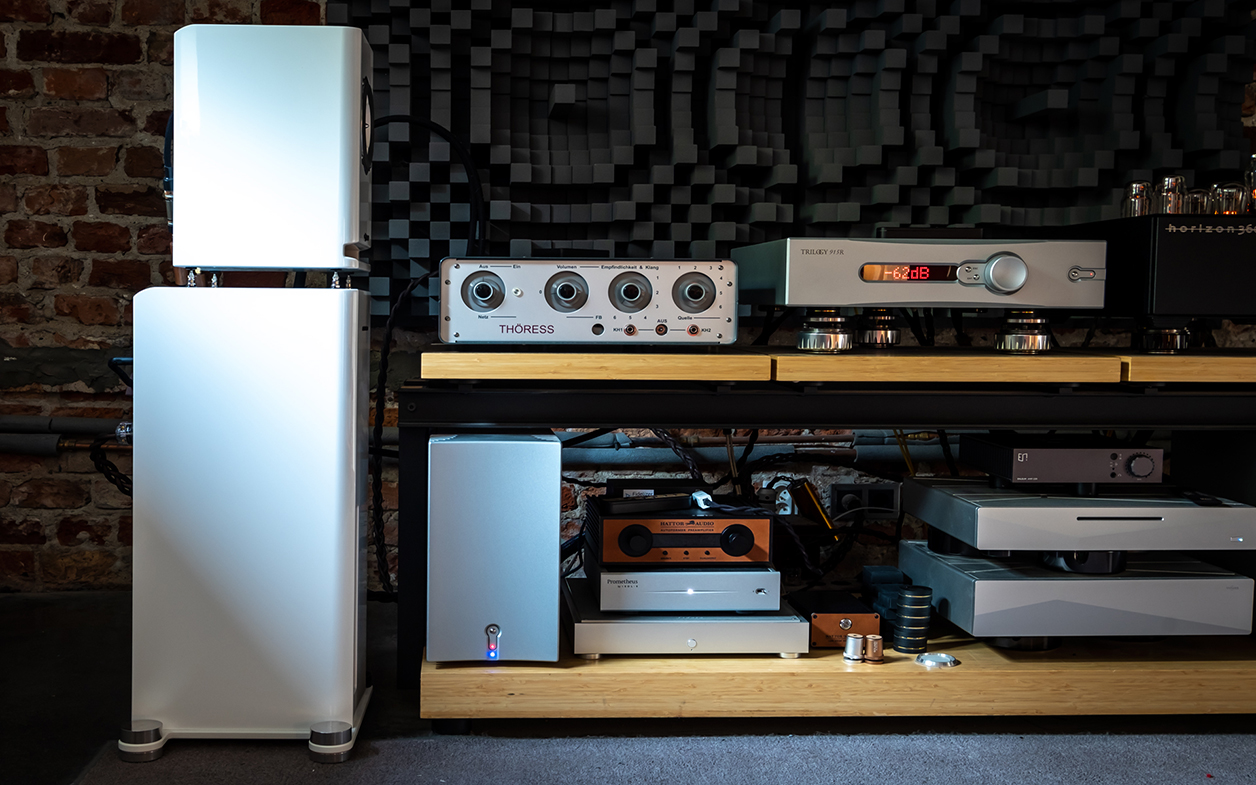
Amplification suitable for solo widebanders is no rocket science. Such low-mass drivers hate being overdamped. Then they get frosty, piercing, thin, whitish, nervous, grainy, shouty and dry. Companion amps with very high output Ω are the real ticket. Low-power DHT and specialist single-stage class A transistors fit that profile. Beefy class D and AB tuned to control tough low-impedance loads do not. To put this into perspective, the lower the amplifier's damping factor on Alberich²'s 10.3Ω AF-2A drivers, the better they'll sound. Any amp capable of a damping factor of 1 would no longer act as a brake. A widebander's excellent self damping now becomes the opposite of dry, its most desirable traits flourish, their innate sophistication blooms. The remarkable FirstWatt SIT-4 would multiply our ideal DF of 1 by 2.5 which is enjoyably low. Yet the amps at my disposal were nowhere near. Trilogy's 995R monos score about 20 which was already too high for my taste. A FirstWatt F7 cranked that number to nearly 130. Enleum's AMP-23R was the saving grace at 13. While the stopping power of this tiny integrated was five times higher than the SIT-4 would have been, it did very well. While Srajan found his Enleum too icy for Alberich², he predicted that a tube preamp groomed for high colour and density would elevate the South Korean. I saw his logic. Fronting my AMP-23R with a valved Thöress DFP might net some good results? Spot on. This really was the best combo I could assemble from the building blocks at my disposal.