Correct amp type aside, the upper Alberich² boxes just need speaker cables. Each bass bin requires a power cord plus line-level RCA signal. While no tall order by any stretch, an integrated amplifier or pre of our choice must support this. Considering the key ingredients of the Voxativ, let's first tackle its bass, then describe how it combines with the bandwidth above. To kick off, in my Duo SD review I wrote that… "it quickly became clear that most conventional passive speakers can't compete with the Duo SD's bass in my listening room. Vented boxes designed for smaller spaces will neither dig as deep nor land blows from the lowest depths with the same ease. They also won't be as agile, direct, controlled and simultaneously as dismissive of room resonances. To illustrate what I mean, years ago I picked up a music tip from Srajan in the track "Gold Dust Bacchanalia" from Mychael Danna's soundtrack for the movie Kamasutra. Around the 40-second mark, content around +/- 25Hz kicks in which we feel rather than hear. Though most speakers including my daily drivers won't reproduce it, they leave the irresistible impression that something should be there. The Duo SD showed exactly what that is: lively, physically obvious vibrations and rumblings that drift through the listening room, energize it and cause it to pleasantly rumble without any signs of boom, sluggishness or chaos. I could count on one hand speakers I reviewed which were capable of reproducing this with comparable intensity. That's a shame. A lot of electronic music features content below 30Hz so it would be great to always hear it. Just to give two additional examples, the track "Queen Mary" by Francine Thirteen demonstrates this as does "Inchworm" by Battles. The takeaway is clear. If speakers even larger than the Duo SD are not allowed, we need specific and let's be honest, active measures to keep up with their bass."
On extension alone, Alberich² was as superb and acted with equivalent ease. I imagine that many listeners would scratch their heads in disbelief over how a speaker this size can recreate such bass. Those into electronic music genres would find it enormously impressive. I did. But RiPol subs really are different. We are so used to bass boom, chunk, smear and drag as by-products of port emissions and room talk that we overlook them without awareness thereof. Alberich² drives home what bass sounds like without these common disturbances. Only by subtraction can we learn how these side effects often framed politically correct like meatiness or warmth are in fact distortions that don't belong. Without prior exposure to dipole bass, Alberich²'s subs may seem too invisible at first as though they lacked something. While that won't prove out, there is a learning curve. Past introductory courtesies we acknowledge that their character is very fit so highly articulate, precise, dynamic and very fast. Once our perception resets, this kind of bass no longer seems dry and off in some weird way but colour-wise spot on, wondrously elastic, responsive, meticulous, powerful, majestic, clean and gorgeous. Let's inhale, exhale, enjoy the experience then return to conventional bass. Oops, now that's more problematic than we'd like to admit. Too late, we should have read the small print first. This RiPol thing is some seriously potent highly addictive stuff. It honestly doesn't take much to get hooked.











Now it may feel odd that early on I gushed over how accomplished the Duo ST were down low. As a semi-active affair with sealed bass built upon 12" hard-hung pro-audio woofers armed with enormous voice coils, it truly was. Just then I simply couldn't have predicted how Alberich² would be so different yet please me even more. While I couldn't compare them side by side, the white set arrived a mere week past the Duo SD's departure and was auditioned with the same music. On bottom reach it followed without a miss, on fill it was leaner yet still quicker, more immediate, cleaner and less room interactive. Above the lowest two octaves Alberich²'s hard-hitting artillery would render the Duo SD a touch calmer, softer and bloomier even though per se its bass is not that. Context matters. Preferences and what we're used to do, too. I think that most listeners would enjoy the Duo SD's bass more. Why? It would feel more familiar and be far more in line with their habits. While plenty quick and feisty, it would feel denser and earthier than today's extremely sporty very rapid RiPol subs. Against most regular speakers Duo SD would easily position far higher on overall bass quality. However, the dipole aesthetic has the upper hand in listening spaces with untreated acoustics. It's one more reason why the bass gestalt proposed by Voxativ spoke to me even more than the Duo SD. While very rare, it's actually the more practical solution. And let us not forget that a classic flat-panel dipole capable of digging as deep as Alberich² would necessitate a monstrous woofer or two in a correspondingly large frame. That Alberich² can package such bass into compact floorstanders is its most outré virtue. As Srajan mentioned repeatedly in his own reviews, the sidewall reflection cancellation baked into this design effectively makes it a room treatment. As far as objective bass qualities are concerned, it's factual that RiPol loading outmatches non-dipole speakers in rooms without bass traps or heavy DSP compensation.
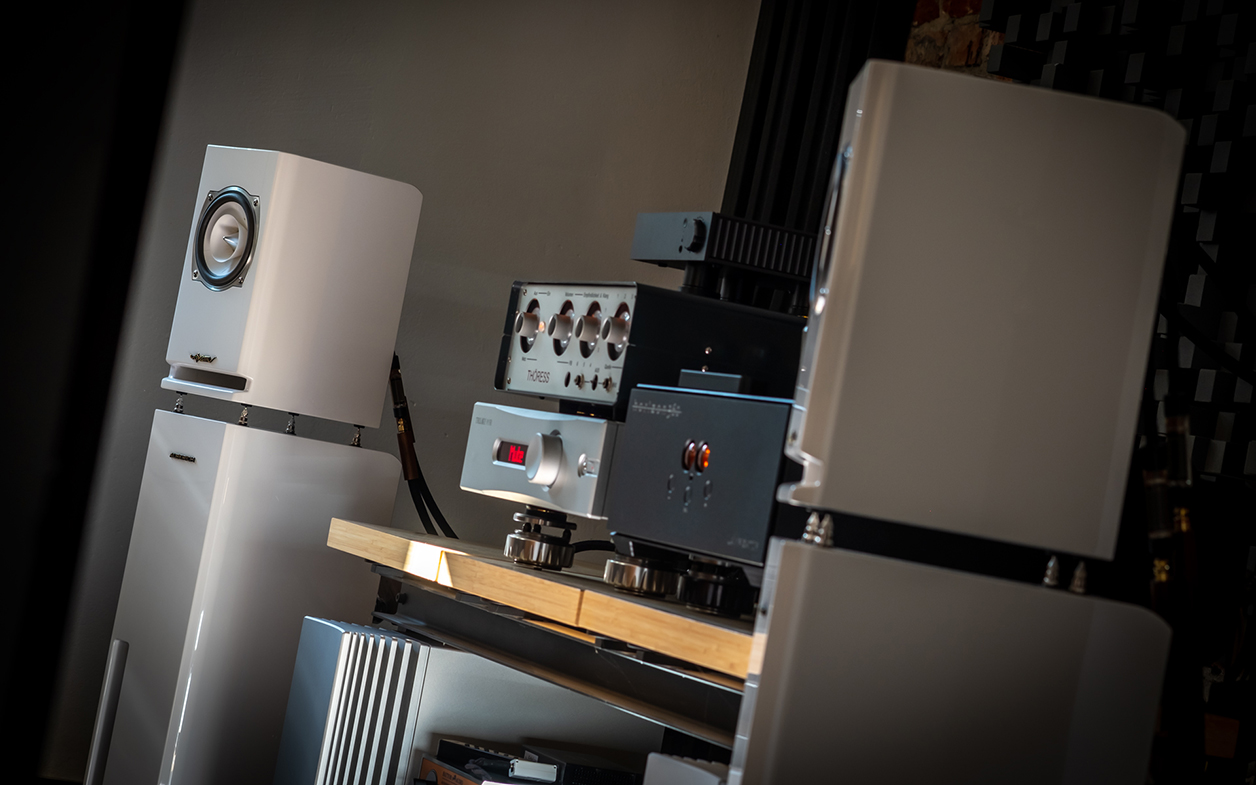
Suffice it to say, Alberich² handled bass in a remarkable, wholly positive and very much unique way. I honestly failed to see any downsides. How this speaker fared above the bass proved far more predictable so just as accomplished. I know quite a few multi-ways superb on imaging and soundstaging. Many compact two-way monitors act like point-source propagators to inherently excel at such tasks. Squeeze into a bookshelf warrior a widebander to do most the work and it'll up that ante even more. In my collection, here the sound|kaos Vox 3afw represents peak performance. I know none other that can image like them. If they were to ever get outclassed, I'd expect another widebander to achieve this feat. There are however speakers which I rate as high. Alberich² was one of them. With the right amp, this specimen blends generous illumination, air, detail, insight, directness, accuracy, freshness, quickness and timing with persuasive, seductive and sensual textures packed with fruity colors and presence. This was all expected given a 5" classic widebander. Users used to a darkish voicing built upon density, voluptuous images, tonal warmth, intimacy and an autumnal atmosphere will most certainly find Alberich² unusually quick, lucid, communicative, specific, shiny, contrasting, detailed, sunny and happy. As such it lets in loads of fresh air like spring season on its best day. That's the rough guideline. Also, any seam between Alberich²'s upper and lower box was undetectable to my ears. Aspirated filterless drivers working alongside RiPol subs were like two peas in a pod.