My current system's digital front end is a Taiko Extreme server and LampizatOr Horizon 360 DAC. The digital stream enters via Taiko's network switch. Everything plugs into an Audioquest Niagara 5000 power conditioner. A Marantz 6015 AV receiver and my vintage Spendor LS3/5a combined with a XTZ 12.17 sub was our TV sound before repurposing the living room as listening den. The speaker signal in the new arrangement could come from the AIC-10 or Marantz through an amp switcher. When I discussed my conversion project with Srajan, he initially advised a 2.1 configuration with relatively small yet efficient monitors combined with a Ripol sub driven by a dedicated amp all managed by an active xover. The purpose was flexible seamless bass integration with the bonus of shifting the LF away from my AIC-10 thus expanding speaker options. It was very sensible advice but conflicted with my intention to keep the system as simple as possible. When I made my constraints clearer and given Srajan's read of my sonic preferences, he recommended the Zu Audio Soul VI. I was aware of the brand and ingenious mind behind it from many reviews and interviews which in my head had formed an attractive idea of their sound but I'd never yet heard a Zu in person. However, looking at the information provided on the website, it was clear that the Soul VI indeed was a splendid candidate for my initial brief. They are 100dB/8Ω, of manageable size and weight, integrate very well with our décor especially in the dark undyed Okoumé. Bass extension was potentially good enough to do without sub for a simple 2.0 setup. Having appreciated widebanders or coaxial point sources in the past, I was also intrigued by the driver arrangement wherein a full-range whizzer-cone 10.3" driver and super tweeter combine with virtually no filter. When Srajan forwarded my interest to Zu's Sean Casey, he generously offered to send a pair in my favourite finish. I was as excited as I was grateful. After a few weeks of to-order manufacturing and factory burn-in, the Soul VI arrived.
The methodology I used to integrate the Soul VI with my room was as follows:











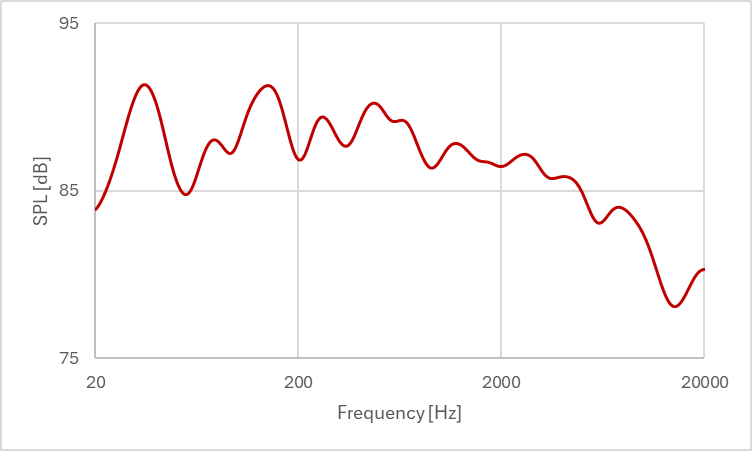 My living room is part of a 50m² space where one side flows into the rest of the flat. To obtain a certain degree of sound isolation, my wife and I decided to install a thick solid-wood sliding panel to keep this space airy and open when not doing hifi whilst segregating it in listening mode. As a result I obtained a 5 x 4.5m multi-purpose room which we use as living room, to watch TV and to enjoy playback. In acoustic terms this is a small space with nearly square proportions and their known challenges. It contains some furniture which I cannot get rid of if I want to stay married. The location of the large couch which is intrusive in acoustics terms is relatively fixed as I can only move it back and forth by ~30cm. On the upside, the room and its contents present visual symmetry and my wife generously agreed to acoustic treatments and placing the speakers well into the room away from the front wall. Here is an averaged measurement with just one speaker in the left corner plus subwoofer.
The results weren't too bad a starting point and fairly consistent across multiple measurements which also changed the front-wall distance within my allowable range. The reverberation time (RT60) showed an average 0.7s which was rather high and likely contributed to some perceived fuzziness of imaging and mid-to-lower-treble lack of articulation. By repeating the measurements with both Soul VI confirmed the findings and allowed me to dial in subwoofer gain and cut-off frequency a bit more effectively.
To further improve my acoustics, I could play with additional furniture. Given how minimalist our room is, that could have easily achieved some reverb mitigation but I decided to move to professional room treatments instead. Here I didn't want an overly dry room. Given my preference for acoustic music, liveliness even buoyancy of the midrange and a decay structure which resembles a live venue were key. Also, I like the sense of a room filled with sound wall to wall, floor to ceiling without overloading and experienced that in the best-sounding rooms I have visited. You certainly don't get there with an excess of absorptive treatments. Based on what more knowledgeable people told me, this would mean an RT60 target of 0.3-0.4s. However, I also needed more sound isolation where our wood panels do a rather poor job. Given the sliding side wall, the only viable option were heavy wall curtains as an integral part of the acoustic treatment. I was prepared to accept some over-dampening in trade. Considering these objectives and compromises and the set of baseline measurements, my acoustic consultant went home and after some additional measurements, simulations and evaluations came back to us with a nice kit of treatments which they installed in about a full day.
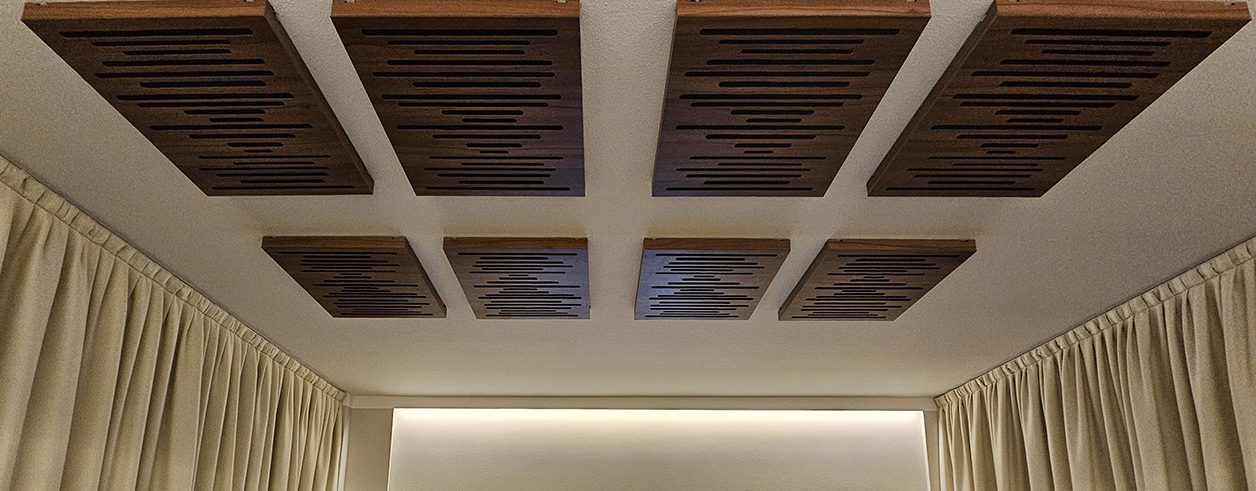
The treatment consists of acoustic sidewall curtains, eight ceiling panels for a mix of diffusion and absorption plus a pair of clever Vicoustic VicTotem Ultra VMT which act as diffusers, absorbers and bass traps depending on position and configuration. I placed my pair in the front corners to leverage their bass trap functionality and arranged the rest of the system for mainly diffusion. The main effect of this passive acoustic treatment was a dramatic reduction of the reverberation time. As shown in the diagram to follow, the average RT60 dropped from an average 0.7s to around 0.3s, with most of the midrange around 0.25s. My objective was to stay within the 0.35-0.45s range for most of the spectrum so overdid damping. A measurement taken with the sliding wall and curtains open shows about 0.45s, confirming how relevant the combined effect of the sound-proofing curtains and sliding wall is. After the acoustic treatment, the main changes in the sound I observed were as follows:
All in I'm fairly satisfied although the balance is a bit more on the dry/dead side than I wanted. I'll need to work more on this so consider my room project to be a work in progress.