
Country of Origin

Reviewer: Srajan Ebaen
Financial interests: click here
 Main system: Sources: Retina 5K 27" iMac (i5, 256GB SSD, 40GB RAM, Tahoe 26), 4TB external SSD with Thunderbolt 3, Audirvana Studio, Qobuz Sublime, Gustard U26 USB bridge, LHY Audio SW-8 & SW-6 switch, Sonnet Pasithea; Preamp: Hattor Audio ARP-S; Active filter: spl Audio Crossover MkII; Power amplifiers: Vinshine/Kinki Dazzle & Audiophonics NCx500 on subwoofer; Loudspeakers: Qualio IQ [on loan]; Subwoofer: sound|kaos D15; Cables: Exact Express Flame, Furutech; Power delivery: 2 x Kinki/Vinshine Tai Hang on amps and source stack, Furutech DPS-4.1 between wall and conditioners; Equipment rack: Artesanía Audio Exoteryc double-wide 3-tier with optional glass shelves, Exoteryc amp stands; Sundry accessories: Acoustic System resonators, AudioQuest FogLifters; Room: 6 x 8m with open door behind listening seat; Room treatment: 2 x PSI Audio AVAA C214 active bass traps
1st upstairs speaker system: Source: Shanling EM7 into Soundaware D300Ref SD transport to Cen.Grand DSDAC 1.0 Deluxe with POW; Preamp/filter: Lifesaver Audio iCon 4SE & Gradient Box 2; Amplifier: Kinki Studio EX-B7 monos; Loudspeakers: sound|kaos Vox3awf; Subwoofer: sound|kaos D12 on twin Nord Acoustic NC500 monos; Cable loom: Exact Express Earth; Power delivery: Vibex Granada/Alhambra, Akiko Audio Corelli Corundum & Castello Solo; Equipment rack: Hifistay Mythology Transform X-Frame [on extended loan]; Sundry accessories: Furutech cable lifts, Furutech NFC Clear Lines; Room: ~3.5 x 8m
1st upstairs headfi system: DAC: Cen.Grand DSDAC 1.0 Deluxe with POW; Headamp: Cen.Grand Silver Fox; Headphones: Raal 1995 Magna, HifiMan Susvara
Desktop system: Source: HP Z2 workstation Win11/64; USB isolator: LHY UIP; LAN distributors: LHY AS6 Pro & SW6-SFP; Ethernet reclocker: Stack SmoothLAN; DACs: Gustard R26II & Audalytic DR70; Preamp: Topping A900; Speaker amps: Topping B200 monos; Headphone amp: Enleum AMP-23R; Loudspeakers: Virtual Hifi Viper; Headphones: Final D-8000, aune SR7000, FiiO FT7, HifiMan Susvara Unveiled
2nd upstairs headfi system: Shanling EM5; Headphones: Meze 109 Pro, Fiio FT3, HifiMan HE1000 Unveiled
2nd upstairs speaker system: Source: smsl PL200T CD transport; DAC: Shanling EM7 w. 1TB microSD; Crossover: Lifesaver Audio Gradient Box II; Amplifiers: LAIV Crescendo Chorus monos; Loudspeakers: MonAcoustic SuperMon Mini with Dynaudio S18 subwoofer
2-channel video system: Source: Oppo BDP-105; All-in-One: Gold Note IS-1000 Deluxe; Loudspeakers: ModalAkustik MusikBoxx; Subwoofer: 2 x Zu Method; Power delivery: Furutech eTP-8, Room: ~6x4m
Review component retail: from $1'520/ea.
 |
 |
 |
 |
 |
 |
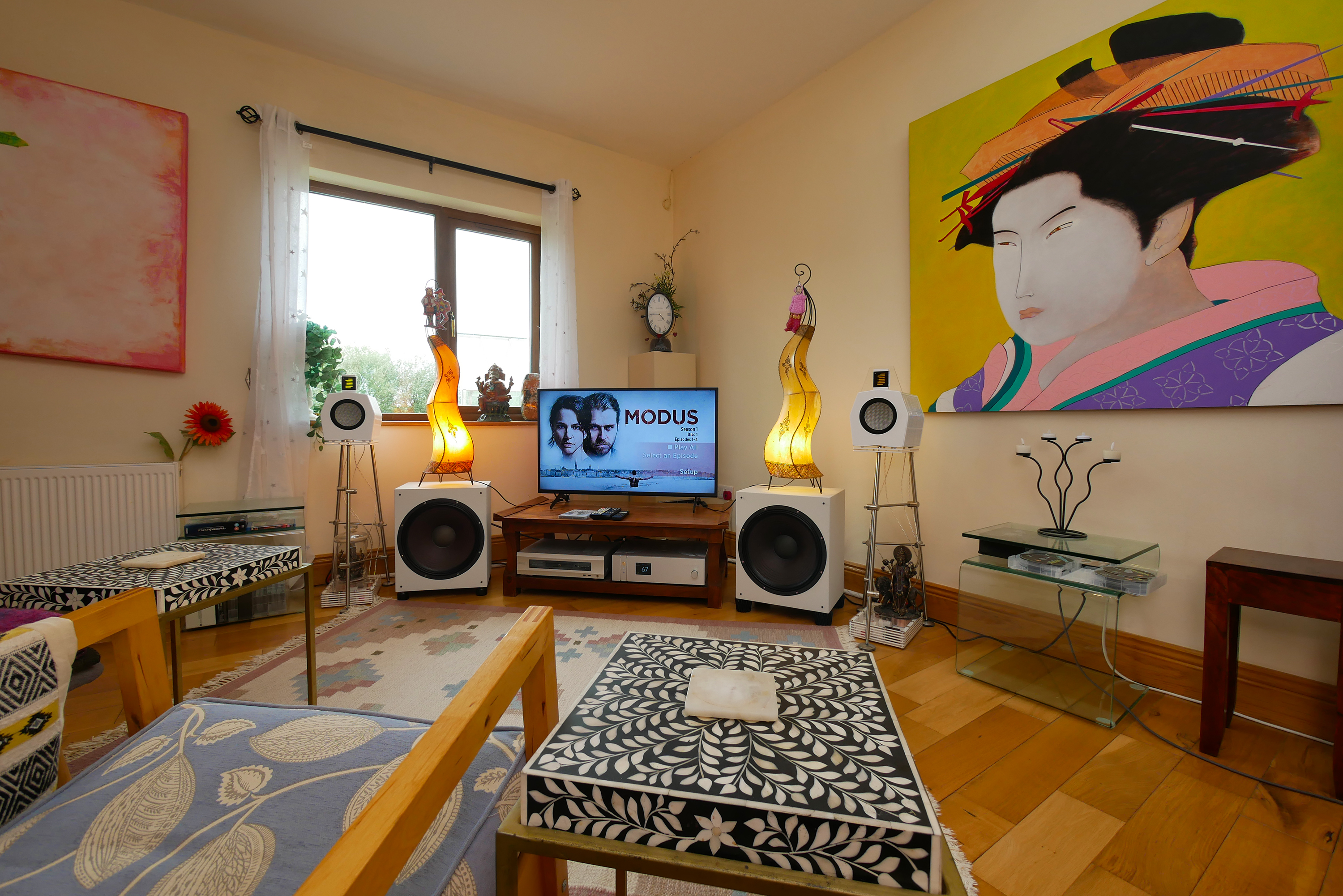
What's the opposite of double trouble? Pleasure squared? Let's set the scene. In the wake of my sound|kaos Vox5 review, I wanted to clone that performance in my bigger upstairs system with the stablemate monitor Vox3 I already had. The Vox5's folded-dipole arrays of dual 12-inch woofers per side would go mono with a sound|kaos 2×12" RiPol D12 sub on order. A Lifesaver Audio Gradient Box II active analogue crossover could then split the signal into 120Hz/4th-order hi/lo-pass legs to exploit RiPol's asymmetrical 'super dipole' radiation pattern across 2½ octaves. That seriously undermines the room gain of sealed/ported omni radiation with its pernicious reflective time delays. My downstairs main system had already had that scheme in place for very many moons. Its 2×15" RiPol sub is simply too heavy to safely stairlift by my lonesome. So I'd never yet heard quasi cardioid bass upstairs. The lighter Vox5 had popped that cherry with desirous consequences. I'd ordered the smaller still stair-liftable version of my big sub. Alas, that suddenly had unemployed a Zu Method sub to look for work. Its obvious destination was my downstairs 2.1 video system. Here this pair of compact sealed 6" 2-way monitors from Germany's ModalAkustik boutique run full-range to ~55Hz whilst a single Zu Method fills in below on its own Hypex Fusion low pass. Its Zu-coded filter values for the companion Method monitor so happen to fit these Germans to perfection. As a virtual square, this room sets up diagonal. Its central axis deliberately deviates from a perfect 45° relative to the front corner. Minor room asymmetry, of the classic symmetrical stereo triangle within it, is an ancient trick to minimize frequency-response aberrations. During my formal review of the Method twins—monitor + sub—I'd briefly experimented with two subs. Audiophile ambition states that multiplicity trumps singularity when it comes to subwoofers. The chief argument is mutual fill. If placed correctly, one sub's room-induced peaks and troughs will mirror-image the other's to sum to a more linear response. A secondary argument is that twice the cone surface moves double the air. Equivalent SPL need half the excursion. That means lower distortion and more headroom. In a home cinema calibrated for excessive THX sound pressures, that math might audibly add up. In my far more civilian use, already a single 15" hard-hung Zu cone does all I could want whilst a sly twirl on its bass attenuator would do way more. My original review had thus heard no real justification for twin subs so instead parcelled them out across two systems. Happy days. Case closed?







With much music below ~100Hz recorded mono, a diehard argument for stereo subs might stand on one shaky leg unless we practice yoga's vrksasana posture. Regardless, the Vox5's showings in my primary and secondary system down to 25Hz had exhibited greater substance from twinned 12" woofers per channel than my usual subs. This was despite running the downstairs' face-to-face 15" woofers off mono amps with discrete not summed l/r signal. I didn't really think that this difference was down to classic stereo vs mono bass but rather, extra cone surface split across two locations. For the difference, chunkier LF presence from greater cone surface moving air in extra locations seemed the kindergarten memo. Now I had a syndicated rerun of that conclusion in my 2.2 no longer 2.1 video system. It wasn't about more loudness. Again, a single Zu Method exceeds my needs. It wasn't about more stereo specificity in the low octaves. On that score a mono sub not set up centrally in my video system had never betrayed its location. It wasn't about more amplitude evenness either. This setup had been admirably non-lumpy with a single sub already. Just so, there was a lovely benefit from going beginner Mormon—I leave the four wives to younger men. How to describe my extra pleasures from Zu's micro harem?
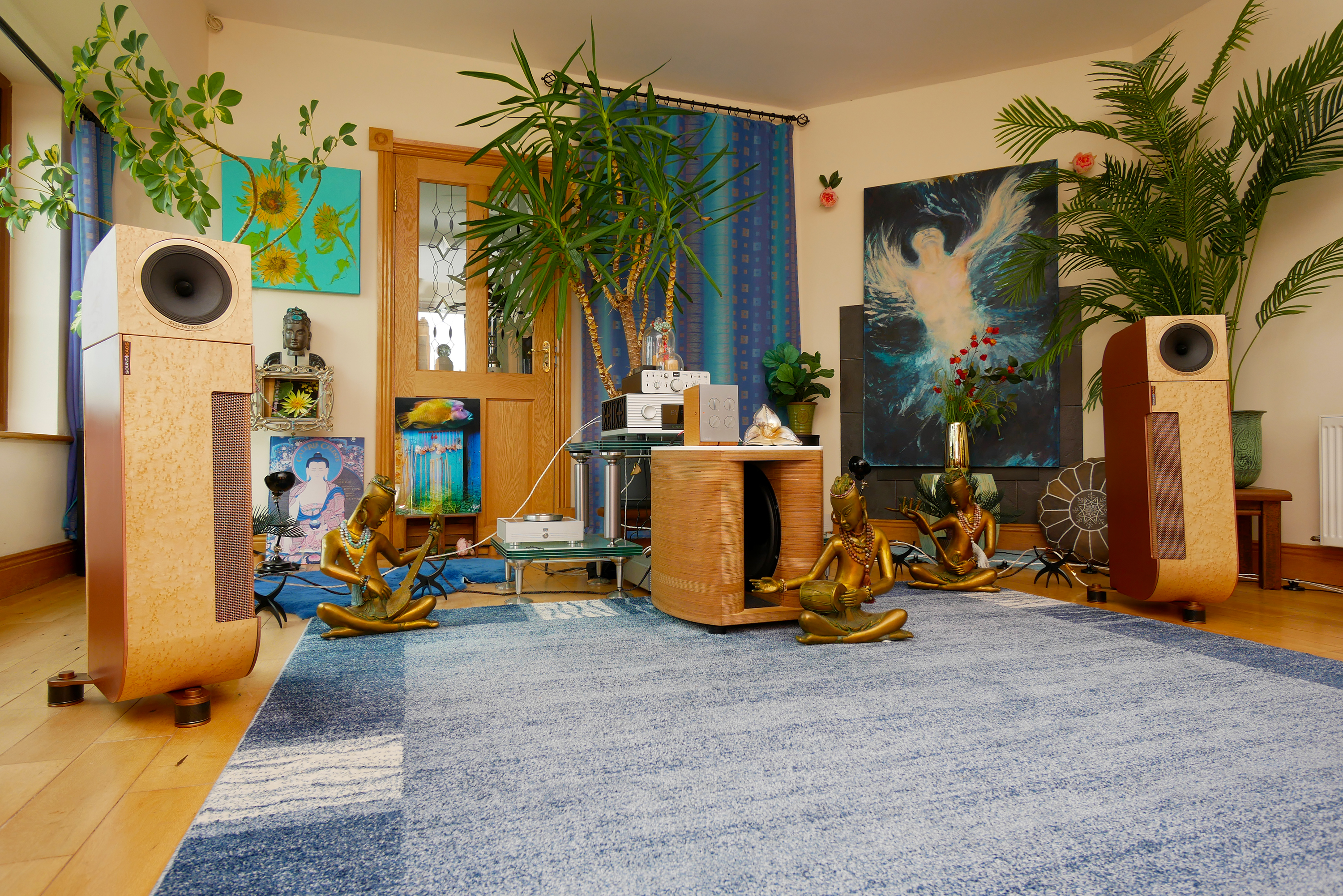 Two 2×12" folded-dipole bass arrays vs a stereo-fed 2×15" sub in a central location.
It's back at more substance hence LF presence. I think it's not from more linear or higher amplitude but a broader virtual LF source. This was apparent in the above setup. It previewed running twin Method subs in the TV room across the hallway. Here's the thing. To my ears the primary gains from two bass wives come at low SPL—lazy foreplay not sweaty coitus. It's where Fletcher-Munson compensation reminds us. In the frequency extremes our hearing becomes ever less sensitive as we turn playback volumes down. A common trick of sub owners is to goose them a bit when playing quietly. It's partial loudness compensation though doesn't address the treble. With twin subs set up for a linear not lifted response, I thought that particularly lower SPL gave me extra foundational presence and intelligibility. Put differently, it wasn't about more mayhem but extra subtlety. Particularly in quickie store demos, anything subtle is often a hard sell. It's where Zu's direct sales with return privilege make all the difference. We get to live with something under consideration long enough to learn its behaviour across different music, moods and SPL—in our own room. Our domestic circumstance may not be able to replicate a dealer's hopefully fine-tuned facility. Being able to experiment for a few weeks in our own crib then becomes essential. That's extra useful with subs where most two-channel listeners have zero prior experience. The Hypex Fusion electronics of the Method sub have somewhat archaic downloadable software through which we can make adjustments even build our own filter functions. Because Zu don't lock access, power users can help themselves. Just connect sub to PC via USB Micro. Others can ask Sean to recode one or more of his stock three presets to their own filter requirements. All this by way of briefly revisiting his sealed 15" Method in twinned guise after getting hip to benefits I didn't fully grok the first time. That's because I don't do what multiple sub users typically would: high SPL with room-shaking blockbuster fare. As it turns out, there's more to it; at the attenuator's opposite end.
So yes, two subs can make even an older guy happy, no (cough) youthful excess, vigour or acrobatics implied.

Zu's website
