
Country of Origin

Reviewer: Joël Chevassus
Sources: Esoteric K-03 & N-05 XD, Lumin U2X [on loan], XACT S1 Evo, Cybershaft OP21A, HifiRose RS201E, Macmini M1, CH Precision C1.2 [on loan]
Power & integrated amplifiers: Esoteric S5, Coincident Speaker Technology 845 Turbos, SPEC RPA W3 EX, Kinki Studio M7, Kinki Studio ChocoSound, Red Dragon S500, CH Precision M1.1 [on loan], CH Precision L1 [on loan], CH Precision X1 [on loan], Coincident Speaker Technology MK2 Line Stage, Kinki Studio P27
Loudspeakers: Vivid Audio G1 Spirit, Aretai Contra 100S, Leedh E2 Glass, Recital Audio Illumine Hefa, Kii Seven [on loan]
Cables: Luna cable red series interconnects & speaker wires, Vertere HB Pulse USB cable, Esprit USB digital wires (coaxial and USB), DELA C1-D20 SFP cable
Review component retail in Europe incl. VAT: €6'000
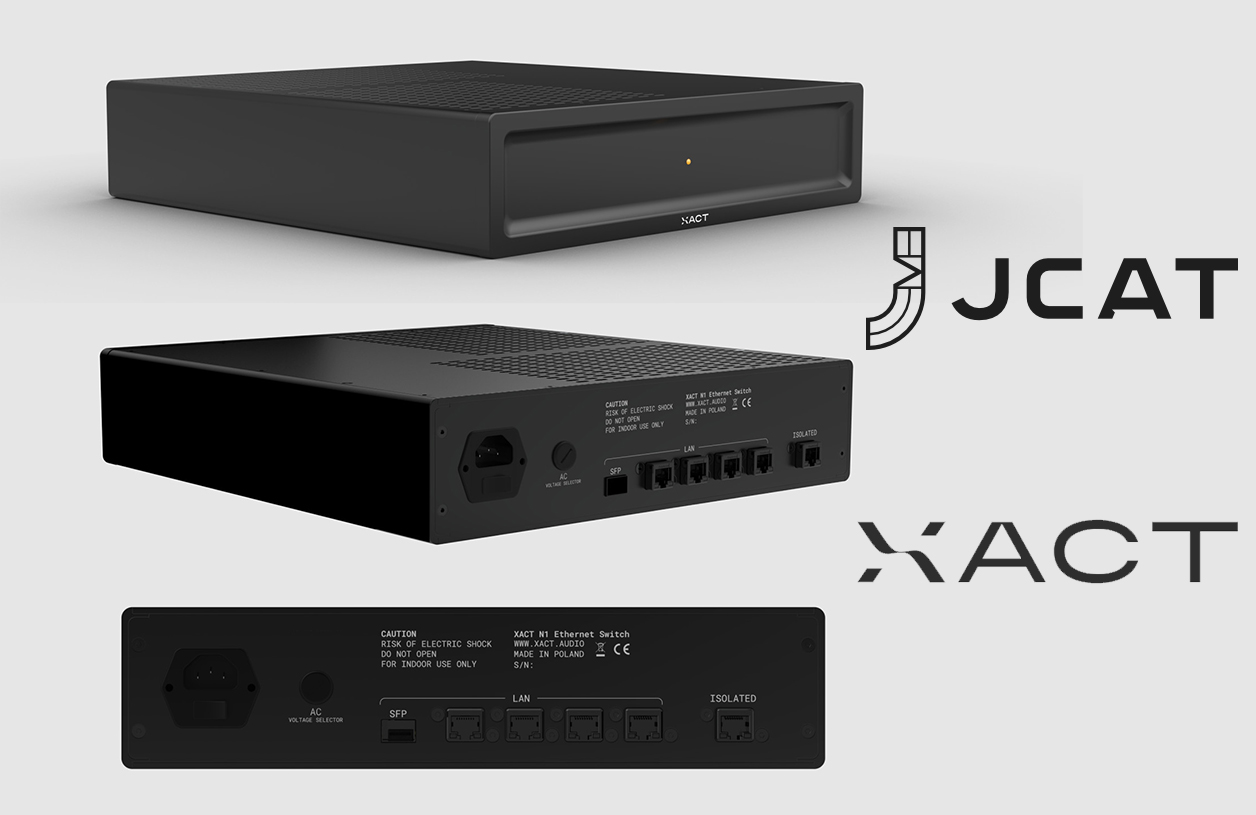
Marcin Ostapowicz developed the N1 switch after initially pursuing a network-switch function integrated directly into his S1 network player. However, the latter couldn't simultaneously double-task at file reading and network switching to where it ultimately proved useful to offer an independent switch. Separates have their own appeal and undoubtedly offer better versatility when assembling an ambitious digital front end. According to XACT, the N1 represents a new benchmark in network performance. Like their S1 player, the N1 started from a blank slate and differentiates itself from those competitors who adapt pre-existing computer hardware for audio use. Most 'audiophile' network switches are based on standard motherboards designed for general office or computer use. Their problem are noisy if economical switching power converters that pollute the network with spurious high-frequency noise to infect other components and degrade the overall sound by giving it an unpleasant 'digital' character. Although some digital hardware designers attempt to mitigate these problems by tinkering with filtering and power regulation of standard motherboards, according to Marcin Ostapowicz this does not address the root cause of the problem—the actual motherboard which was never designed around high-end audio performance to begin with.
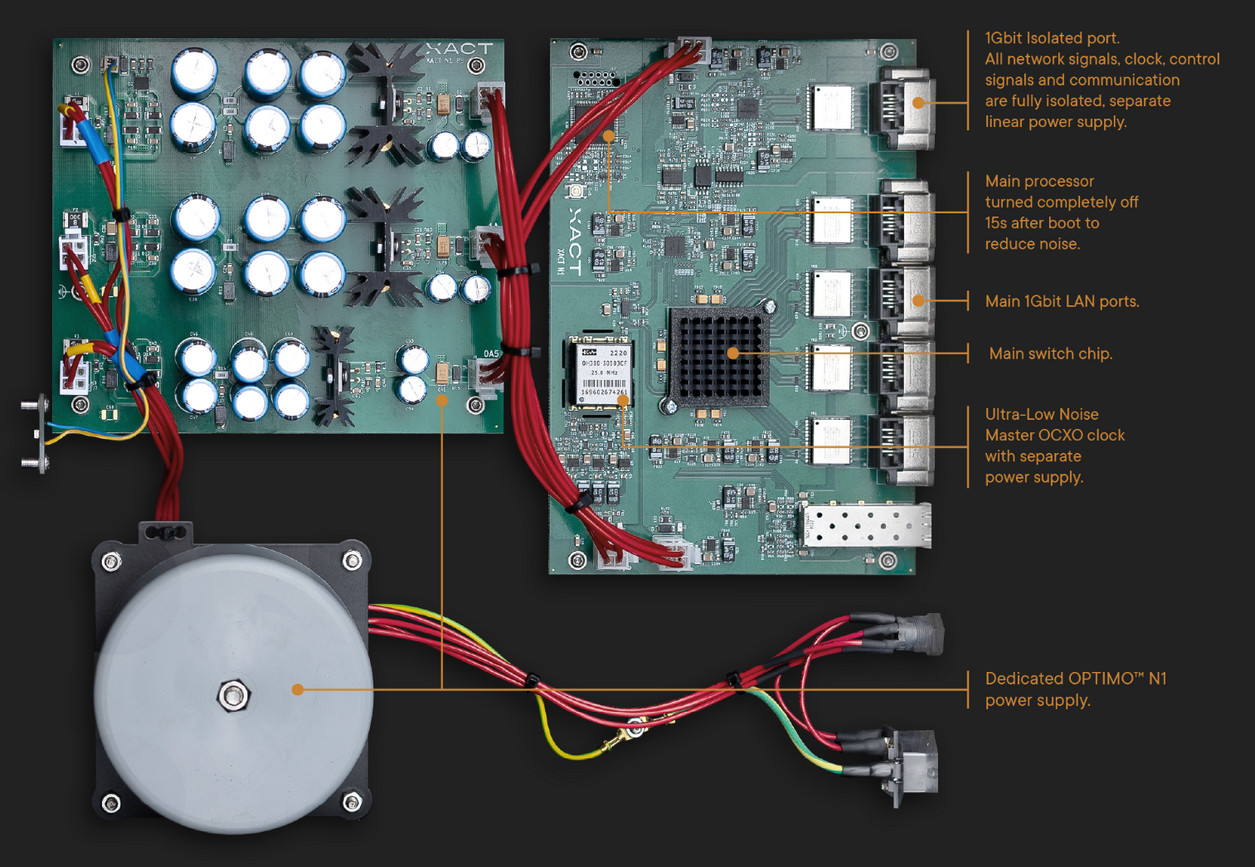
XACT's credo is to design motherboards whose sole purpose is to offer the best possible sound performance and eradicate all sources of noise pollution at their root. That's why the N1 was designed around a fully custom motherboard developed for the sole purpose of delivering exceptionally pure natural sound over Ethernet. Each component of the N1 was carefully selected or developed specifically for this application then thoroughly tested by ear. The N1 is therefore a true audiophile component created to drastically reduce noise, interference and temporal disturbances which plague the quality of networked systems. Like the S1, the power supply of the N1 circuits is 100% linear. It is claimed to be the first audiophile network switch that places such importance on power integrity. Its motherboard uses ultra-low-noise linear regulators or LDO dedicated to each critical sub circuit. Unlike traditional switches with noisy switching converters or generic power rails shared across the entire PCB, the N1 uses linear regulation exclusively. This no-compromise power architecture delivers superior electrical performance, promising natural sound without listening fatigue.










The Optimo™ linear power supply implements three separate, galvanically isolated power rails that segregate the main switching circuit, system clock and isolated output. The heart of the XACT N1 integrates a very high precision OCXO clock, ensuring optimal synchronization of digital streams. Unlike my $1'349 LHY SW10 switch which offers a clock output and a word-clock input, the €6'000 N1 limits itself to an internal clock without seeking synchronization with other digital components. As I understand it, Marcin Ostapowicz wanted to leave nothing to chance by providing options for unknown 10MHz peripherals whilst his own oscillator clocks at 25MHz¹. Though 10MHz remains the most commonly used frequency, more and more manufacturers adopt 25MHz to lower PLL-induced jitter. The N1 has four standard RJ45 Gigabit LAN ports which share a common ground. These ports connect devices like routers, NAS, WiFi access points or other network components. All Ethernet ports run low-noise high common-mode-rejection signal transformers combined with mil-spec connectors for long-term reliability and optimal signal transmission.
_______________________
One RJ45 port isolates from the rest of the switch circuit by opto-coupler on a separate power supply and independent ground connection. This port is meant to connect our network transport, streamer or DAC for best isolation from upstream gear. Additionally, the N1 has a Small Form-factor Pluggable aka SFP fibre-optic port. The general recommendation is to connect it to an SFP compatible router via fiber-optic cable. This port can also connect to a downstream network drive like my Lumin U2X loaner with SFP input. The N1's main processor turns off 15 seconds after start-up to minimize standing electrical interference. Once it turns off, all configuration functions including isolated port-speed negotiation disable to optimize audio performance. This is where we must accept the N1's radical non-standard concept whose software is streamlined for best digital audio performance. This disables all unnecessary protocols including power saving features. This could result in limited compatibility with older devices operating only on the 100MHz band particularly at the isolated port level. Since isolated port connection speed negotiation is handled by the switch's main processor which shuts down after 15 seconds to reduce noise, if a device operating at 100Mbps fails to establish a connection within this period, it may not function properly because the port will default to 1Gbps. On aesthetic and practical details, the N1 is made of solid aluminium, comes in black only and runs a perforated cover to dissipate the heat generated by the power supply and related circuits. Its depth of 27cm for a width of 24.1cm and height of 97mm is quite unusual for this type device and takes up a little more space in your hifi rack. Its weight is 5kg.