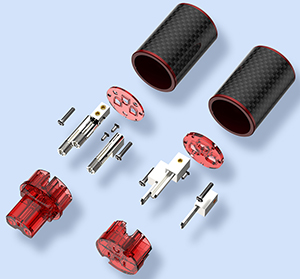
 Decisions, decisions. "To cover Europe, the US and UK, Japan and most of Asia, for now I'll offer type B, F and G connectors for the wall side and C15/C19 on the component side. Later I will still add C6. Working with Viborg has been excellent. They are very open to custom requests which makes development much easier. The Viborg plug bodies are CNC-machined aluminium in carbon-fibre sleeves. The cable geometry combines lightly twisted 2.5mm² solid-core conductors with two solid cores per pole. The base cable is a certified off-the-shelf product from a Polish manufacturer. Selecting this took quite some time. I tested close to 100 different conductors and configurations including pure silver, silver-gold alloys, OCC copper, cryo-treated copper, Litz and more. I also compared my prototypes directly against several well-known reference cables in the $3'000–$10'000 range. The first clear conclusion was that solid-core conductors offered a distinct advantage over stranded designs. The presentation became more direct, focused and precise, with higher resolution and better definition. In comparison, stranded conductors consistently sounded softer and less resolved. Once I committed to solid core, I looked into how others approach this. There are companies using solid-core conductors in their top-tier cables like Nordost with Valhalla and Odin; and Neotech with their high-end power cables. So this is a known approach, albeit not very common.
"From a safety perspective, no regulation forbids solid-core for AC cables but it does require proper implementation regarding bend radius, insulation and mechanical stability. The most sensible approach was an already fully certified base cable and build from there. I eventually selected a pure copper cable which consistently outperformed all other candidates in my listening tests. It offers an excellent balance of dynamics, tonal density, vocal presence, bass extension and clarity.
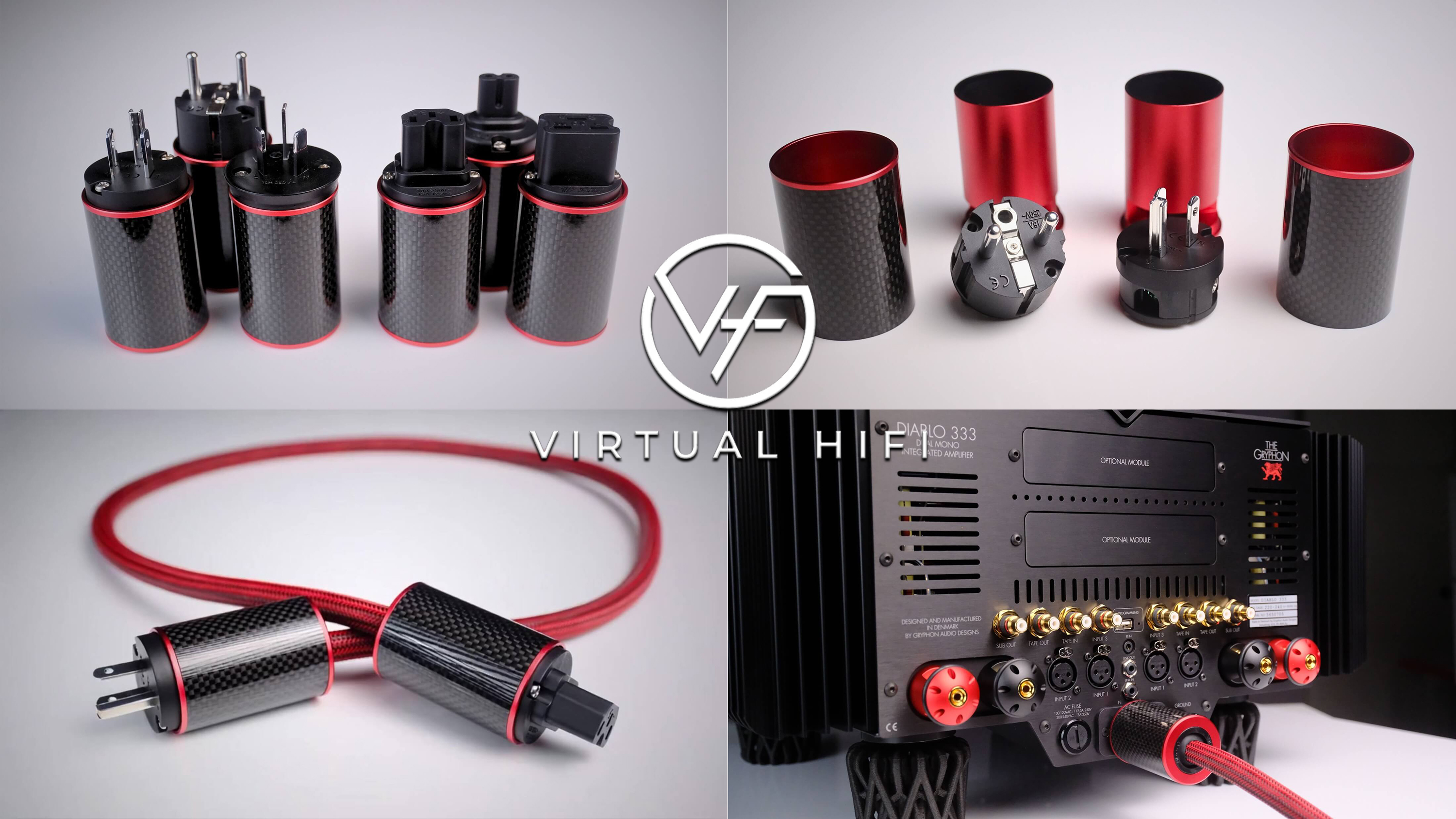
"An additional practical advantage is material cost stability. Copper is far less volatile in price than silver or gold. For terminations I tested pure silver, pure copper, gold-plated copper, rhodium-plated copper and silver-plated copper. The latter proved to be the best match. It adds a touch of openness, spatial detail and air while preserving the natural richness and body of the copper conductors. Although the design appears simple—essentially just two key ingredients— it took nearly six months to finalize through extensive listening. And yes, differences between plating materials are clearly audible."
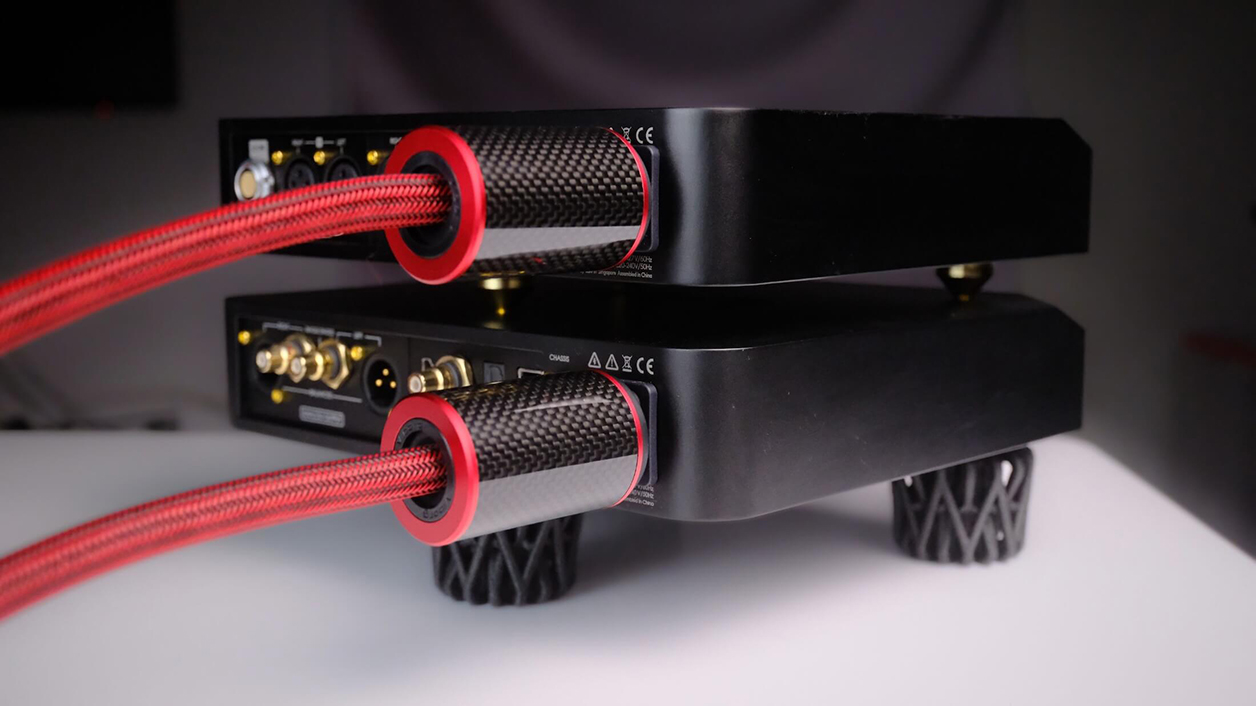








 Whilst common sense predicted a certain stiffness for solid-core conductors, actuality was rather friendly. Once straightened out from their transit curves which fit them inside red-metallic padded envelopes then branded black drawstring bags, routing was child's play. The connector barrels obviously require sufficient clearance. This should only be a potential concern with rare gear where socketry ends conceal beneath overhangs to create the damnation of crammation. With my desktop on Vermillion power, I turned to a recent discovery, this year's new George Dalaras album I Doxa Ton Anemon with all songs by Michaelis Terzis. It's been on heavy rotation around here to serve as perfect contrast foil. Meanwhile the outside sun against Greek laiki music reminded me of our two very hot years living on Coral Bay beach in Paphos/Cyprus. Power cords are all the same? Be that way. Versus my mixed quad where I only have fully consistent looms in two systems, the Vermillion cords had a definite effect. They were juicier overall so the antithesis of 'dry'; and tonally expressed more sonority in the lower midrange. They upped soundstage dimensionality in the outer sectors from a bit more hemispherical—deepest in the centre, shallower towards the actual speakers—to a virtual red carpet rolled out evenly at full width. Finally bass impacts had more shove. It's how extra juice didn't get soggy but stayed firm around the edges.
 Here it's fair to remind ourselves. Grzegorz is no slide-rule jock who caters to flatlined neutrality. He has distinctive taste and for Virtual Hifi bends his creations to it. Hello deliberate voicing pursued across extensive auditions. Much power-cord antipathy even pushback probably derives from spending habits. A shiny new DAC, amp or speaker not only feels more significant. We look at it each time we're in the same room. The same cannot be said for most cables, especially AC cords which come for free and work out of the box. It's easy to see why their place on the desirability pole sits out of sight, underground with the worms and microbes. Meanwhile anyone who has done actual listening to a broader swath of power cords knows how they do put their hands on a system's sonic steering wheel. That's not really in question. Return on investment is. Can the changes good power cords make be achieved by different means; for less; with a bigger before/after delta? It's once the primary sound makers are locked in because they are what works best in our room, to our budget and aesthetic concerns that the next optimization round makes sense. Hello power delivery, resonance control, grounding, noise traps. Where to begin, what to skip? This could be as much about what we've been exposed to and impressed by as it could be dictated by what conforms to, or conflicts with, our worldview and take on Physics.
On the physics of audio retail, arguably few would go about pimping out their desktop system as I have. I thus decided to depart early and move upstairs. I brought with me the 1m Vermillion XLR from the office to assemble my closest approximation of an all-Virtual system for the fullest 'greater than the sum of its parts' promise. As the Vermillion power quad departed, rather than return to my mixed bunch, my hifi closet scared up a matching power quad of Allnic ZL-range. This too overshadowed my earlier mix. It was similarly rich to Greg's set but a bit more hard-edged or damped. Just so, Vermillion had inspired a personal upgrade even in its departure. Looking up Allnic's pricing in my earlier review, 1.8m leads cost from €1'400 to €2'000 depending on version—roughly twice what Vermillion gets.