 Be dazed by the Dazzle. Raise your raspberry razzle. That was my opening gambit six pages ago. It was written on spec² so a combination of specifications and speculations. The latter invoked prior familiarity from extended use and ownership of numerous Kinki Studio kit. Against that, Dazzle's evolutionary next-gen refinements and superior mechanical construction all signalled another level packaged not as traditional separates but 5-input integrated. Hands-on inspection bore out those speculous advantages. Check. Ears-on inspection against my trusted EX-B7 monos further bore out that in more compact and snazzy threads, Dazzle's dual-mono output stage with new driver stage eclipses them, too. Checkmate. Hardwired audiophile thinking can't help but suspect advantages for mono over stereo amps. Dazzle bins that memo, a second power cord and a second amp stand. I applaud whenever less does more. Ivan Liu and Alvin Chee must agree. Otherwise they'd have upscaled their existing Kinki Studio separates with more separates.
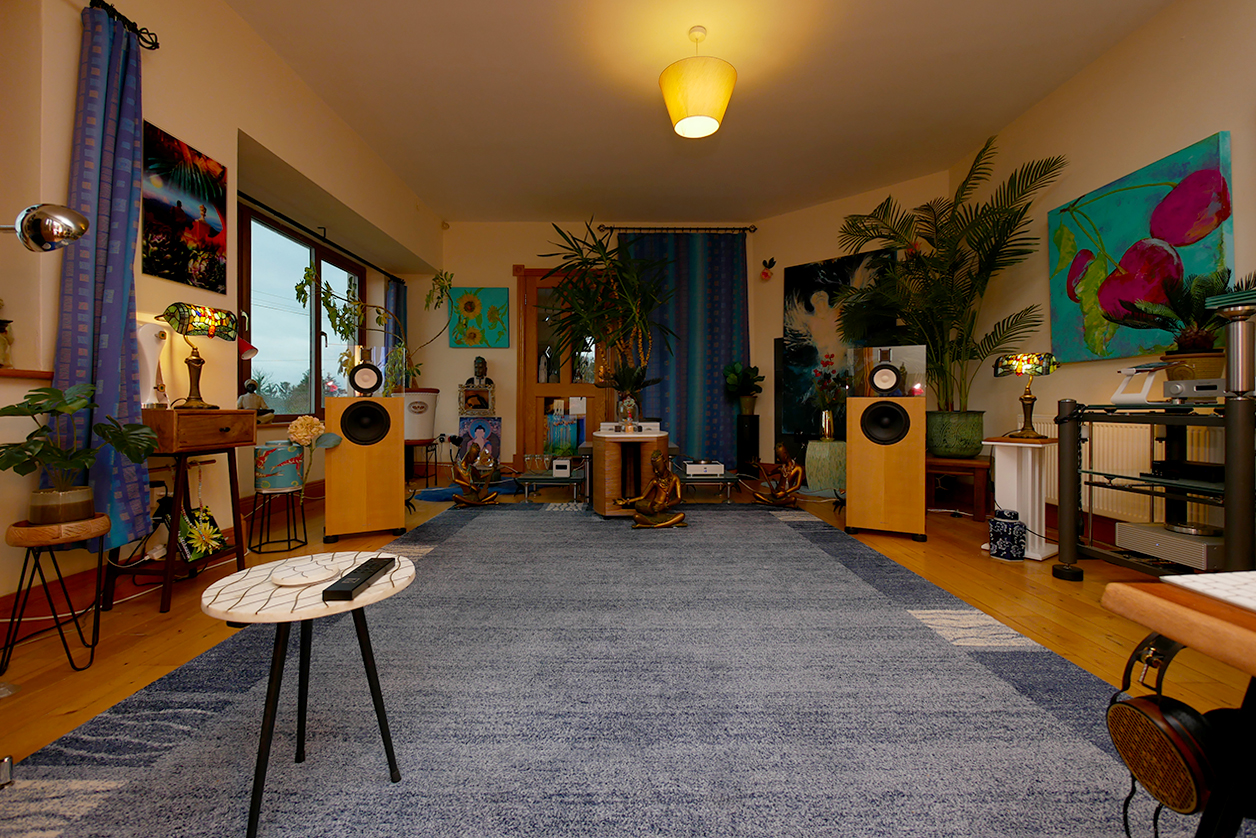
Instead our two Asian men with conveniently Western call names took a gamble on discerning shoppers with extra cash past the EX-P27 preamp and EX-M7 stereo amp or EX-B7 monos—S$5'796 or S$6'696 for the respective combos—opting for the one-box S$8'449 standard or Vinshine-sanctified S$10'998 Dazzle instead. This assumes a certain maturity that has already outlived then discarded initial indoctrination that two or three chassis are better than one. Banking on buyer maturity can be risky business when most salesmen exploit its absence. But Vinshine Audio's track record and educational YouTube channel promise the best possible infrastructure to have this gamble pay off. Hopefully this review shed its own useful light. The next photo shows how my main system would look were Dazzle to stay. The small box to its left is the active analogue crossover, the one to the right a high-power Ncore amp for the subwoofer. Considering a stereo 2.1 split with a passive sub, it's rather neat. Dazzle's deeply rippled optics also mirror my two Tai Hang power conditioners, another Kinki/Vinshine component and one which ended up on this year's shortlist of favourite finds.
Be my huckleberry? In the most primitive terms, beyond basic tonal balance I see the key fulcrum on which hinges hifi system tuning as the speed/comfort equation. Just as with cars tuned sporty or family, needs and preferences span the gamut from waterbed suspensions on one extreme to telegraphing each minor pebble on the other. I find the prospect of setting this balance very critical to personal satisfaction; and most easily upset when shopping for either extra RPM or cushy poundage. It's an endless tug of Tom stealing from Jerry rather than keeping things centred with equal pull from either side. If the image were a vintage weight scale of two suspended dishes moving a needle, perfection would mean a still needle whilst we keep loading up each half. The balance itself wouldn't waver yet we'd net more of our complementary usually mutually subtractive qualities; simultaneously. I tend to think that our perception has a very hard time not to equate more of one with less of the other. That said, replacing my 250-watt Kinki Studio EX-B7 monos with Dazzle in bypass barely moved the needle whilst adding noticeable comfort as hifi's stand-in for greater density, mass and gravitational anchoring. Frankly, I found this result quite miraculous. When something nips, something else always tucks. Add weight. In its shadow enters an injection of darkness. Add density. Watch transparency as the ability to see through complex mixes obscure. As you already know, Dazzle eluded this usual dance. If I can work out a payment plan to make the above setup permanent, I'll pursue it for 2026. If not, being dazzled in the present will transform into, once I was dazzled. Either way, what a memorable and impressive encounter. Though quite cheekily, it really is named to a 't'. It ain't pretention when true.









 Given my running subtext of vividity—better to be vivid than livid!—Laurence Dickie's South-African speakers actually brand as Vivid Audio. Having reviewed their smallest Giya model, I can attest to the naming's sense. How did these speakers manage their results? With low-mass enclosures for minimum energy storage; with matching membrane compositions across the bandwidth; with clever driver geometries to push breakup far out of band; with effective rear-wave absorption to eliminate cabinet resonance and delayed reflections through the diaphragms; with force-cancelling bass arrays. The sum of these solutions netted high speed, clarity, resolution and dynamic responsiveness. Whilst Dazzle's tuning vs the EX-B7 monos has loaded up on chunkiness, the Vivid Audio qualities clearly remain in play when we subtract the extra linestage gain. Once more, the bypass inputs are hardly the intended majority utility. Yet for this listener, they became a decisive difference maker. So kudos to Ivan Liu for including them for the occasional contrarian; or for those who loop in an HT pre/pro for shared television duties.
Let's wrap with six minor housekeeping details. 1, Dazzle's power mains is actually a standby button confirmed by a small white LED in the display. 2, Dazzle is mechanically 
 and electrically quieter than my EX-B7 monos which probably factored in retaining excellent resolution whilst building more body. 3, The footers are easily adjusted for perfect levelling. 4, As stated in the intro but worthy of repetition, these XLR inputs are mere convenience items. This is not a true balanced circuit. Hence the priority inputs 1-3 are on RCA as are the pre/ins. 5, If you do your best work in the dark, Dazzle's display currently won't black out in bypass mode, just shuttle between bright and dim. In bypass, each power-down also requires you to reset 'bypass' as your chosen input which can only be done by remote. 6, Dazzle lacks a pre-out for sub users. As I put it in the linked POTY feature, Dazzle belongs to the emerging breed of Chinese SuperFi. Whilst a loud forum contingent decries spending beyond entry/appliance-level dosh on Sino imports to reserve the posh for Euro, US or Japanese products, a quieter very selective minority shops beyond geopolitics. It's at them Dazzle grins suggestively. With China the biggest supplier of my various systems, that memo I incinerated long ago. Mission accepted.
The new wrinkle is that Sino fare like today's has already breached the top echelon previously off limits to it. Will that antagonize the old boys' club? I don't doubt it. Should it make them nervous? I'd say so. How many years will have to go by before this new membership registers broadly? I couldn't say. My work is about the hear/now, not future. However, I do know of one successful firmly established Chinese hifi designer and brand owner who already last year applied for US citizenship to there design and manufacture bona fide high-end products. Despite the current Trumpian hostility, he clearly believes that to sell successfully, such more upscale models beyond his current China crop must carry the made-in-America endorsement. Our alliance of Kinki Studio and Vinshine Audio appears to disagree; or at least prepared to put in the hard work and re-educate public perception. Secretly meanwhile they may still share the sentiment when Mr. Liu's 790/791 separates remain exclusive to the Middle Kingdom. In which case, might single-box Dazzle be the front runner preparing for their eventual arrival like John the Baptist?
If so, there's nothing eventual about Dazzle.
It has arrived. Get wet. Be baptized!
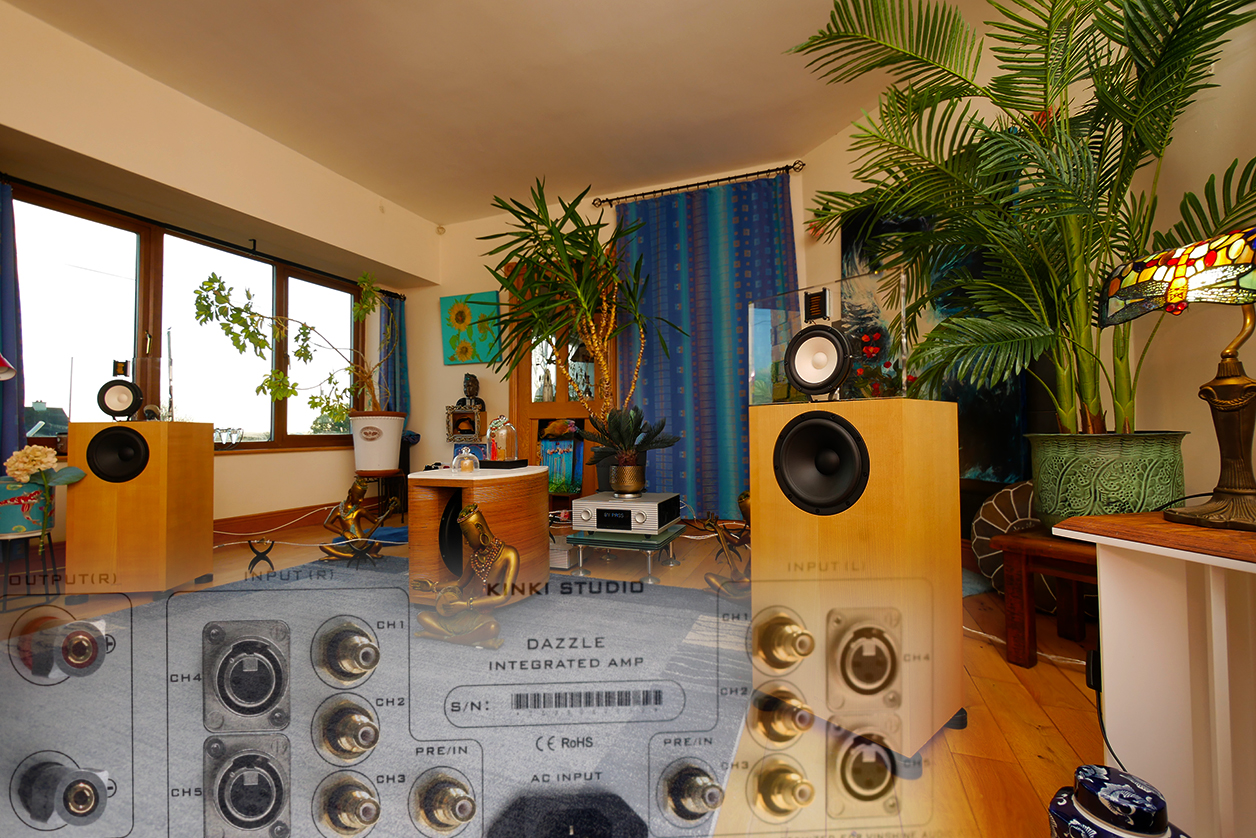
Postscript: Days after publication, readers asked whether Dazzle-level separates were already on Vinshine Audio's roadmap. Replied Alvin Chee, "I don't currently have plans to offer a stereo-amp version of Dazzle". Thus the bypass inputs I explored gain even greater validity because they instantly convert Dazzle into a classic uni-chassis power amp to decommission any rationale for a separate amp-only version to even exist. In scenarios where a fixed-gain amp is preferable, one can of course also run any of Dazzle's standard inputs then fix its volume control where its gain best matches the preceding preamp's or variable source's attenuator. ~65-70/100 is close to unity gain. Now the signal runs through Dazzle's preamp stage regardless of its volume control position. In bypass it does not. This gives power-amp scenarios a number of useful options of sonic consequence. And to finish off the sole hanging thread, a few days after publication I did pay for the sample to keep in this main system as shown. Going forward, I shall be dazzled daily. The EX-B7 monos have displaced the upstairs stereo amp, the latter moved into another system. You might say that it's all in the family now.