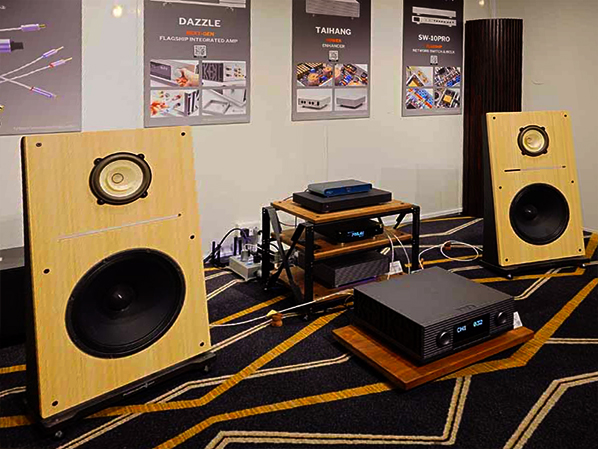
 Next-gen flagship integrated amp. It's what Alvin Chee's Singapore show poster called the Dazzle. In my little black book of past hifi dates, memory groups them into sundry sonic schools. I've always thought of Kinki Studio's aural aesthetic as a Chinese kin to Switzerland's Goldmund. The various Kinki kit I reviewed and still listen to was a step up from Goldmund's direct-selling budget Job gear. That repackaged bona-fide Goldmund circuitry a generation or two behind their most current.
German members of the same class were Ivo Linnenberg's €8'500/pr Liszt monos. Those I owned for many years before Kinki's EX-B7 monos upstaged them for less than half the coin. It's a lucid quick linear sound of high speed and airiness, not a warm thick enhanced backward-leaning type.
Since I've attempted to mirror the performance of Raal's ribbon headphones with loudspeakers, this Goldmund/LinnenberG/Kinki style really suits. It appears directly tied to wide bandwidth and the elimination of signal-path capacitors. It had me give away various pure class A amplifiers earlier this year whose sweeter slower fatter darker voicing no longer suited. Stumbling in Dazzle's specs across richer class A bias to 15 watts—that covers most my usage and certainly all small signals—I wondered. Does Dazzle signify a shift away from the established fast transient-defined arguably slightly cooler trim muscular tuning? If so, by how much?
After all, if next-gen suggests an evolution, an already quick sound further goosed could become a bit of a go-nowhere-fast caricature. Was the evolution about adding more weight and warmth without making for a less exciting less resolved ride? For reviewers and shoppers, there's just one way to know.
We must listen for ourselves. And though that remains true for the next stat, I actually would not sign up for Goldmund's Telos 800 stereo amp which at 240/375wpc into 8/4Ω costs ten times as much yet makes less power. In trade we get a 3'200VA transformer for twice the grunt; and 73kg for twice the weight. Knowing my wallet and coccyx limits—no thank you!—I'd opt out of that math no matter what. It's my way of saying that Dazzle sits right at the limit of what I can still manhandle by my lonesome. When my FedEx tracker arrived, it boldly proclaimed 67x65x37cm and 40.5kg.
At this juncture American reviewer Steve Huff's review dropped. Explaining why he purchased his sample, he lists four competitors which he considers as good or somewhat better, just not sufficiently so to his purse. Those four are the $28K T+A 3100HV; $20-25K Devialet Astra; ~$25K Enleum AMP-54R; and $15K Luxman 509Z. Taking names not prisoners, that's a telling list. To him, Dazzle makes a convincing argument against up to four times its own tariff. Because I rarely play in those league even if Enleum's European 54R reviewer sample was enroute to me just then, giving you Steve's specific challengers felt useful.








For power-worshipping transducers I had just the thing: Grzegorz Rulka's Virtual Hifi Cobra, a 9-driver stand mount two-way with response to 25Hz wrought from paralleled 7-inch Dayton Epique mid/woofers (compound 10" driver) handing over purely mechanically to six 7" matching passive radiators below ~60Hz (compound 15.5" woofer) whilst a tall dipole Mundorf covers the top three octaves. Crossover parts are top-level Mundorf/Jantzen issue, the cabinets monolithic 3D-print jobs lined with a rubber compound containing stainless-steel micro spheres. It's a totally OCD project shorthand for Optimum Concept Directive. My resident amp on them is Kinki's own EX-M7 so inserting Dazzle in power-amp mode on the shelf above it would make for my first comparator.
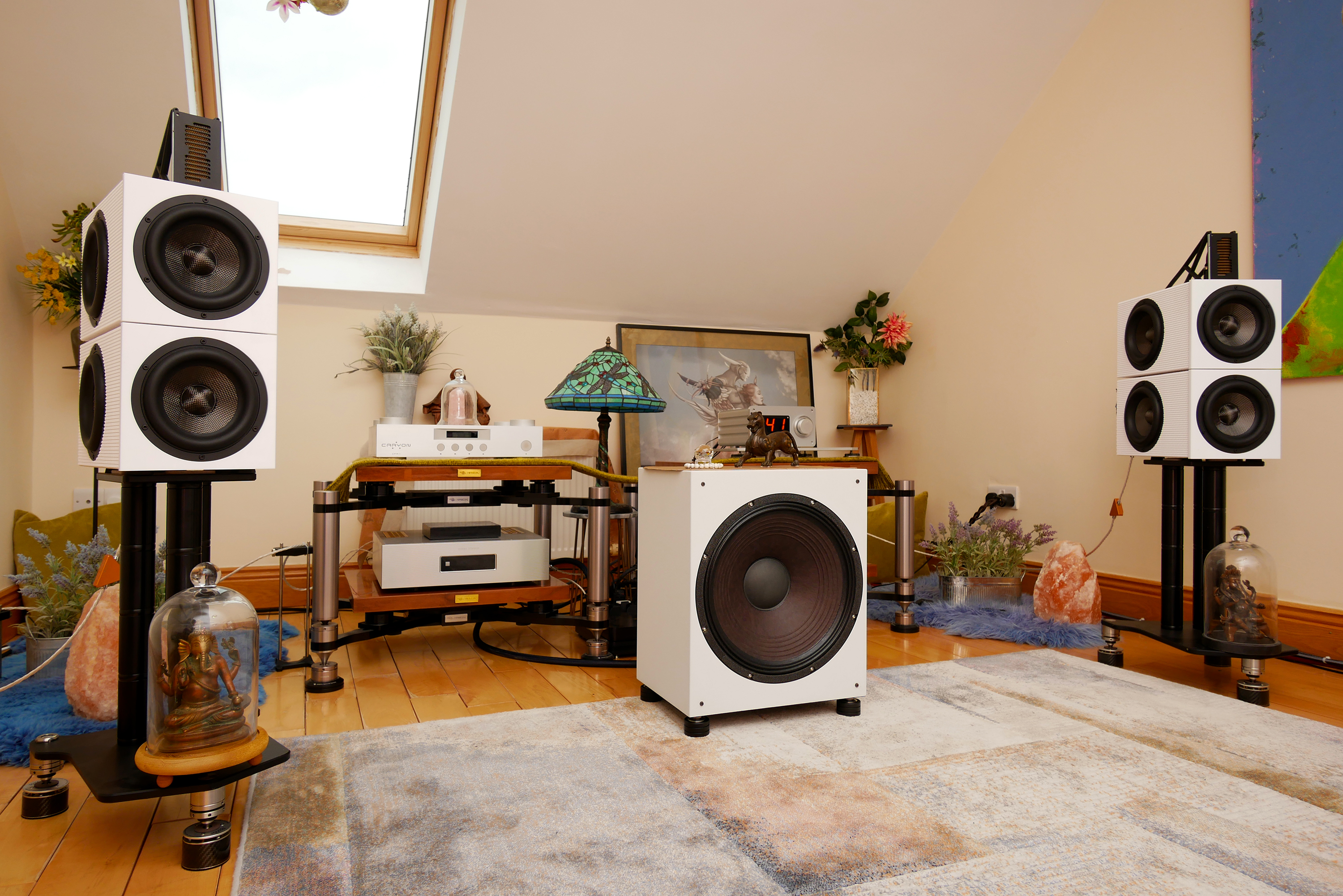

 About which, how does one select pre/in? Does it show up as an extra input on the display? "Power-amp mode is triggered by the remote control BYPASS button which then confirms as such in the display." Incidentally, this can't be done with the knob selector only by remote. So don't misplace it. What about the filtering⇒through toggle on the rear? With the built-in DC servo already nulling direct current offset on the power line, it's a switchable AC filter. Also, the power transformers cover 100-130V or 210-240V for some extra margin and the display brightness is adjustable with an IR metal wand. In power-amp mode, Dazzle's input impedance is 56kΩ, its input sensitivity 1.42V, voltage gain 23dB. In integrated mode, the latter is 36dB.
With these gain figures Kinki Studio's founder and chief designer Ivan Liu works very close to the unofficial standard whereby power amps run ~26dB whilst an onboard active preamp stage adds from 6-10dB: "My favourite amplifier brands include CH Precision, Goldmund, Nagra and Spectral." That's heady company. Ditto Mr. Liu's 76kg/ea. Stunning 791 mono with its sixteen Exicon Mosfets generating 600w/8Ω backed by a quad of 800VA power toroids and 88'000µF of capacitance. Against this evidence even in absentia, thinking of Dazzle as a flagship effort in the purely analog integrated space thus doesn't feel farfetched. How about in the heavy metal?
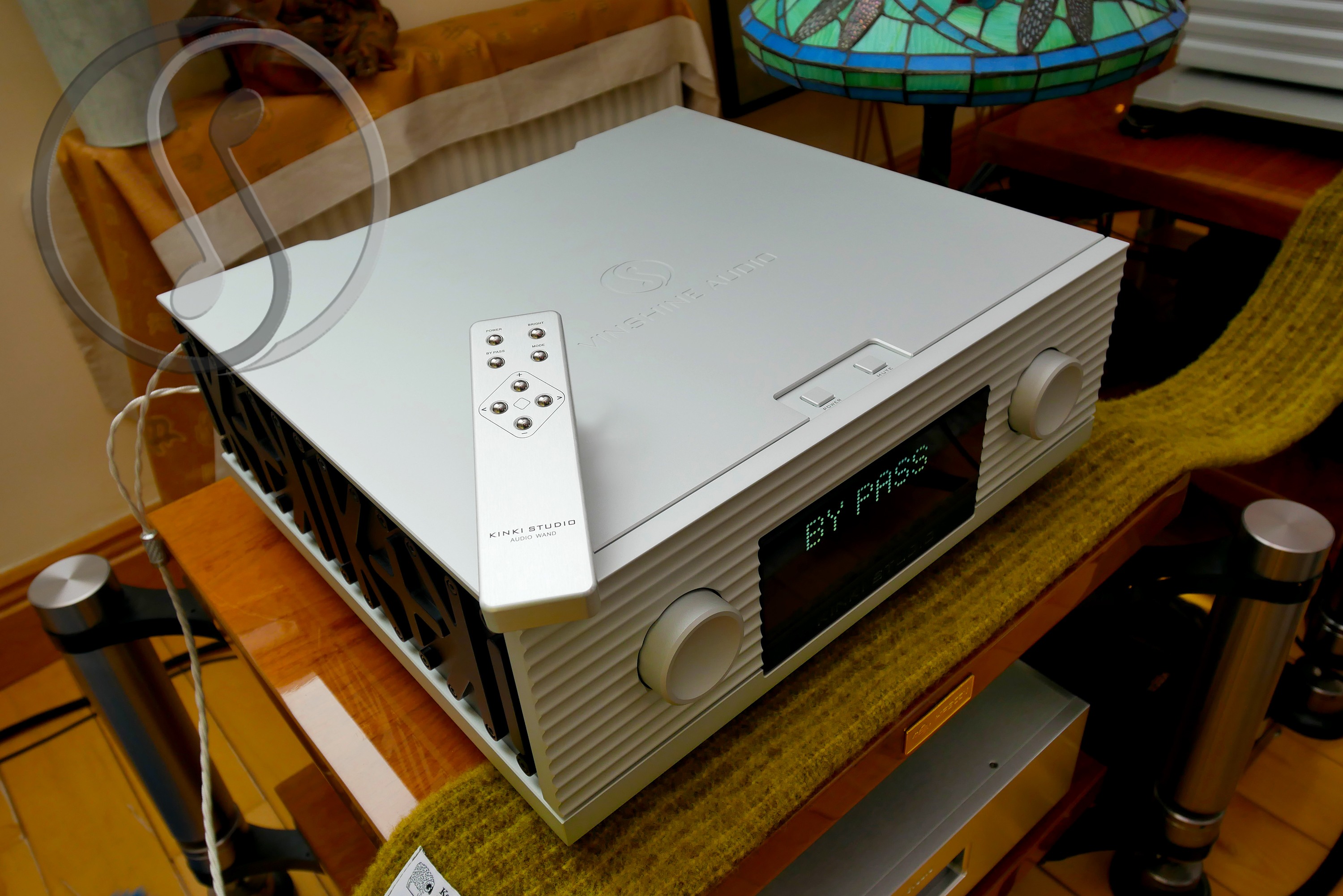
Not just via its extraneous spacer in this display mode did Dazzle recall Pass Lab on quality whilst finish execution arguably had the edge over Nelson & Co. The remote's bottom cover affixes by magnets so peels off without screw removal. We must provide two AAA batteries since shipping them installed is outlawed now. The remote buttons are captive spheres for a lovely touch. Strangely the dot-matrix display only features bright or dim in bypass mode but adds off for any of the regular inputs. Then only a small white LED in the centre of the display confirms power-on status. Via remote, the 0-100 volume steps stop at every 10 increments. Traversing the full range requires ten prompts in either direction. If the last setting was 34, one continuous press will get us to 24 or 44, the next to 14 or 54.