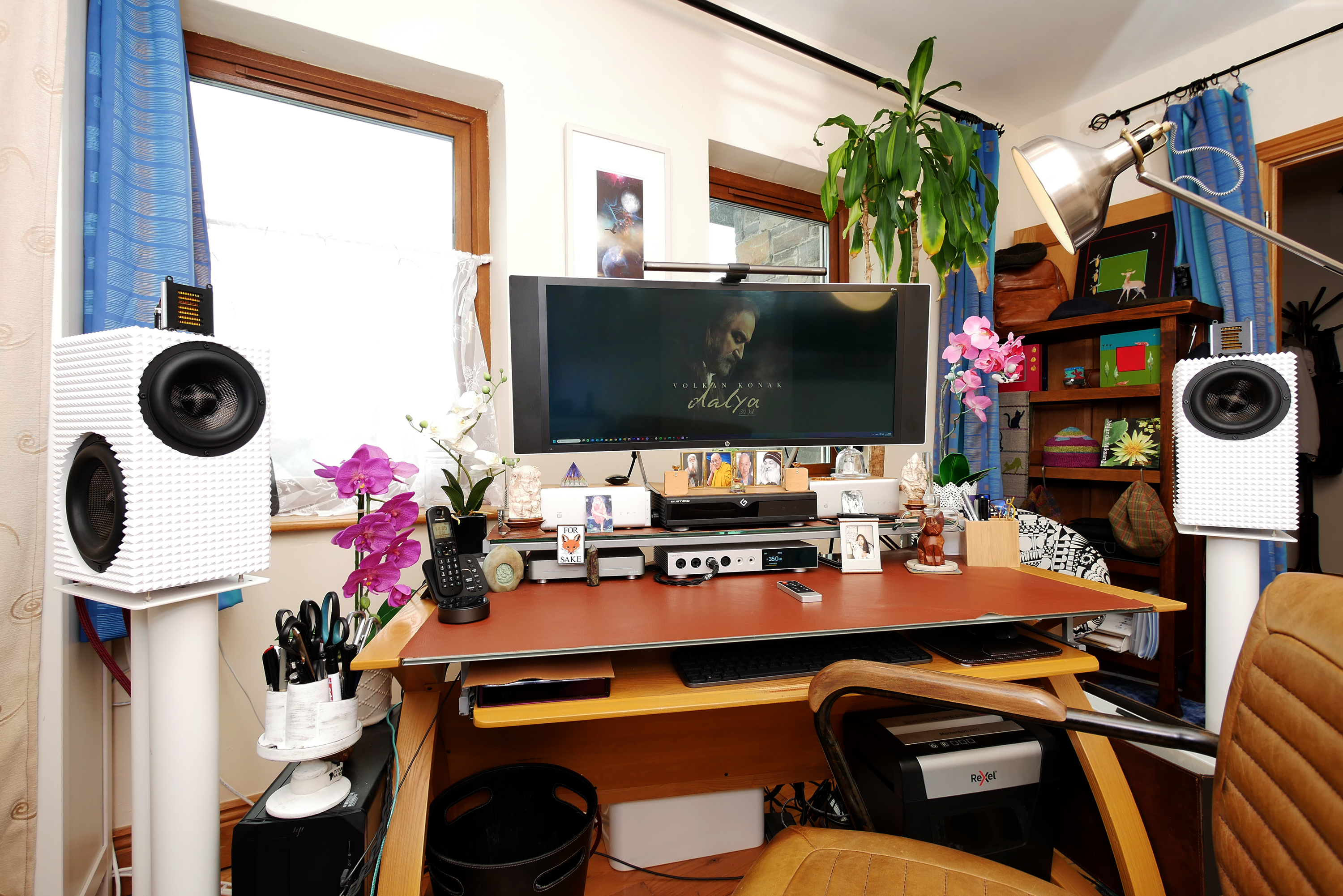
Topping the desk. The monitor shelf of my work desk offers exactly 73mm clearance before the metal crossbar supporting the tempered glass interferes. At 57mm, the A900 readily slipped beneath whilst its 330mm width precisely mirrored that of the Gustard R26II 25-bit discrete R2R DAC above. Even 200mm depth didn't overhang in the back or protrude in front. Dimensionally, this ¾-width lowrider should work on many a desktop though the mains rocker does live on the back adjacent to the universal power IEC. Most keyboard warriors won't use that power switch and instead the standby function on the wand or master controller.
As we learn in the manual, the various i/o are under menu control so can be individually deactivated to remove those we don't need. This flexibility includes running the pre-outs and some/all of the headphone ports simultaneously; or not. The display can run a home screen showing the active input and output/s, gain, volume setting and level meter; an FFT screen for dancing comb teeth in different colours; or a classic orange VU meter.
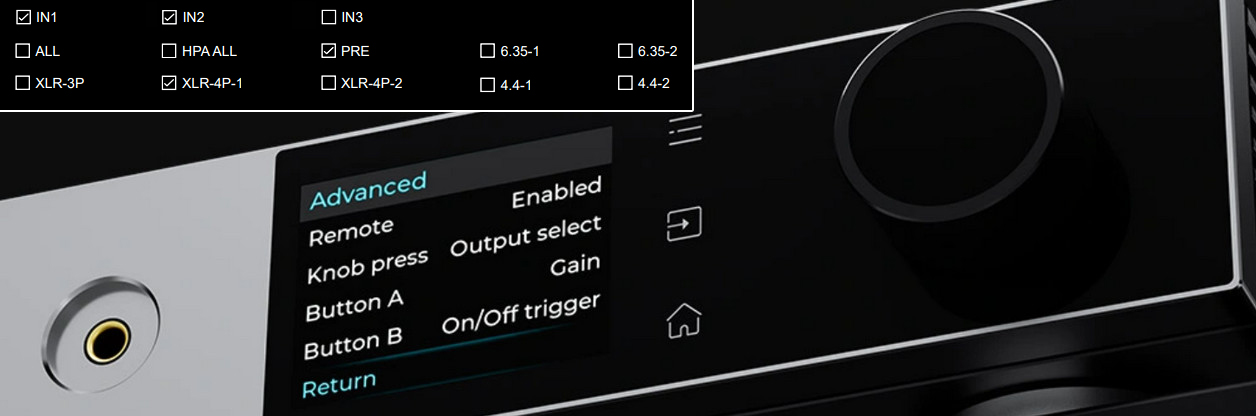
The remote's A/B buttons—its CR2032 coin battery doesn't include—can be configured to trigger whatever particular two settings we want to access directly¹. The C1/C2 buttons can capture any current setting combination (i/o selection + volume + gain) with a 3-second hold for then instant recall. The attenuation steps can be 0.5/1dB, display brightness low, medium, high or auto off. The A900 can remember our last volume/gain setting and restore it when we reselect that channel; customize a safe volume range anywhere between -80.0 to 0.0dB. Further adjustments set the 0dB reference voltage for the FFT screen (2/5/10Vrms) and VU meter. To check our current firmware requires a secret handshake. In standby we sequentially push the back, next and mute buttons on the remote. If that shows a lower version than Topping's download page for this model, we use the USB-C port to install the newer firmware. The last 2025 update merely fixed certain display-related bugs so had no sonic effect. My 2026 sample already came with the most current version.
________________________
¹ I defeated all inputs except 1; and all outputs except pre-out and XLR4 1. Then I made button A the output selector to quickly switch between headfi and speakerfi; and button B the gain selector. Most convenient!







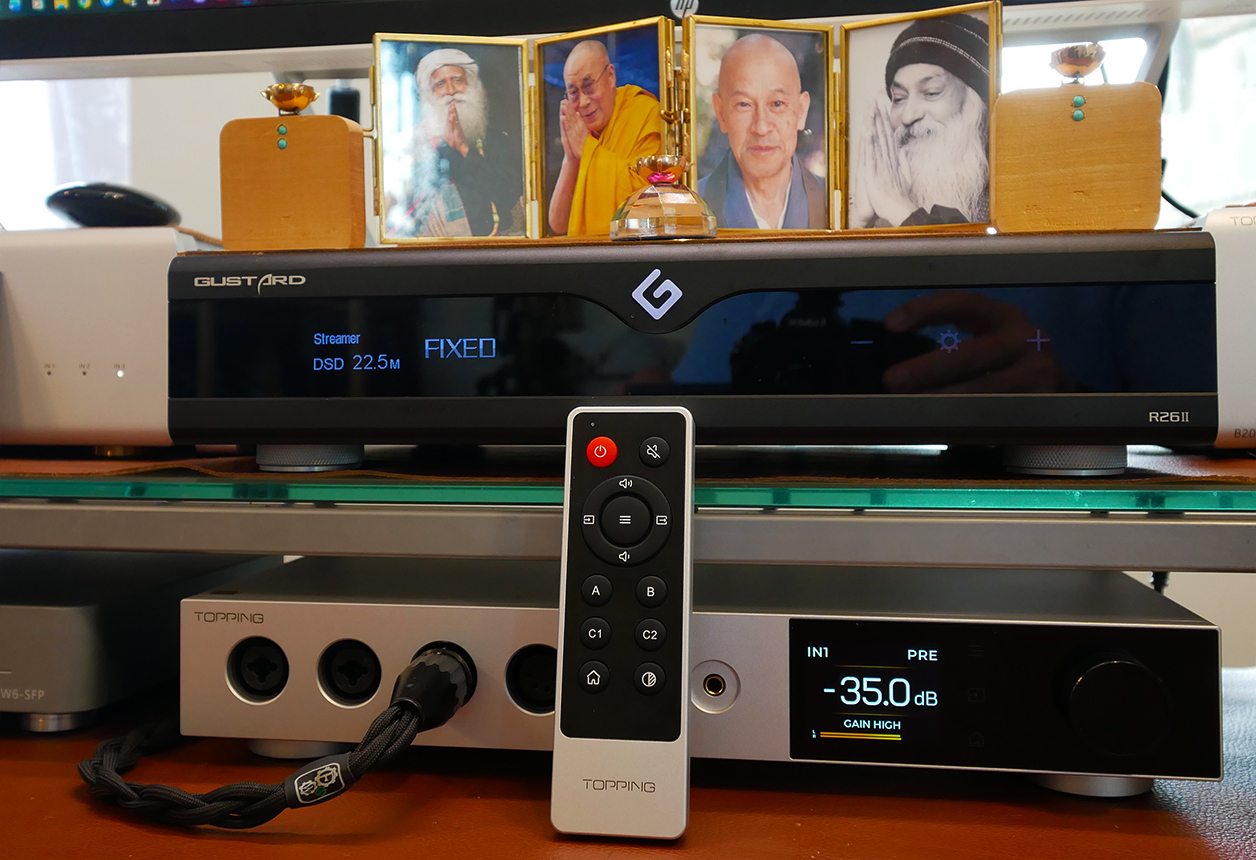
 Topping off. My B200 monos operate in low gain for greatest S/NR. For my desired nearfield SPL into 83dB monitors, the A900 could run in its own low gain nearly maxed out; in high gain at -35dB; or in medium gain in-between. Low gain was brightest and hardest overall; as though perhaps applying the highest negative feedback. In any case, as shown next I preferred high gain in deeper attenuation. The overall gain topology of all my rigs has my majority volume at minus 30-40dB below unity gain. It's why three of them avoid classic preamps in favour of advanced autoformer passives. On my desktop, the R26II DAC includes passive ladder-on-a-chip analog volume. It can easily run amp-direct. Unlike my bigger systems, here I simply favour a preamp. The A900 confirmed said preference. Over DAC direct the sound gained gumption & gravitas, vim & vigor. In my setups built around passive-magnetic attenuation, active preamps tend to gelatinize, obscure and slow down. In the office meanwhile, the A900's benefits on the 'g+v' score, in high-gain active mode, came without trade-in losses of energy or resolution. It just wasn't as juicy as the thrice-priced FangSound Dionysus so drier or more matter of fact; a fab quality on Natasha Atlas' "Yeranos" when after three minutes beat and bass show up to set up the slinky lounge groove. From FangSound designer Zheng Jinquiang, "Dionysus required nearly four year of development. Our first challenge was technical stability. The amp employs a complex nested multi-feedback topology. Its stable operating window is extremely narrow. This required extensive prototyping and repeated refinements. The second challenge was sonic character. Heavy feedback can reduce distortion on paper but may also suppress dynamics, tone density and natural flow. It can result in a grey, emotionally distant presentation. It took us nearly two years of listening and adjustments to achieve our desired balance. We optimized not only through circuit refinement but careful parts selection, mechanical damping, vibration control and connector quality." Whilst its only supposition, I suspect that past achieving their core tech parameters, this overtime Zheng Jinquiang's team spent on critical listening to modify details of their technical execution far exceeded what Topping applied. Conceptually the multi-stage nested-feedback A900 belongs to the same crew on a parallel route of ascent but the FangSound Dionysus—as well it should for €3.5K—gets us far closer to the peak.
That assessment felt most apt over headphones. Between my office's aune SR7000, FiiO FT7 and Unveiled versions of HifiMan's HE1000/Susvara, the A900 minimized familiar differences to have them sound more alike; extreme fit bodies all graduated from the same gym. Reaching for an admittedly price-exploding reference in Enleum's AMP-23R highlighted this effect in stark relief. Over the Korean's less rigid damping and more advanced voicing, the individual tuning personalities of my loads reasserted themselves. Music unthawed into free flow. Bass gained a dancing elastic quality to abandon the A900's more military-parade mien. Whilst ideal for crisply cracking EDM, the marching-band aesthetic foreshortens decays. Ring-outs loosen our musical weave with air gaps to inject a sense of buoyancy and breath. This observation doesn't deny the A900's fantastic resolution and linearity. It merely points at a relative lack of gush factor or textural generosity. To overwrite for effect, it puts our musical stage actors into straightjackets. That's a feel/flow not amplitude, detail or imaging quality. This parameter expressed itself instantly when I switched to the AMP-23R. Given my Viper's innate voicing for warmth, density, dynamics and tone-colour intensity, the A900's overdrive didn't distract me as much in preamp mode as it did for headfi.
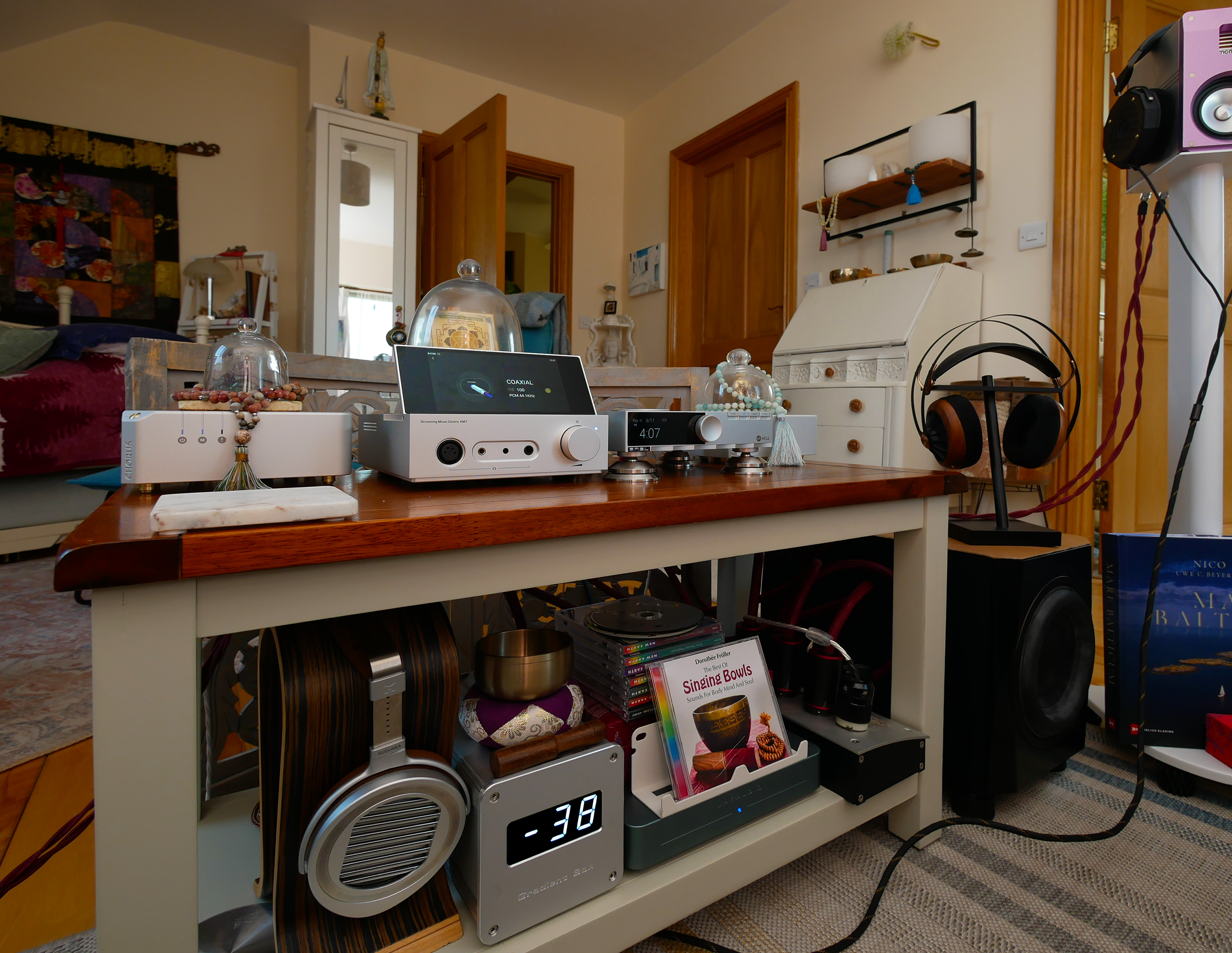 Shanling fronted by smsl PL200T CD transport reclocked by 50Ω/10MHz LHY external master clock.
sTopping short. One needn't involve Enleum to make the case. At just ~€500 past the A900, Shanling's EM7 offers 7wpc/32Ω power to readily airlift Susvara & Co. For the upcharge it adds LAN and 2TB microSD streaming, AKM-based D/A conversion, fixed/variable outputs and a full-colour tilt touchscreen to navigate/access a local or cloud library. Whilst neither claiming nor aiming at extreme Topping specs, Shanling who also build for Onix and YBA are sonically more evolved. Off the A900, my EM7's tuning well more than halves the AMP-23R distance. This settled my earlier curiosity over whether my ears would concur that 'perfect' measurements equal ideal sound. My pink bits are stubborn customers. When they don't feel the gut-level luv, they close off to slick arguments of technical superiority. Though my B200 monos do ideally match my desktop needs due to my particular inefficient but 'enhanced-mode' speaker profile, today's showing suggests that whatever sonic corner Topping already turned against their earlier œuvre, more corners await. That's my conclusion. Though the A900's three 'f' of fit, finish and featurization truly impressed not just for the price, at heart this component struck me as a somewhat hollow exercise in speculative braggadocio. Topping refer to this as an ultra flagship. My ears torpedoed that lofty status. So I shan't revisit this brand too soon. I'll give them time to catch up to their domestic competition at Gustard, LAiV and Shanling. Already licked are manufacturing, industrial design and measurement-led circuits. What to me still needs more attention? Careful listening whereby an extreme distortion-cancelling cure isn't allowed to get worse than the presumed disease of normal measured imperfections¹.
_____________________
¹ There are different design philosophies. For example, Nelson Pass and Luca Chiomenti—of Pass Labs/FirstWatt and Riviera Labs respectively—favour simpler circuits of fewer gain stages whose innate behaviour requires little to no feedback whilst their THD profile corresponds to research into human hearing rather than pursues records with inanimate oscilloscopes. Horses for courses. If you enjoy knowing that your hifi's measured performance pings even represents the state of the art, Topping seem to be the go-to-brand for more modest budgets.