
Country of Origin

Reviewer: Srajan Ebaen
Financial interests: click here
 Main system: Sources: Retina 5K 27" iMac (i5, 256GB SSD, 40GB RAM, Sonoma 14), 4TB external SSD with Thunderbolt 3, Audirvana Studio, Qobuz Sublime, Singxer SU-6 USB bridge, LHY Audio SW-8 & SW-6 switch, Sonnet Pasithea, LAiV Audio Harmony; Active filter: spl Audio Crossover MkII; Power amplifiers: Vinshine/Kinki Dazzle & mono Ncore 500 Nord Acoustic amps on subwoofer; Headamp: Enleum AMP-23R; Phones: Raal 1995 Immanis; Loudspeakers: Qualio IQ [on loan] Cables: Exact Express Flame, Furutech; Power delivery: 2 x Kinki/Vinshine Tai Hang on amps and source stack, Furutech DPS-4.1 between wall and conditioners; Equipment rack: Artesanía Audio Exoteryc double-wide 3-tier with optional glass shelves, Exoteryc amp stands; Sundry accessories: Acoustic System resonators, AudioQuest FogLifters; Room: 6 x 8m with open door behind listening seat; Room treatment: 2 x PSI Audio AVAA C214 active bass traps
2nd system: Source: FiiO R7 into Soundaware D300Ref SD transport to Cen.Grand DSDAC 1.0 Deluxe with POW; Preamp/filter: Lifesaver Audio Gradient Box 2; Amplifier: Kinki Studio EX-B7 monos; Loudspeakers: ModalAkustik MusikBoxx; Subwoofer: Zu Method; Cable loom: Exact Express Earth; Power delivery: Vibex Granada/Alhambra, Akiko Audio Corelli Corundum & Castello Solo; Equipment rack: Hifistay Mythology Transform X-Frame [on extended loan]; Sundry accessories: Furutech cable lifts, Furutech NFC Clear Lines; Room: ~3.5 x 8m
2nd headfi system: DAC: Cen.Grand DSDAC 1.0 Deluxe with POW; Headamp: Cen.Grand Silver Fox; Headphones: Raal 1995 Magna, HifiMan Susvara
Desktop system: Source: HP Z2 workstation Win11/64; USB bridge: LHY UIP; Ethernet bridge: LHY EFI; Ethernet reclocker: Stack SmoothLAN; DACs: Audalytic DR701 & Gustard R26II; Headphone/preamp: FangSound Dionysus; Speaker amps: Topping B200 monos; Loudspeakers: Virtual Hifi Viper; Headphones: Final D-8000, aune SR7000, FiiO FT7
Upstairs headfi system: FiiO R7; Headphones: Meze 109 Pro, Fiio FT3
2nd upstairs speaker system: Source: FiiO R7; DAC/pre: COS D1; Amplifier: Kinki EX-M7; Loudspeakers: sound|kaos Vox3 with Dynaudio S18 subwoofer
2-channel video system: Source: Oppo BDP-105; All-in-One: Gold Note IS-1000 Deluxe; Loudspeakers: Zu Mission; Subwoofer: Zu Mission; Power delivery: Furutech eTP-8, Room: ~6x4m
Review component retail: €1'089
 |
 |
 |
 |
 |
 |
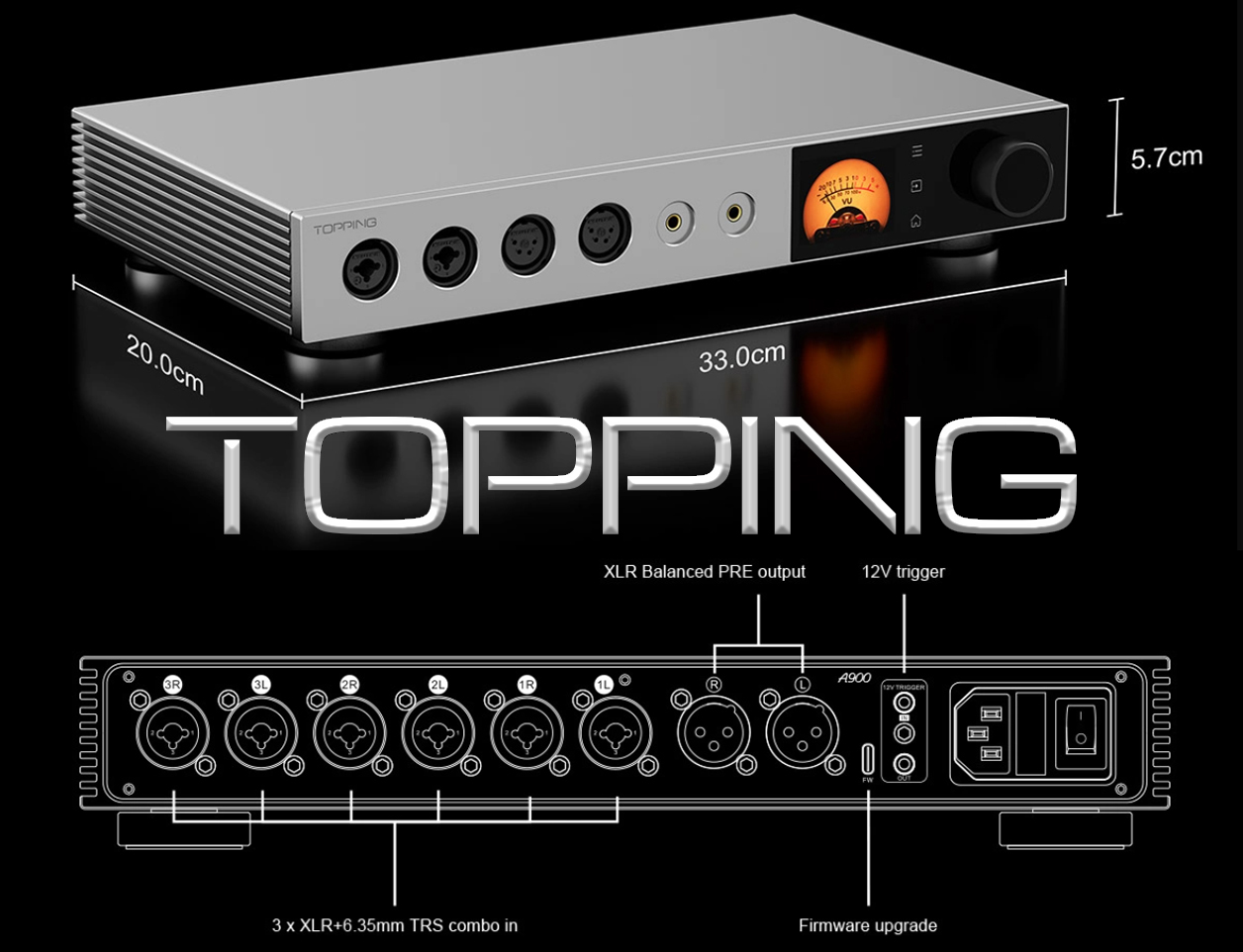
Topping off. This Chinese brand with a strong budget focus has great pop with the oscilloscopes at AudioScienceReview. It's because their extremely shiny measurements confirm Topping's own. When perfect measurements equal perfect sound, ASR propose that naught but Topping is required; that in fact anything costlier but measuring worse is for dunces. Romania's Sandu Vitalie of YouTube review channel SoundNews has covered much Topping gear in the past. Last year I came across one of his videos in which he opined that finally someone at Topping had started listening to advance beyond raw measurements. To his ears their designers had turned a sonically significant corner. Encouraged I'd surfed over to Audiophonics.fr then bought myself a €1.2K pair of Topping's class AB B200 monos for my desktop. With my Virtual Viper monitors from Poland's Grzegorz Rulka deliberately and gloriously voiced, I meant to front them with invisible drive of max resolution so micro noise. In this context, Topping's complex nested feedback embedded in multi-stage discrete circuitry performs exactly as hoped: quick, lucid, well damped and keen as a tracking bloodhound on the trail of faint memory puddles—which is what scent remnants of a passerby from days even weeks ago seem to be. Would these amps sound dry and overdamped on very neutral speakers? Possibly. I got them for very specific warm and dense loads and never tried them elsewhere. Tool. Job. Because the Viper valse was so victorious, today we look at my amp's natural companion. It's the ambitious A900 head slash preamp. What makes it ambitious? Specs.
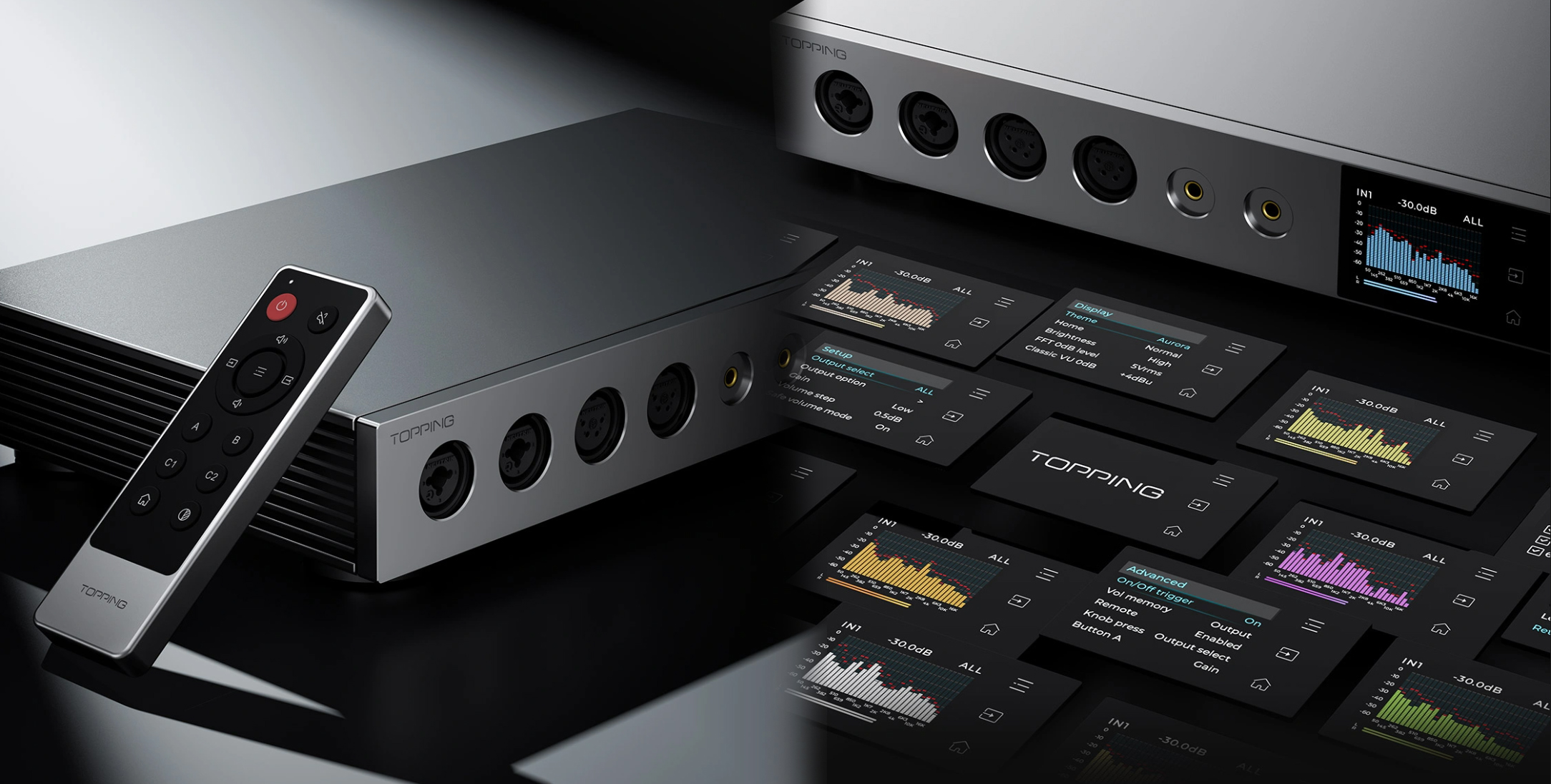
We're still in topping-off land after all; "ultra-flagship" territory in their own words. 6-channel fully balanced circuity duplicates the 3-stage feedback concept of my monos. Here it nets a claimed 22wpc/16Ω or 14wpc/32Ω headphone drive with a micro 0.1Ω output impedance then record-shattering 151dB of S/NR and <0.00003% THD across the audible bandwidth. There's a 2-inch full-colour display, a multi-purpose control knob with menu-nav functionality and a plethora of connectivity. The front rocks six headfi ports, two of them combo 6.3/XLR3 jobs¹, two classic XLR4 and two 4.4mm balanced. The rear panel flies three pairs of 6.3/XLR3 combo jacks and one pair of 100Ω XLR outputs, a 12V trigger loop, USB-C for firmware updates and the ubiquitous 100-240V power IEC. A full-metal IR remote comes with. The R2R volume control with its relays claims crosstalk reduction of -153dB and precise 0.5dB steps. The isolated power supply is a switcher. To really rattle your brain with off-world specmanship, go here. Even bandwidth pursues ±0.1dB conformity to the straight 'n' arrow; from 20Hz to 200kHz. 3-stage gain duplicates across the headfi and pre-out paths at -0.1dB for low, +10.3dB for medium and +19.8dB for high. We could thus run the A900 as a passive albeit fully buffered preamp with fixed i/o impedance; or low/high-gain active. In a calm moment of introspection after feeling all sweaty over such whiz-bangery on the score cards, you might wonder. I certainly did. How does one even measure a signal-to-noise ratio of 151dB? The answer is, one doesn't; not directly. One infers it: "The actual noise level is obtained by boosting the noise of the A900 by 40dB using a low-noise amplifier in front of the APx555B oscilloscope then dividing the measured noise by 100."
___________________
¹ In our home-audio space, these 6.3mm connections require a single-ended cable with ¼" plug on one end and RCA on the other.








Could I apply that trick to measure my listening pleasure? First boost pleasure by 20C°, then cool it back down in the fridge for 15 minutes before counting the goosebumps? Let's not answer that. It's too silly when the A900 is perfectly serious about ultra-low distortion and noise in a compact stylish case without appending a high-end tariff. With Susvara OG and Unveiled plus Raal 1995 Immanis and Magna in the house, I even had the right stuff to tap into the onboard juice bar with a bigger glass. To be fair, 3wpc/32Ω tend to be recommended for these loads. That makes the A900's headroom seem excessive though more demanding headphones like the ModHouse Tungsten should dig deeper into it. At least technically it makes the A900 a reason for every season; even parallel drive of multiple cans at once. But would my ears concur that 'perfect' measurements equal ideal sound?
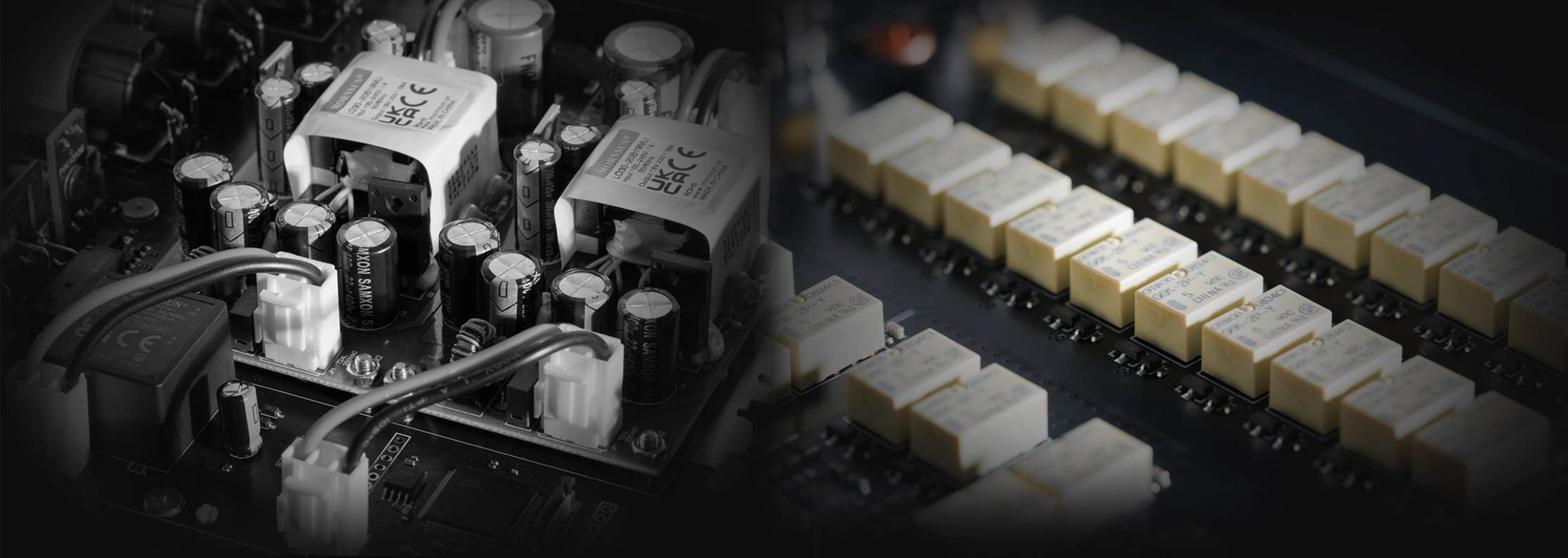
As Shunyata have their Everest power conditioners and FangSound their 40wpc/32Ω Kunlun circuit named for a high mountain range in Western China that's believed to be the abode of Taoist deities and the meeting point of heaven and earth, Topping named their latest 3-stage nested feedback topology after a mountain range. Their chosen topography is T'ang-ku-la situated in the centre of the Qinghai-Tibet plateau. In Tibetan, tanggula means a mountain so high that an eagle cannot cross it. This vast range stretches across 150km and its main 6'621m peak Geladandong serves as the primary geographical source for the mighty Yangtze River. That's quite the godfather for a hifi schematic. In Topping's œuvre T'ang-ku-la replaces their prior NFCA circuit. One stated distinction is that the new version runs much cooler to be more efficient. Less heat usually bodes well for longevity and thermal drift. Nested feedback of multiple local loops inside slaved gain stages which then all embed inside a global loop is common in operational amplifiers. Might we say that Topping's circuit is likely a kind of big discrete opamp? When details are so sparse, guesswork is our only option. This image from a Korean website better shows the twin Mornsun not MeanWell switch-mode power supplies; the relay-switched resistor ladder for volume control; a central narrow but long heatsink covering up hidden parts; plus the three balanced T'ang-ku-la modules. For more 3rd-party context not from ASR, take a look at Paul Miller's lab report of the companion DAC for HifiNews: "The core technical performance of Topping's D900—S/N, distortion and low-level resolution—nudges at the state of the art alongside Chord's Dave [HFN Apr '16], the Mola-Mola Tambaqui [HFN Nov '19] and dCS Varèse [HFN Feb '25]. However, at the price, the D900 has no technical peers." Incidentally, that price was £1'799 when said review published earlier this year. Dave wants ~€12K, Tambaqui $13.5K, the five-box Varèse system £217.5K. Whilst the review did not even remotely claim that the D900 matched them sonically, its measured performance did get within kissing distance—far closer than spitting. Topping clearly know a few things about advanced yet cost-effective engineering.

12
