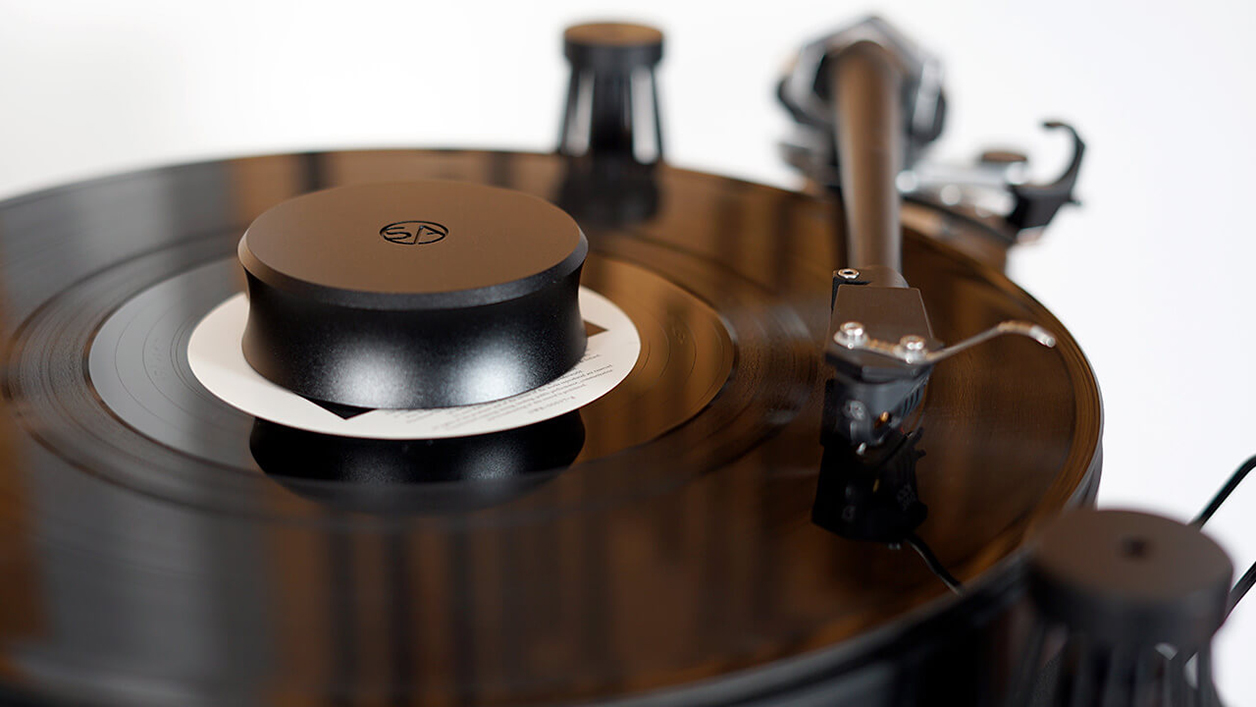
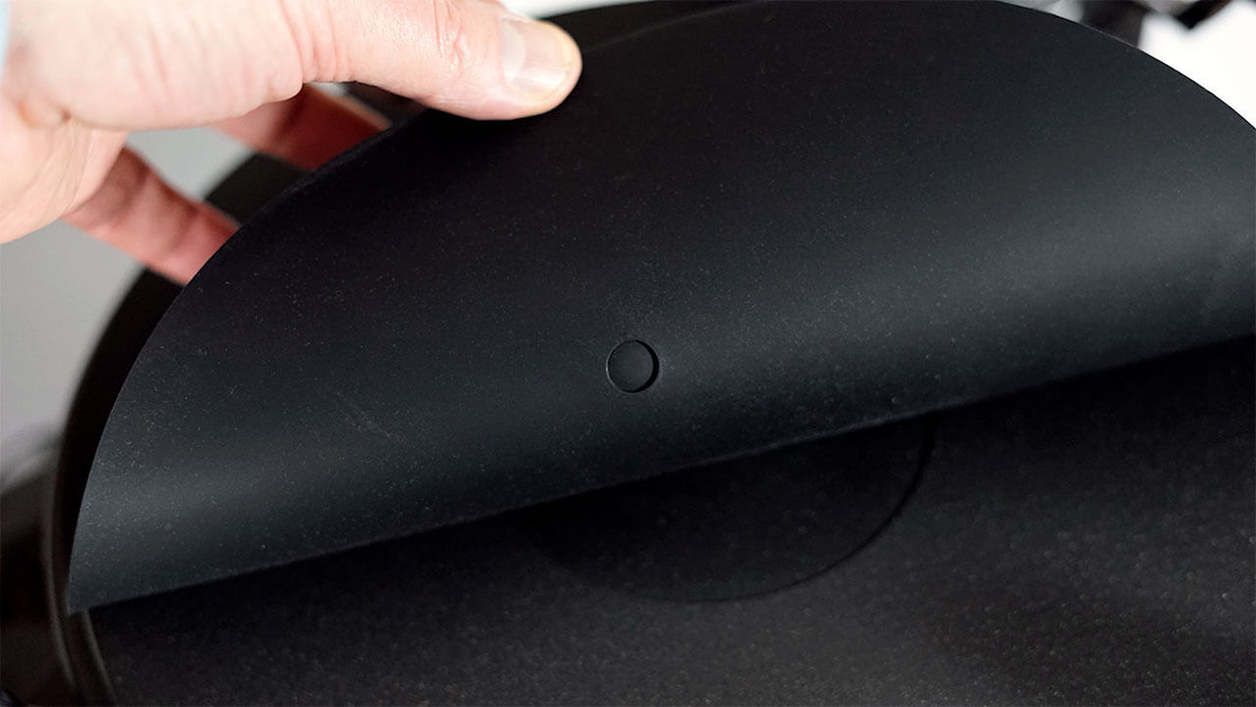
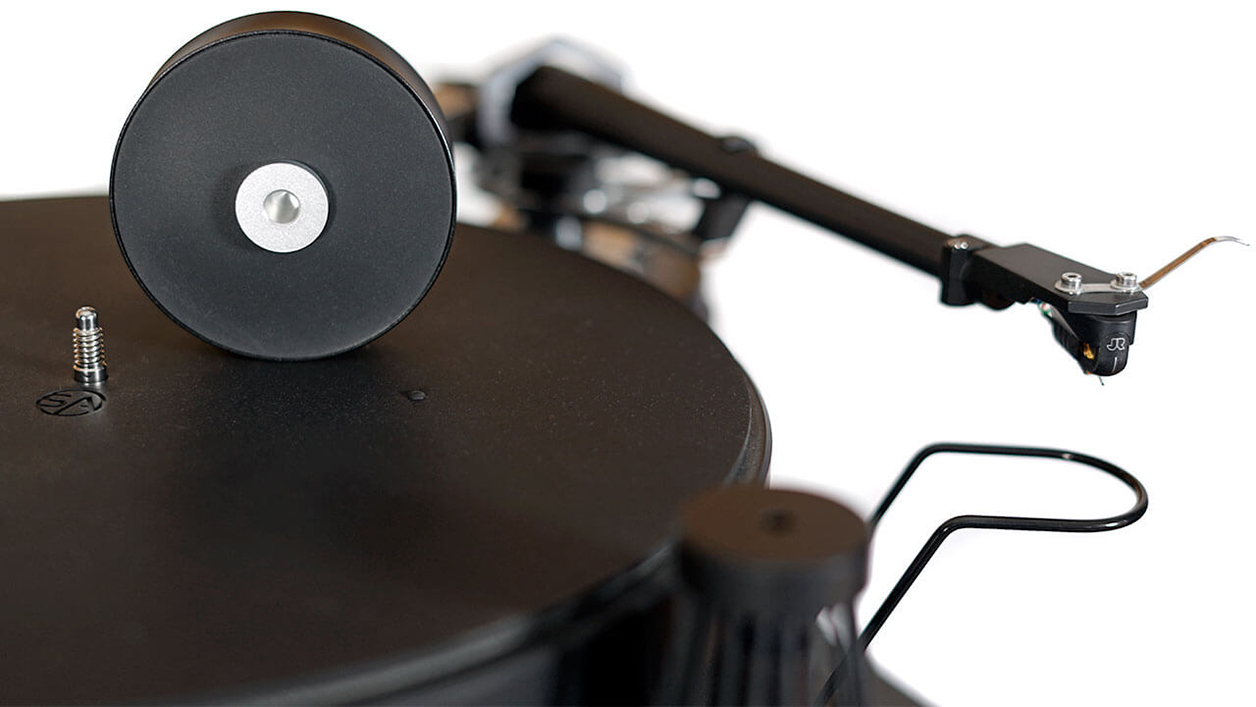
Listening tests 'n' comparisons. Before I get to listening impressions, a few more notes. The Serene Mat is compatible with record weights up to 500g. Record clamps should not be used. The reason is easy to understand. The mat’s MO is its spring action. Too much weight prevents the nubby springs from working as intended to undermine the entire concept. Second fact, the mat is three mill thick. If you've previously DJ'd without a mat or used a very thin one, you should adjust VTA. Otherwise you'll hear the effects of the adjusted vertical tracking angle rather than Stack mat. There's something else with the Stabiliser. Its spindle bore is 14mm deep. There are a few turntables with longer spindles which could be a problem. My SME Model 15's is actually a millimetre longer. Now the stabilizer floats slightly above the record label. The sonic effect is still clearly and distinctly positive and together with the Mat, the stabilizer lies flush with the label anyway since the mat reduces relative spindle height by 3mm. However, if you have a turntable with a really long spindle, I don't think the Serene Stabiliser will be useful. It's better to measure beforehand. Now I placed the Serene Mat on the platter, adjusted VTA, put the record on and the stabilizer over the spindle. Hmm, tonally it sounds just like I know, overall pretty great. But doesn't it always? In fact, I hadn't listened to records for a few weeks because unfortunately, the everyday life of a reviewer is far too digital. So I give myself a few albums to get re-vinylized, then it's time to remove the Serene Stabilizer and use the bare platter. Once again I'm left looking stupid because this is pretty intense. "How can such cheap parts make such a difference?" my inner snob complains. A dozen conversion sessions later I have a better idea of what's going on. First off, both tools do essentially the same thing, although the effect of the Stabilizer seems somewhat more pronounced than the Mat. As I heard correctly from the get, tonally nothing shifts with either Stabilizer or Mat. I find the latter particularly pleasant because I worried that such a thick soft mat would drown out the highs a bit. Nothing of the sort. Those are as balanced as with the bare platter or my standard solution, the ~€130 Optimatte-I from Dereneville made of very thin silicone fabric. But beyond that, similarities end.
 There are essentially three improvements that caught my attention. The most noticeable is the imaging quality. Individual voices and instruments appear a little more compact, less wide. In turn they have more precise edging and depth. In other words, the 3D impression or plasticity improves. Be it the "Men with many Guitars" by Howe Gelb and a Band of Gypsies' Alegrias or the "Woman with a Cello" by Leyla McCalla from Vari-colored Songs, the vocals now have a better grip and string instruments clearer definition to be less smeared at the edges if you know what I mean. Everything becomes a little more concrete, more tangible. And that's also the case with less handcrafted music. I grab Underworld's Oblivion with Bells. What is that actually, old-school house? The bass beat seems more clearly defined, more accurately placed. So it is with all the sound effects on the album. It's as if autofocus had finally taken hold. One more thing. This beat also seems dynamically sharper. It's possible that the overall macrodynamic thump comes across slightly more massive without Stack Audio's little helpers so strictly speaking, less controlled so slightly more bloated. With the Mat and Stabilizer, things are more impulsive. The attack phase seems exposed to come on more sudden. You notice it even more clearly in the midrange especially on plucked strings. It's primarily a gain in microdynamics. Once you've heard it, you won't want to go back. Something also happens to the sense of space. My impression is that depth layering comes across more clearly. On the one hand, because individual sounds portray more focused with more accurate bordering, you don't have to listen around them as much to discover what's happening behind them if you can relate. On the other hand, the space between performers seems emptier. The term blacker background is appropriate. There is more calmness between the sounds. This not only makes their contours sharper, their relationship to one another is somewhat clearer, too. While I hear the main benefit of the Stack devices in terms of microdynamics and imaging precision, I'm also happy with the small improvement in depth layering.











I'm not familiar with every turntable mat in the world but compared to my loose collection of felt, leather, rubber, cork and silicone mats, the Serene Mat from Stack Audio stands out favourably. It doesn't shift the tonal balance but creates a more dynamic finely detailed sound with more precise three-dimensional images. There's also a gain of transparency in depth layering. I can't detect any sonic drawbacks but there are practical considerations. If you can't adjust VTA of your tonearm, the three-mill thickness of the mat could counteract the result. And if you absolutely must use a really heavy record weight or clamp, that clashes with the Serene Mat's concept. The Serene Stabiliser however is a perfect complement, offering the same sound improvements on an even greater scale. There's also something to consider with the stabilizer. The turntable spindle shouldn't be significantly longer than 14 mill, otherwise the Serene Stabiliser will float and its particle impact damping not work properly. You also need to use something else for warped records. I certainly won't throw away my record clamp which does a better job where the Stabiliser is too light 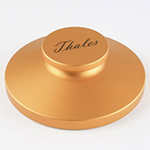 to properly mass-load vinyl to platter. However, the majority of my records are fairly flat and the Stack Audio Serene Stabiliser makes a noticeable improvement and the trend is toward secondary weight anyway. Ultimately as so often, it's a question of price-to-performance ratio. If you had to invest nearly four figures for the Stack Audio Serene Mat plus Stabilizer, I'd consider them more carefully. But at their asking price, these are no-brainers and so this Stack Audio review ends like the first one: these helpers are here to stay.
Publisher's comment: Inspired by this review, I wrote a brief industry feature on synchronicity since Thales of Switzerland too make a membrane-activated particle damper for spinning records called the Silencer. It uses heavier micro bronze spheres and encases in this anodized metal body to weigh 300g. It also retails for a whopping €1'500 so details of execution and positioning differ a bit; and a lot. Still, the general concept is exactly the same. – Ed.
Facts: