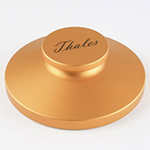

In one corner the Brit in classic black, in the other the copper/gold Swiss though also available in charcoal. 95g x 300g. €232 x €1'500. Both execute the same idea of absorbing vibrations generated by spinning vinyl via a stabiliser in Stack Audio talk, a silencer in Thales lingo. These spindle-riding pucks are filled with tiny loose particles dancing on a thin silicon skin. Stack Audio uses light plastic grains, Thales heavier micro bronze spheres. Not being a vinylista myself, I have no sonics to comment on. Sonics weren't today's focus. The idea of synchronicity is. Here's just one example that shows how the same idea occurred to two different people in two different countries. If ideas somehow share themselves between multiple people simultaneously, what makes us believe that they're ours in the first place? Perhaps they broadcast globally and we just happen to tune into the right free-for-all station? It is said that when Albert Einstein registered his theory of relativity, he beat a competitor by just a few hours. There are many such tales of patent applications arriving for the same idea in different offices around the world, filed by different individuals with no knowledge of each other. These two vinyl accessories, one a cost-effective direct-selling version from the UK, the other a properly swish Swiss, illustrate the same effect in our little sector. Whilst the executions differ as you'd expect, the embedded concept of membrane-activated particle damping is clearly the same. In the review of my Berlin colleague Ralph Werner of fairaudio.de, it mentions that Theo Stack has already applied for a patent for his Serene Stabiliser. Should Stephan Schertler of Thales have done likewise for his Silencer at the Swiss patent office, it'll be down to the clock of who filed first. Not that it matters for other than patent bragging rights. If an idea is good, does it matter if it came to others, too? Doesn't more make merrier?