Proviso. "It's a condition or qualification that specifies how something must happen or be true before the main action or condition can take effect." Whenever an audio adventure leaves the highways of bleeding obviousness to explore dim back alleys where returns are weak, picking a bright well-lit day not fog-ridden twilight makes all the difference. That bright well-lit condition is system resolution. The higher it is, the more we magnify small changes. What may not translate enough or at all to matter in fog-ridden twilight could become – um, clear as day under the right conditions. That's the hardware side. Recording quality matters as well. We can't squeeze blood from a stone. Good software with plenty of micro-level data offers more than dynamically redlined wall-of-sound productions. The trinity of success then includes wetware as the bio computer between our ears¹. Knowing what to listen for, caring to pay close attention and derive satisfaction from it are equally important. If this stuff just isn't that important to us, why pretend then accuse those who are deeply involved of hearing things just because we don't meet the required conditions? That wrapped the small print.
____________________
¹ To complete this picture, we invoke Harry Pearson's notion of the absolute sound. In his era it primarily meant classical and Jazz concerts where attentive listeners could train their ears in the various timbres and textures of unamplified instruments and voices. Only such exposure can recognize varying degrees of playback 'realism'. Someone who never attended a live performance or didn't grow up in a musical family with access to a piano, guitar or violin has no reference. That lack of reference also informs the expectations one levies at one's hifi; or not. If one's main musical diet is synthetic hyper-processed fare as our hobby's form of junk food, nobody knows what it's supposed to sound like. If that's the standard, anything goes. Here, add some brown sauce, vinegar and salt. Regular hifi show attendance confirms it. Anything does go. It's an inevitable side effect of fewer people attending unamplified live concerts. It's also how indigenous languages die out. Once the few people still fluent in them pass on, so do those tongues. The United Nations estimate that an indigenous language dies every two weeks and that half of the world's languages will disappear by 2100.

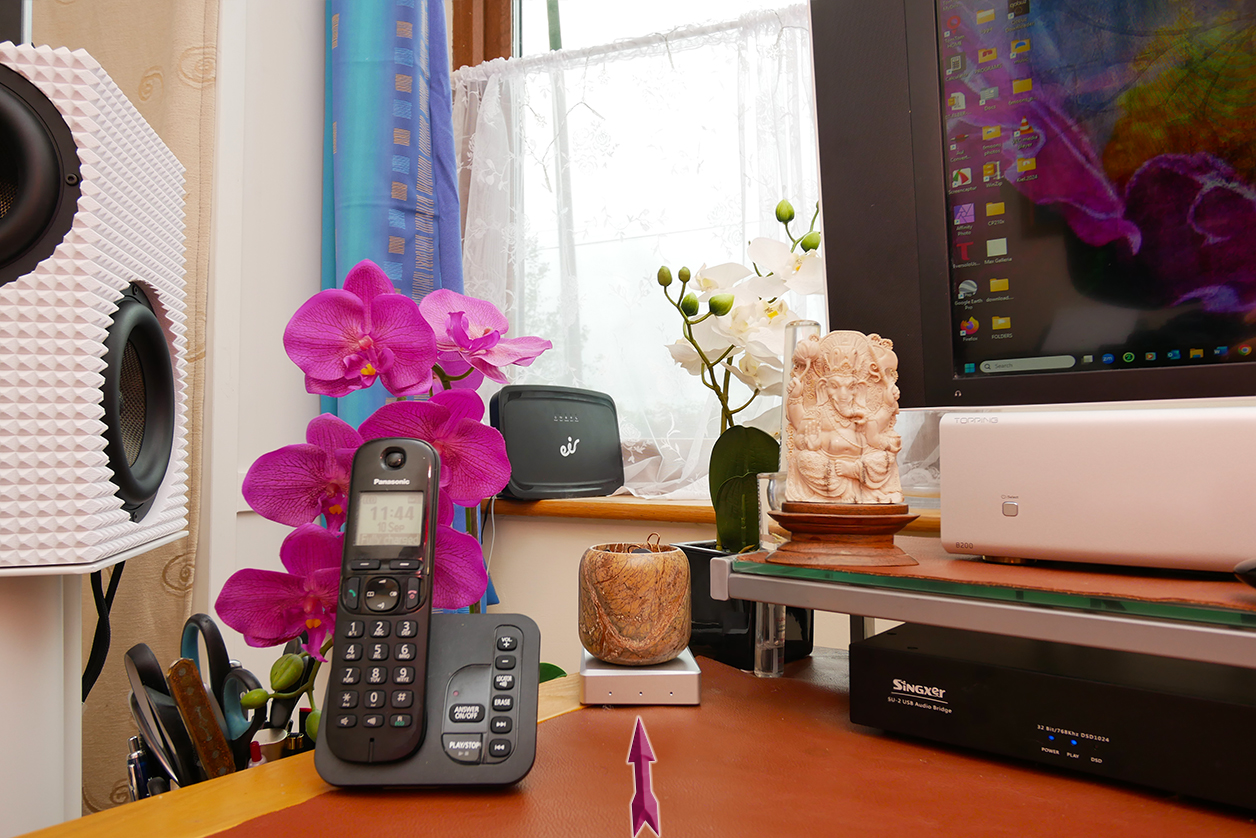
My Ethernet link from the router is industrial CAT8a, Regie's included short link is CAT6. Audirvana Studio is my music-player software set to 4 x upsampling with its SoX engine. A Singxer SU-2 bridges PC and DAC via AES/EBU. The DAC scales incoming 176.4/192kHz signal to 705/768kHz via Thorsten Loesch's Gibbs transient-optimized filter. Because this deck can swing a colossal nearly 12V over XLR, the 200W/4Ω Topping monos run at just 11.6dB voltage gain for even better self-noise figures. The low-down on the Viper speakers is here. Speaker cables are Zu Event, XLR cables upscale Furutech. Most people would consider this desktop über kill. Given my job description and amount of time spent here, I call it (cough!) appropriate. That word certainly felt à propos for today's purposes. My system resolution was as bright and sunny as Ireland's rainy west coast manages in September.








When Regie rang my bell in pouring rain, his entourage was a 50cm directionally marked Ethernet link with Telegärtner-type plugs; 5V/2A wall wart with click-lock plug insert and 2m hardwired USB-C umbilical; and 2-page stapled instruction guide. It notes that the minimal current spec for the power inlet is 0.5A; and that the three white LED reference incoming signal (left), power (middle) and downstream signal lock (right). Regie's belly pockmarks with 18 hex bolts for an airtight seal of the innards then floats a millimetre or two on four rubber bumpers. As a pocket rocket, Regie's size will fit even the damnedest of crammednest desktops. Not being a videophile who knows his Ps 'n' Qs of resolution vs speed specs, I ran 96kHz Qobuz and YouTube in parallel. Regie's 100Mbps rate readily supported it. Wanting to know how much headroom that left, AI Overview explained that "100Mbps is more than enough to handle uncompressed 24/96kHz PCM which requires approximately 6.23MBps. 100Mbps is sufficient for multiple simultaneous streams of 4K video and 4K gaming. YouTube requires at least 1Mbps for standard definition, 2.5Mbps for 720p HD, 5Mbps for 1'080 HP, 10Mbps for 1'440p Quad HP and 20Mbps for 4K Ultra HD." As Rolls-Royce would allow with bored British understatement about their cars' power, "it's enough". I felt assured that driving my desktop on slower Regiematic would encounter no speed bumps.
How about mental bumps aka mumps? Can silence come by degrees? Properly diagnosed pregnancy has no half measures. Isn't the same true for silence? Either it's quiet; or it's not. Again, ground loops, power-supply surf and such live elsewhere. This is about digital silence. It suffers no vinyl surface noise, no vintage tape hiss. Yet cut some way-out-of-band noise we couldn't hear in the first place and there's clear change. That offends hard logic. More silent than silent is shyte. To open-eared perception it just is. Here it even had a psychological component. Things sounded and felt decidedly more relaxed and elastic. The upshot was more flow, less choppiness; more easefulness, less effort; more purity, less agitation. Spec-driven listeners don't know what to make of such descriptions. Listeners who account for qualitative shifts in their own experience relate easily. It isn't just about good sound. It's about a deeper experience which plays on more aspects of their being. Sound quality is only one dimension though the dividing lines between that and subjective reactions are fuzzy. For musical meditators that's perfectly fine. There's no need to analyse satisfaction which is in place and the case. Analysis enters when it's not. Now we ask why not. Why can't we get into the tunes when objectively, nothing seems wrong with the sound per se? In that exact sense, Regie eliminated hidden wrongs. Without seeing exactly what they were or needing to, their absence already communicated the difference between a ripe fruit's enzymatic vitality; and how it dulls once it starts to oxidize and change colour. The apple remains an apple, the sound the sound. Yet life force weakens and with it, nourishment. Ultimately even taste suffers. But it starts on an energetic level. Spec-driven hifi commentary doesn't really account for it. So its vocabulary lacks terms and concepts to describe it. On the next page I'll give you my best shot to account for Regie's difference making.