
Country of Origin

 Reviewer: Srajan Ebaen
Financial interests: click here
Main system: Sources: Retina 5K 27" iMac (i5, 256GB SSD, 40GB RAM, Sonoma 14), 4TB external SSD with Thunderbolt 3, Audirvana Studio, Qobuz Sublime, Singxer SU-6 USB bridge, LHY Audio SW-8 & SW-6 switch, Sonnet Pasithea, COS Engineering D1, Laiv Audio Harmony; Active filter: Lifesaver Audio Gradient Box 2; Power amplifiers: Kinki Studio EX-B7 monos & Gold Note monos on subwoofer; Headamp: Enleum AMP-23R; Phones: Raal 1995 Immanis; Loudspeakers: Qualio IQ [on loan] Cables: Exact Express Flame, Furutech; Power delivery: 2 x Kinki/Vinshine Tai Hang on amps and source stack, Furutech DPS-4.1 between wall and conditioners; Equipment rack: Artesanía Audio Exoteryc double-wide 3-tier with optional glass shelves, Exoteryc amp stands; Sundry accessories: Acoustic System resonators, AudioQuest FogLifters; Room: 6 x 8m with open door behind listening seat; Room treatment: 2 x PSI Audio AVAA C214 active bass traps
2nd system: Source: FiiO R7 into Soundaware D300Ref SD transport to Cen.Grand DSDAC 1.0 Deluxe with POW; Preamp/filter: Lifesaver Audio Gradient Box 2; Amplifier: Kinki Studio EX-M7; Loudspeakers: ModalAkustik MusikBoxx + Dynaudio S18 sub; Cable loom: Exact Express Earth; Power delivery: Vibex Granada/Alhambra, Akiko Audio Corelli Corundum & Castello Solo; Equipment rack: Hifistay Mythology Transform X-Frame [on extended loan]; Sundry accessories: Furutech cable lifts, Furutech NFC Clear Lines; Room: ~3.5 x 8m
2nd headfi system: DAC: Cen.Grand DSDAC 1.0 Deluxe with POW; Headamp: Cen.Grand Silver Fox; Headphones: Raal 1995 Magna, HifiMan Susvara
Desktop system: Source: HP Z2 work station Win11/64; USB bridge: Singxer SU-2; DAC/headamp: iFi iDSD Pro Signature; Amplifiers: Topping B200; Speakers: Virtual Hifi Viper; Headphones: Final D-8000, aune SR7000
Upstairs headfi system: FiiO R7; Headphones: Meze 109 Pro, Fiio FT3
2-channel video system: Source: Oppo BDP-105; All-in-One: Gold Note IS-1000 Deluxe; Loudspeakers: Zu Soul VI; Subwoofer: Zu Submission; Power delivery: Furutech eTP-8, Room: ~6x4m
Review component retail: €887 contingent on daily exchange against the British £

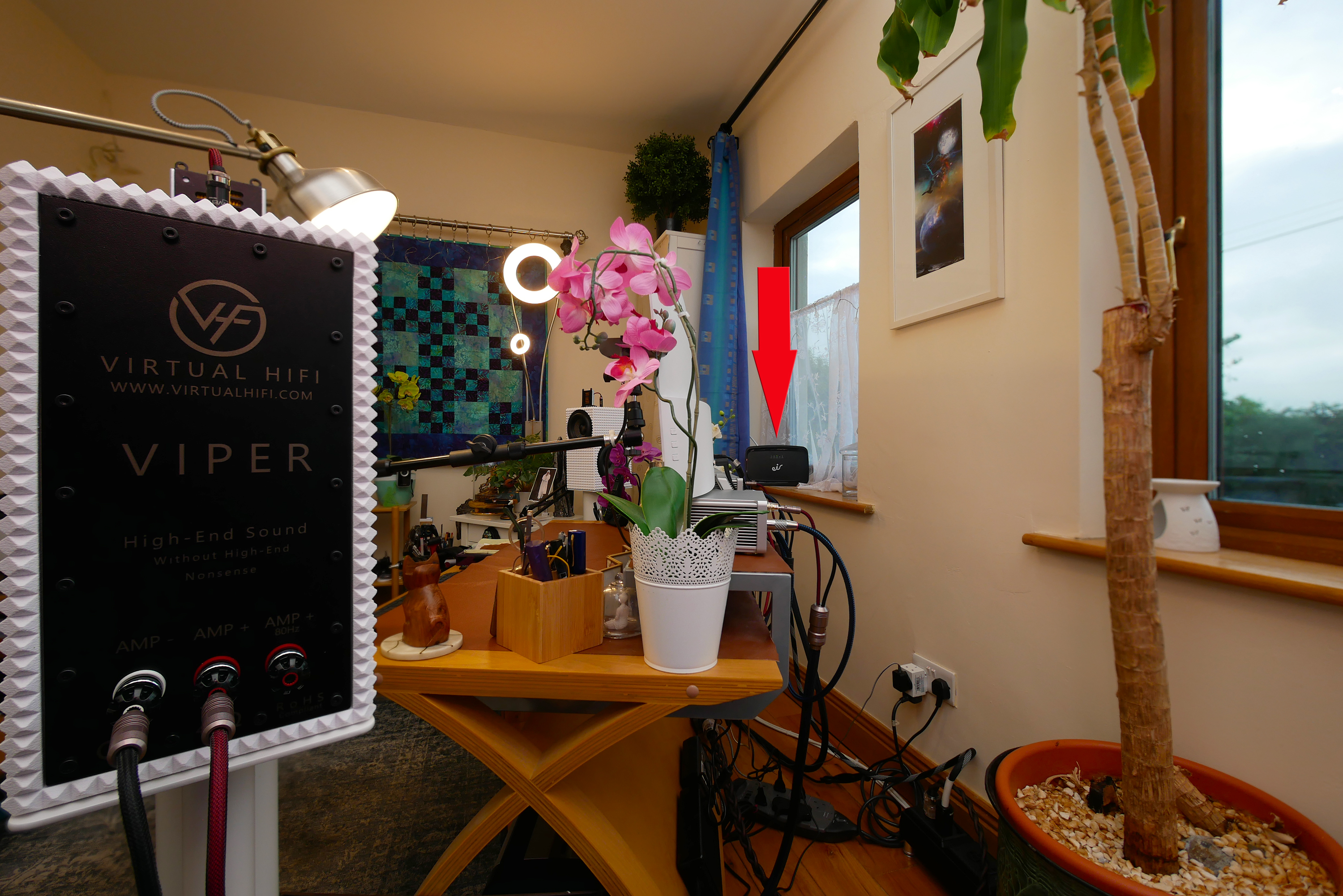
For fox sake. Look closely. My desktop is a chicken little. It's scared of the big bad fox. It says right there on the fridge magnet. My plucky sonic chickens roam the white pens of Virtual Hifi's Viper monitors. That name alone should scare 'em eggless but doesn't. Instead they look in the direction of this red arrow…

… as the source of their fear: my broadband Internet modem/router and all the noise it likely passes like a pestilent wind laden with pungent cow crap. Whilst all else in my sonic office is sorted, EMI which an AC noise-sniffer gizmo recently measured here was by far the worst in my entire crib. I suspect the lethal cocktail of Win11/64 workstation, 34" computer screen and generic router installed by our Irish telecom authority Eir. The lot is SMPS Central. Ever since the gizmo had freaked out with ugly squawking noises, I wondered. What sonic tonic might polish up this rig? UHF noise embeds like a dormant virus. It loads down our system's immune system without it sounding sick at all. We only notice the subliminal noise virus by subtraction. We don't hear it like a separate ground loop, transformer hum or power-supply surf on a tweeter. Yet as soon as we reduce our hifi's exposure to ultrasonic radiation and voltage spikes on the power line, the sound invariably improves. How much more noise scrubbing is possible? We haven't a clue. If more is possible, we only realize it after our next meet with an effective noise-busting tweak. This could become a never-ending tale of many nested noise chapters all interconnected like negative feedback. Noise seems pervasive, brickwall filtering it across endless bandwidth a pipe dream.










I suspected that isolating my modem⇒PC Ethernet connection might be advantageous. I envisioned an inline LAN filter of singular i/o. I'd had excellent results with Theo Stack's and Josh Stephenson's Stack Audio mechanical isolators. Might not their electrical isolators work equally hard for their bread? Below we see what goes on inside their bigger regenerative Smoothlan. Power for this active circuit comes from a 5V/2A power adapter via USB-C input. The CNC'd sliver is all of 10.5x8x2.3cm LxWxH and 333g. Thru-put speed is the 100Mbps standard because it is more effectively filtered than 1Gbps yet plenty fast for even hifi's highest data densities. There's "active regulation, multi-stage filtering and triple active reclocking". There's "a shielded master clock whose tracks bury in the PCB with shielding vias creating a metal barrier around the clock and data paths". There's CAT5-8 in and out. Easy as chips¹ and rain. I had just the place for it. With the ultra-low noise floor of my new Topping B200 monos, system resolution had recently elevated. Any upstream work on out-of-band noise should telegraph greater smoothness I thought. Josh kindly dispatched a sample so that I might find out. Giving streaming's popularity, it's no surprise that helpers for it are becoming numerous. For just one island over from Eire there's English Electric, a subsidiary brand of The Chord Company with multiple LAN devices in their roster. There's the aptly named Network Acoustics. There's iFi with their SilentPower subsidiary. Why did I alight on Stack? For the same reason all of us go back to the well: prior satisfaction. Why not a posh network switch from the likes of LHY/Vinshine? Because I dislike open backdoors to airborne noise via unused RJ45 ports. My desktop application runs just one Ethernet spur. So the Smoothlan Regenerator henceforth Regie had my vote. Reasons. Like opinions, we all have them. Now you have mine. For one more, the gents at Stack are the newer younger generation of audio entrepreneurs. Whenever my choice is down to working with entrenched establishment or newcomers, I favour the latter. Their story hasn't been retold as often. My work has a greater chance of making a difference. When all else is equal, that's an ego bonus. Anton Ego, critic at large, reporting for interview duty. "The name's Reginald, Sir Reginald the Sixth. But please, do call me Regie." Now we're good to go. Let's run the tape. Anton's first question: "Why do you exist, Regie?"
____________________________
¹ About those chips, Regie runs two which don't look like typical 6- or 8-legged optocouplers. Being defaced indicates Stack's reluctance to reveal what these 40-legged critters are, thus also what they do. Armchair engineers are free to speculate. The rest of us don't care. We just want results.
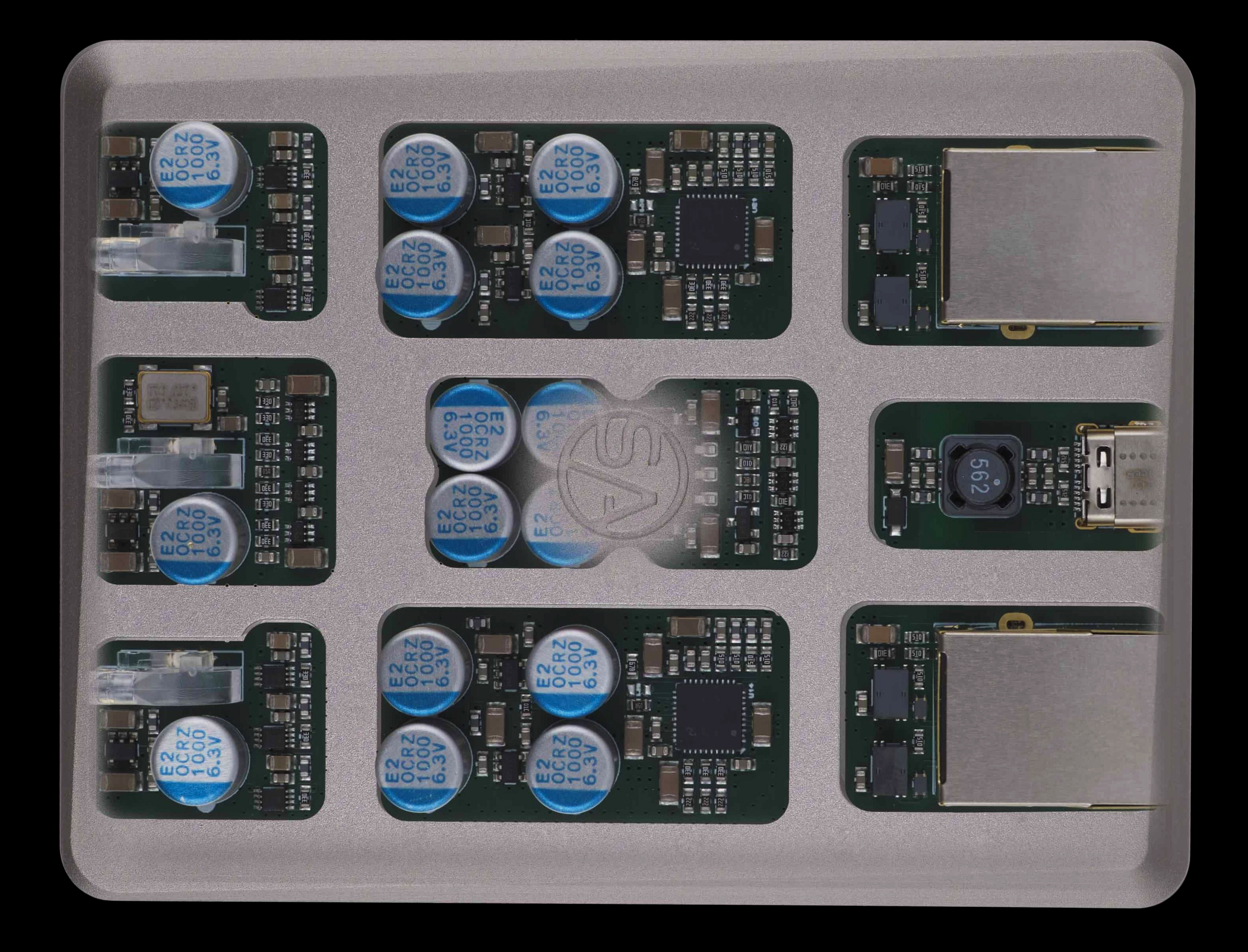
"I take my younger €283 Smoothlan brother to the next level by not just filtering but fully regenerating the signal. My nine nine cells seal hermetically to prevent airborne radiation from entering; self-generated radiation from exiting; and isolate the individual circuits from each other. For anything more, you must leave theory behind, stop your silly questions and listen. Mister Ego, good to have met you. This interview is now over. Let yourself out." Also out the door are generic arguments of Ethernet's robust error correction protocol dismissing all chances of improving the signal—if Ethernet allowed errors, the stock market would crash—and of its micro transformers handling all possible galvanic isolation already. Regie doesn't purport to correct data errors. It strips noise around the signal so that our downstream D/A conversion process works on a cleaner signal with less interference. If we hear any improvements, that's where they occur. The term Regietheater describes the modern practice of allowing a director freedom to stage an opera or play other than its author's original intention or stage directions. This can alter geographical location, chronological context, casting even plot. Typically such reframing makes a particular political point or draws modern parallels remote from the classic interpretation and setting. That type theatre we obviously don't expect from Regie. Nothing in hifi is supposed to make such profound alterations. Just so, the influence of the room, the speakers playing it and the amplifier driving them shape the sound far more than digital transports do. In that hierarchy, Regie isn't even a DDC aka digital-to-digital converter. That would at least change protocols like USB in, I²S or AES/EBU out. Regie behaves as an active¹ digital conditioner. The in- and outgoing protocol remains Ethernet. Since error correction is off the table, what type of sonic changes could that possibly make?
____________________
¹ That distinction is germane because Akiko's NetSilence doesn't use any electronic parts at all whilst passive in-line filters like Stack's own or SOtM's isolators do. Though PoE aka power over Ethernet exists to provide power for network devices like security cameras or VoIP phones, it requires a PoE-enabled switch or injector. Unlike USB, standard Ethernet doesn't include a power conductor. Could a PC's USB output power Regie? "If it stably supplies at least 0.5A, it theoretically could. Most modern ports are 5V/0.9-1.5A so would be fine on raw current. However, we recommend our wall wart since a USB power rail is typically far noisier than our dedicated adapter which should give you cleaner overall performance."