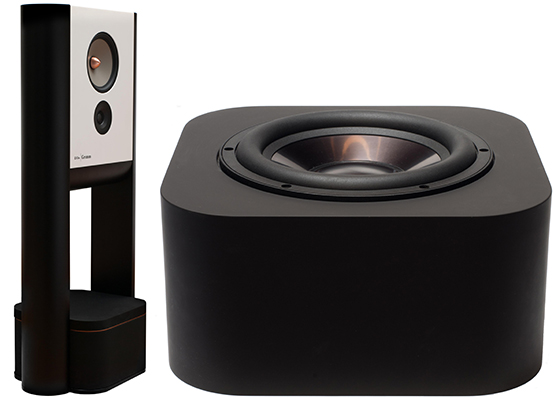
 The Squeeze and Juice. It has the Fox 'n' Hound ring of an Irish pub that went teetotal to start serving fresh vitamins and close at 17:00. Just as that won't happen, I couldn't hear 'more' or 'different' with my Stack stack because I no longer have any of my subwoofers' stock footers, just speciality isolators kept for their efficacy. All no-goodniks left my crib moons ago. To describe the original difference means hitting Memory Lane. I first got hip to just how bothersome structural resonances can become when Grimm Audio sent me a pair of these motion-feedback SB1 subs. Originally sized and styled to sit between the legs of their famous LS1 monitor speaker, these are upfiring low-rider sealed subs. Their woofer rear emissions aim directly at the floor. On their stock little rubber bumpers, I had them set up that way in my upstairs rig then hit 'play'. My wife was in her bedroom on the far side of the same floor.
Very quickly I could hear her protest loudly. I had already heard distinctive ghost beats behind the recorded beats but no idea that those travelled down the 6½m corridor to give her remote disco without mid/upper freqs. I walked over to hear for myself and immediately rushed back to turn things off. Unacceptable. I then flipped the subs 90° onto a narrow side so with the driver aimed sideways, then put proper isolation footers underneath it. That turned off the LF leakage and I could continue listening without late echo beats blurring the sound; and without terrorizing Ivette with partial tunes she was in no mood for.
Many years prior, in our first Swiss rental in Vevey, my system sat on a massive concrete patch whose area under a skylight had been the rear of a stable before the vintner/owner next door renovated it into a 3-storey income flat. On a particularly warm day I listened barefoot and was surprised to feel bass pulses in sync with the music. It turned out that dense high-mass concrete is an excellent resonance transmitter. The suspended wood floor which my two upstairs systems are on now is even more talkative of course.
I remember another incident of tightly grabbing a fatter speaker cable only to feel the same low-frequency pulses in sync with the tunes in my hand. Experiences like these hipped me to the propensity for loud bass energies to hitch a ride on whatever they couple to. Just like so-called room gain from reflections adds output to the direct signal—it's what gives a sub's corner placement the most free acoustic boost because three surfaces meet—so do structural resonances add narrow-band output. The trouble is, that gain is neither linear nor on time. It's always behind the beat. Worse, timing blur and amplitude mud overlays higher bands. To overwrite for effect, imagine mortar hits as bass beats, their exploding impact debris as the lingering elements which fly much higher than the original hit. It's antithetical to high fidelity. The same goes for full-range loudspeakers. Obvious variables are how well damped their cabinets are, how effective their floor decouplers, how reactive our floor and how high our SPL.













That speaker subject reared its head again days ago when I set up these monitors on heavy Track Audio stands. Their stock spikes sat in HifiStay multi-stage roller-ball isolators to protect my landlord's parquet. Whilst mere monitors on the face of it, these speaker combine two 7" high-output midranges for a compound 10-incher; and six 7" passive radiators (two on each cheek, two in the back) for a compound 15½" woofer which kicks in purely mechanically below 60Hz. Worshipfully on my knees to take some photos, I once again felt bass pulses tickling. I thought the culprit the Zu sub on its Auva SW. So I turned that off. The tickling continued. Bloody hell. The high-mass stands topped by crazy-powerful monitors good to 25Hz but here high-passed at 40Hz/4th-order leaked bass energies through their top plates, uprights, spikes and roller-ball footers. Replacing the latter with sound|kaos wire-suspension footers stopped the energy transfer. This demonstrates just how insistent bass energies can be to go where they're not wanted.

Just as we wouldn't let friends drive drunk, we shouldn't let our low-frequency generators hit the road to go places. We want the equivalent of a hovercraft to not feel the waves. As I said earlier, I've experimented extensively with various approaches. When implemented well, they seem equally effective. Some like today's have narrow weight ratings to be specific to a load. Others like my wire-suspension footers—hang speakers off the ceiling then invert that to the floor—are load-invariant up to their mechanical failure limit. Enter size which influences appearance and amount of lift; and price which depresses lift on the wallet. From my proven subwoofer isolation solutions, Stack Audio's Auva SW is tidiest and easiest on the pocket. If you want more pitch-defined bass that stops with less overhang to give the low registers more clarity and specificity whilst also removing mud and blur from obscuring the higher bands, you nearly always can and should do better than what subwoofers come with. Don't shout at the messenger. Get busy and declutter your bassment before it holds the 'high' in your fidelity hostage…