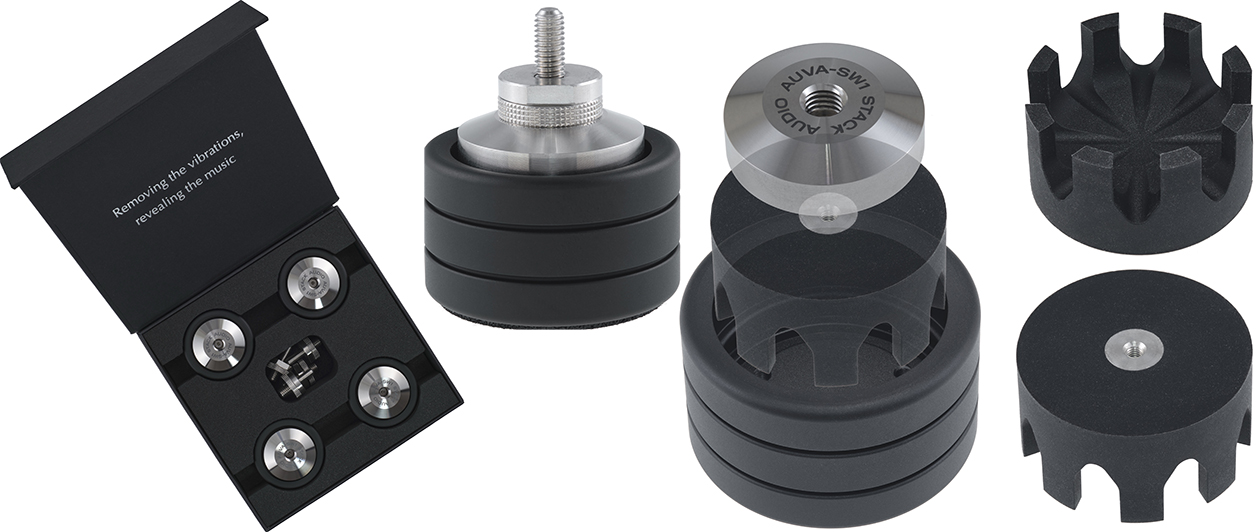
 Rattle'n'squish. It's how we might paraphrase SW's operational principle. We appreciate that the 8-fingered elastic sleeve—hifi's own FaceHugger from the Alien prop department?—is marginally smaller than its barrel retainer. That allows some outside flex for absorbent spring action with a very controlled amount of deformation. We might think how easily these viscoelastic inserts should swap were we to change to a subwoofer above or below our existing weight rating. But no can do. "The CSA [custom silicon absorber – Ed.] can't be swapped due to how they're constructed and braced within the shell." If we need a different weight rating, we must order a new set. Like any spring-based system, effectiveness depends on correct compliance. The only way to avoid having to match load mass to spring rate are progressive rates for a constant natural frequency aka CNF. That is "a complex property which reduces sensitivity to load deviations and offers a high degree of modal decoupling. The natural frequency of most elastomeric mounts lowers with increasing mass or increases with decreasing mass. Hence the vibration isolation characteristics vary with load. Meanwhile isolators with CNF adapt to changes in load with changes in their own stiffness. This holds the stiffness-to-mass ratio constant." A hifi isolator with CNF will be a story for another day. Someone's working on it but that project is still embargoed. Today follows the classic viscoelastic recipe of stepped weight ratings fixed by changing out the squishy element; or here ordering a different complete set. With the Auva SW, the outer barrel never changes so the external dimensions remain the same. Only the viscoelastic inserts change. That being the case, how do we know which version we have? As shown below, the number following the Auva-SW engraving indicates weight rating 1-6, here SW1. [Stack Audio's Josh Stephenson & Theo Stack at right.]
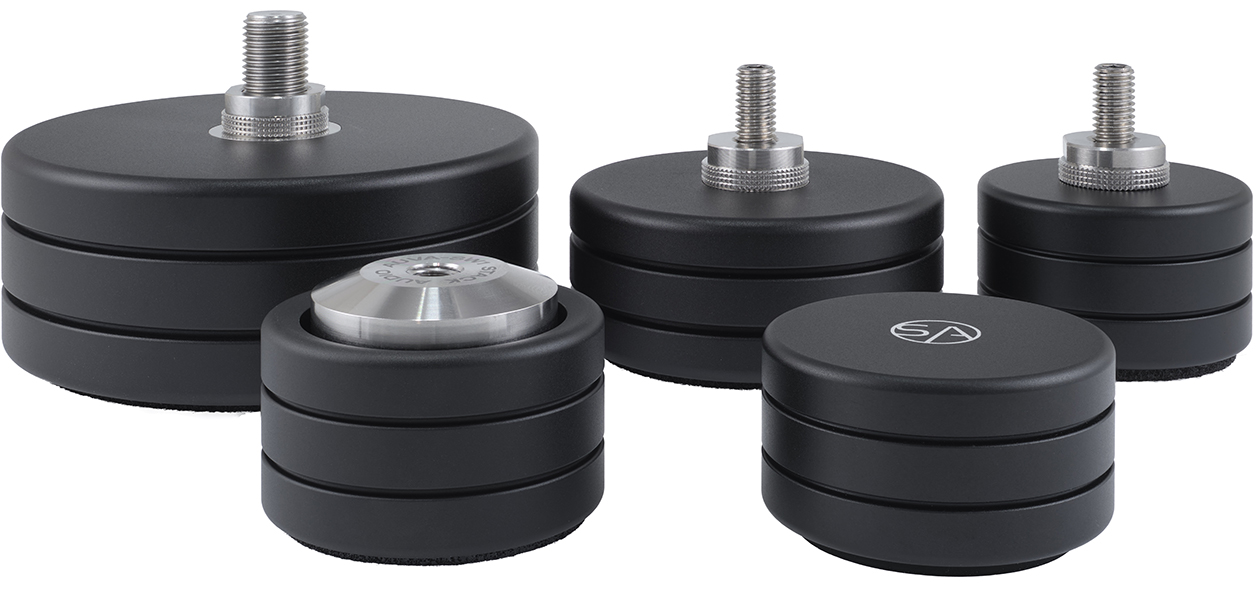
If we already have Auva for speakers/racks or components, here is how SW sizes by comparison. It inherits the silicon-absorber concept from the component Auva front right; and one of the multiple particle chambers from the rear triplet dedicated to speakers and racks. Before we go SW, a final bit of connective tissue. Two months ago, Stack Audio's SmoothLAN Regenerator won our Blue Moon award. These folks aren't just playing footsies or serving up platter mats. To the naked eye a device like today's packs seemingly less engineering than the circuit for a network reclocker/regenerator. So it's good to know what else this youngish team have already done to appreciate how they approach passive resonance attenuation. For example, the molecular makeup of the compression damper's silicone "plays a critical role in its ability to absorb vibrations effectively. We worked closely with a silicone specialist to ensure that each CSA is fine-tuned to meet precise performance specifications. If the molecular properties are not tightly controlled, even small deviations can lead to a drop in performance. The CSA forms an air pocket which acts as a spring while the air holes provide extra compliance. The shape was specifically modelled to absorb particular vibration ranges harmful to the purity of the audio signal. We chose silicone for its combination of viscous and elastic properties, allowing it to deform under stress and gradually return to its original shape which helps dissipate energy. It has high damping capacity, temperature stability, resists material wear, fatigue and degradation over time and maintains its shape after repeat compression."






Though we're not on rocket science or brain surgery, I had a few brainier questions for my contact Josh. If our subwoofer's weight falls right between two different load ratings, is it better to maximally compress the softer silicone or minimally compress the stiffer version? On the subject of which, what is the resonant frequency of this device? Is it correct to assume that to effectively isolate down to 20Hz or beyond, the device's own resonant frequency should sit in the single-digit range? Given that the external barrel never changes, does stiffening the flexible sleeve involve ever thicker silicone walls; a different geometry; or a different material composition? Also, does the earlier mention of "air pocket" suggest that the silicone insert seals off an inner chamber whose trapped air gets compressed by applied weight to act closer to a gas-filled shock absorber than bouncy rubber?
 Dynaudio 18S 2 x 9½" force-cancelling sub on sound|kaos wire-suspension isolators on suspended upper floor.
"To maximize compliance, if a sub is 15.9/16kg, we recommend the CSA 1 as these have been extremely fine-tuned to fit their weight categories. If it is marginally over, we recommend the next model up. It is correct that one wants the resonant frequencies of the silicone isolator as low as possible to achieve high vibration isolation. We indeed pushed that below 20Hz to achieve effective isolation for subwoofers. However, there's a practical limitation to how low that frequency can be since it must be achieved with low isolator stiffness which implies that the isolator might collapse under applied weight. So there's a design trade-off between the low resonant frequency needed for effective isolation and sufficient stiffness to prevent the isolator's collapse. We used finite element analysis (FEA) to study and optimize this trade-off. This led to an isolator with very low resonant frequency achieved by optimized shape, material selection and matching case with support ridges. This delivers effective isolation due to low internal resonant frequency whilst having sufficient resistance to properly support the equipment weight. This was validated in the lab using vibration measurements and listening trials. For example, for our softest isolator (CSA 1/Duro 30) rated for up to 4kg per isolator, the resonant frequencies of the silicone are 10.6Hz horizontally, 14.9Hz vertically. This guarantees effective isolation at 20Hz to suit subwoofers. As for our CSA geometry, it doesn't change. We achieve the disparate load ratings with different material properties of the silicone's makeup. Although the CSA can’t be removed due to the snug fit and how the shell braces the silicone to operate close to its buckling point and maximise compliance, it isn’t completely airtight. Any air under the CSA isn’t sealed in. It can move in and out around the edges so doesn’t behave like a gas spring. The air pressure changes are negligible and don’t contribute to isolation performance. The vibration control comes entirely from the tuned compliance of the silicone and the particle cell, not from any trapped air." To paraphrase in layman's lingo, the softer our suspension, the higher its damping – until we bottom out. Setting the value right at that safe margin creates the cushiest best isolated ride. For once performance freaks don't want a sporty suspension. They want the proverbial water-bed limousine so that no matter the road or speed, they inhabit a floating bubble – well, their sub does relative to the floor.