Deal makers. Der Klang. Le son. Il suono. El sonido. Impresionante. Génial. With the DAM-1 it all meant the same: terrific sound. If we apply my generic formula for top resolution—the ability to choke out SPL to barely a pulse without killing off listening desire—Soundaware's compact reference converter was exceptionally resolved. Yet resolution didn't just cover the realm of how many needles fit on a fir tree. It included tonal substance and weightiness. Such physicality routinely lightens as so-called resolution crystallizes. The DAM-1's tuning significantly delayed that effect. That made for a wonderful whisper freak. Seeing how this night-time system is optimized precisely so I won't disturb Ivette right below this room or down the upper hallway, freakish whisper chops stood tall like flapping freeway feathers which mean to divert passing traffic to the next offramp for a food joint or other attraction. This feather read 'listen more while you keep the peace'. In my book it's arguably the most important quality a hifi must possess. It's called remaining persuasive at low levels. Yet most reviews barely cover it. Getting technical, we call it superb S/NR. Broken down, the term is a measure for how far below a standard signal a component's self noise falls. A classic valve amp might only post 80dB. Today's best digital can eclipse 120dB. Wherein lies the proviso. Our system resolution is only as good as our weakest link. The DAM-1 could measure 140dB yet get disqualified and stripped off its shiny gold medal by said 80dB amp. Suffice to say that I curated this system for silent suavity. It allowed the DAM-1's special strength to strut. And boy did it sashay and swagger.
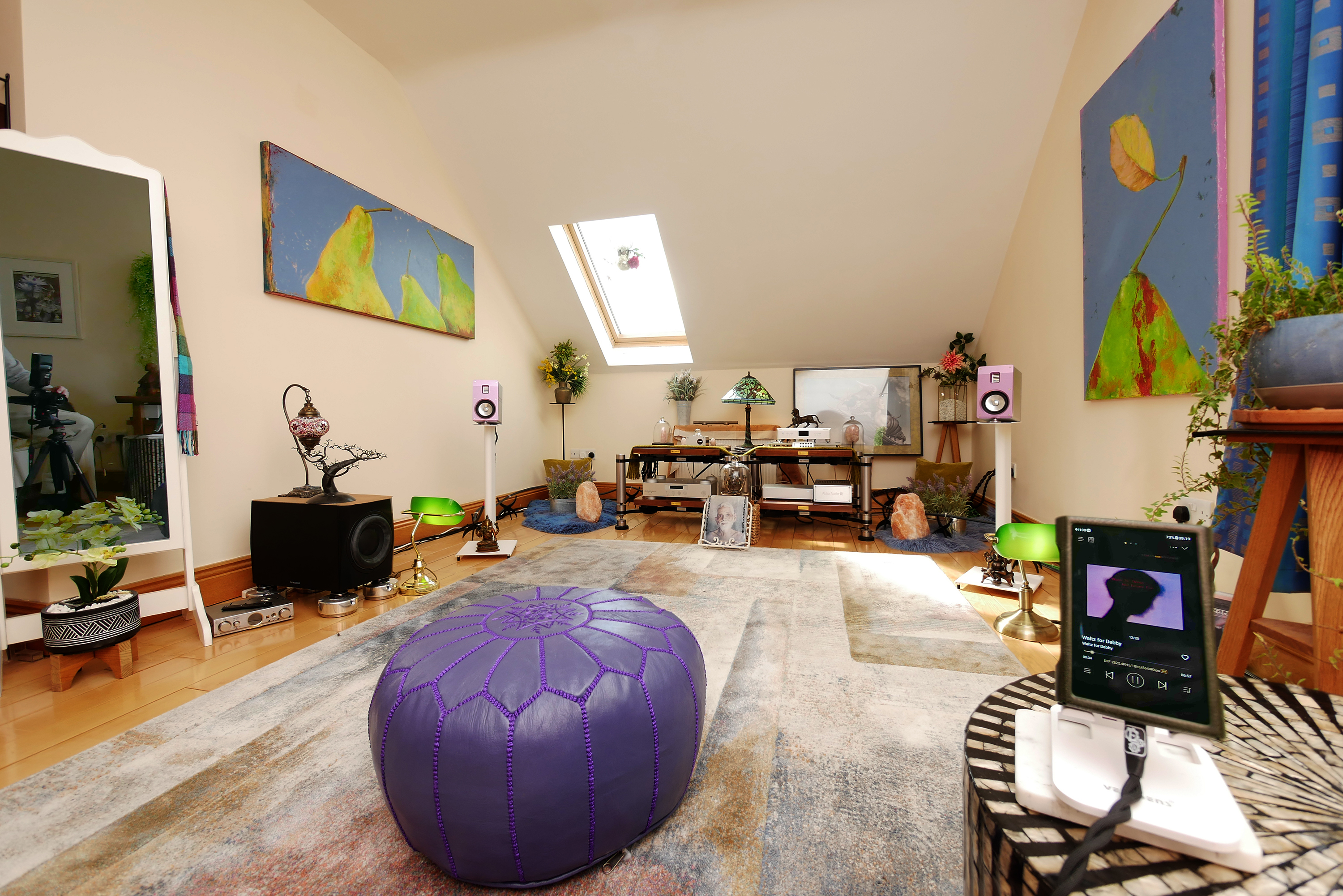
Cranking my rig to what around here leverages lecherous leprechaun levels merely intensified data density. That's an excellent term for this DAC's core attraction. It really packed the expanse between then behind the speakers with sounds big and small. Don't think sardine stuffiness. Don't conjure up clumped cat litter. Au contraire. This sound had plenty of air and agility, space and spunk. The sonic occupancy fronting my chair just felt like more audio protesters had shown up for a better-sound demonstration. Obviously a 5-piece band didn't suddenly gain two extra players. That'd be silly. The 'more' was microscopic flotsam. It added realism to the sketchiness of two sound sources attempting to fake up 3D imaging in our brain. Even a beginner's rig retrieves all primary big sounds. As electronics, speakers, ancillaries and setup improve, tiny stuff materializes around and behind those primary sounds. I call it audible space or connective tissue. It binds together various images into one cohesive happening; one which clearly took place in another time and space. As more and more tertiary data rises above inaudibility to matter, the hifi sketch's outlines fill in not with flat primary colors but carefully shaded heavily variegated hues. Those create textures and shapeliness of images. They make visible the space surrounding them. That builds specific interrelatedness or context between them. Our room's empty space sorts and structures into layers. Its emptiness is really full.






Calling it pitched blackness like interstellar vacuum is a misnomer. Black only applies in the sense that against it, white creates the highest S/NR or contrast. We simply don't talk of images getting whiter. We call backgrounds blacker to suggest that unlike the DAM-1's poor display contrast, we look at a properly back-lit Apple Retina equivalent behind shiny glass to see everything most clearly. Quite apart from this 'black' aspect against which we enjoy superior contrast, highly resolved sonic backgrounds aren't solid absences. They're packed presences of reflections and image haloes. Think tiny tadpoles flitting about a pond's murkier measures. Now more resolution shines extra light in there. It uncovers bounteous life where before there was none. Hifi 101. But there are levels to it and the DAM-1 penetrated murk which usually remains off limits. Whenever we know a system intimately and dropping in new kit suddenly has it sound more present, rich and full without playing tricks with higher SPL, it's perfectly legit to invoke higher resolution. We needn't get any more specific. In practice higher res simply means hearing more. That's it; super basic but super beau. Without frame of reference, 'more' just really means nothing. So know that the two DACs which Soundaware replaced were a Denafrips Terminator Plus with 12th Anniversary firmware update; and an iFi iDSD Pro Signature. It was more resolved than either. C'est ça.
 Load resistor mounted to the PA1-Ref's 2.1mm auxiliary power socket. Despite being deselected, the RJ45's port LED remain lit.
If you have no French, I'll add that from the organic character of Denafrips and our iFi which can upsample all PCM to DSD 1'024 and/or insert micro tubes into the signal path, the Soundaware didn't steal anything that registered. The DAM-1's higher resolution caused no imbalance on materialism. Wikipedia says that "morals and mores are not the same. Morals are a standard or set of rules about what is right and wrong. Mores are the means by which individuals in a culture adhere to their morals." In audiophile terms, the moral is that mores are what we're happy to pay extra for; but even happier when it costs the same or less. Would the upstairs 'more' hold against the Cen.Grand and Sonnet competition on the ground floor? That's where my best most resolved 'morest' hardware lives. At this juncture, Weng's answers arrived:
"The load resistor accelerates burn-in for PA1-REF/LPX customers. Your sample has already burned in so needs no further conditioning. As for the toroidal transformer, its inclusion was by mistake. About NOS/normal, when an NOS DAC transfers I²S inside a chip, the sound is very natural because it has undergone no digital filtering. But it does create noticeable sampling noise above 20kHz. We employ ΔΣ processing to remove this. However, that introduces some time-domain distortion which doesn't match the transient performance of NOS. To achieve more perfect NOS playback, the Jinling DSP applies -170dB lossless upscaling instead of ΔΣ even though it compromises precision. After upscaling and filtering, the audio outputs as NOS. For 'normal' mode, Soundaware decided to apply no digital upscaling to show traditional ΔΣ chip performance. As to why the DAM-1 can't receive DSD 256, it's mainly an input limitation. The coaxial/ AES interfaces don't support native DSD64 and above. Supporting DSD128 is already considered non-standard. USB will support up to DSD256 as long as the driver supports it. It should be no issue for ASIO on Windows. However, WASAPI can only output DOP which limits to DSD128. As for the volume control, it was a late addition based on early customer feedback, hence no physical controls for it on the front. It's a 32-bit linear digital attenuator with a circuit noise floor of ~800nV. Also, a firmware update already increased the original remote's sensitivity. If it remains too weak across large distances, we recommend a twin-eye learning remote."