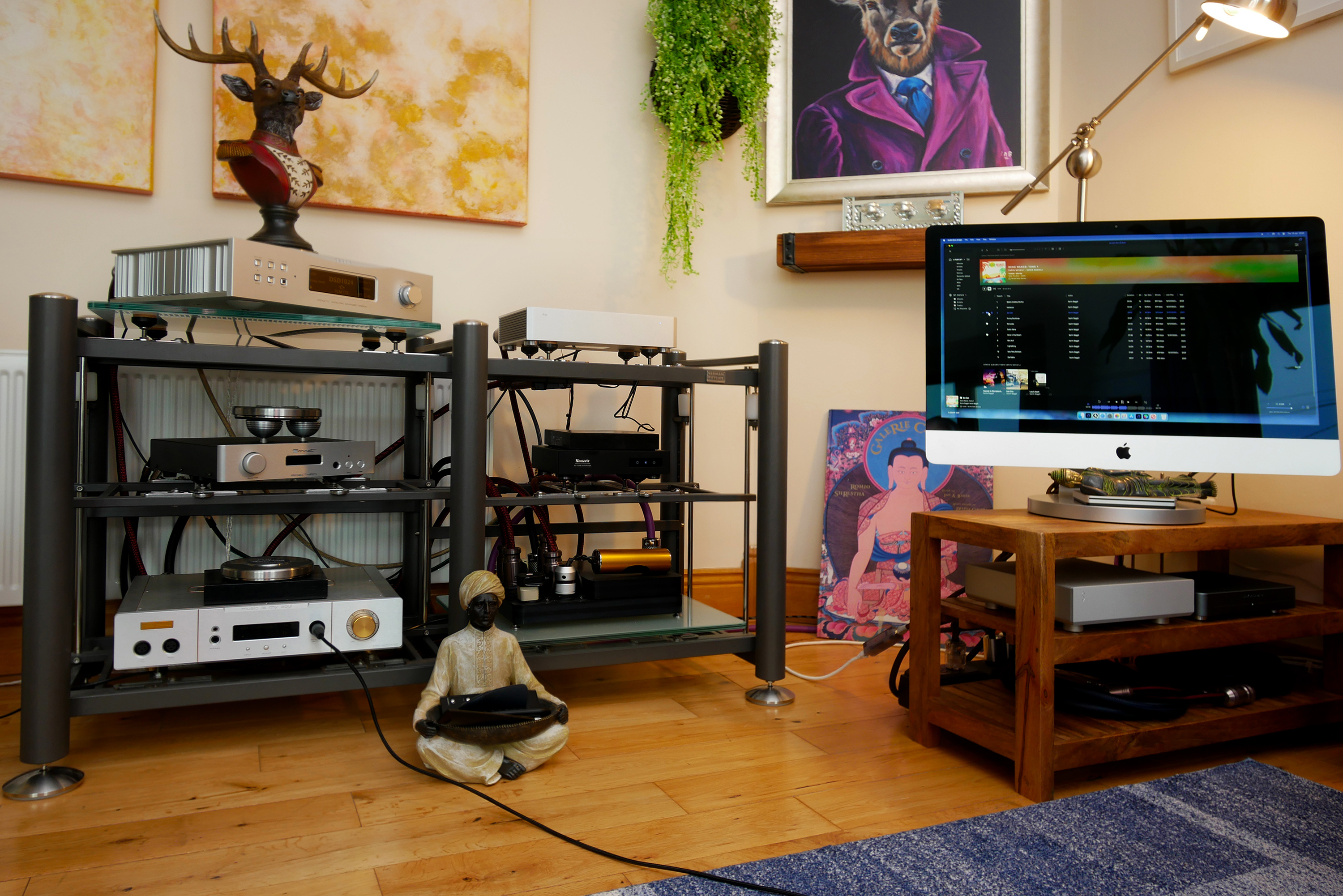
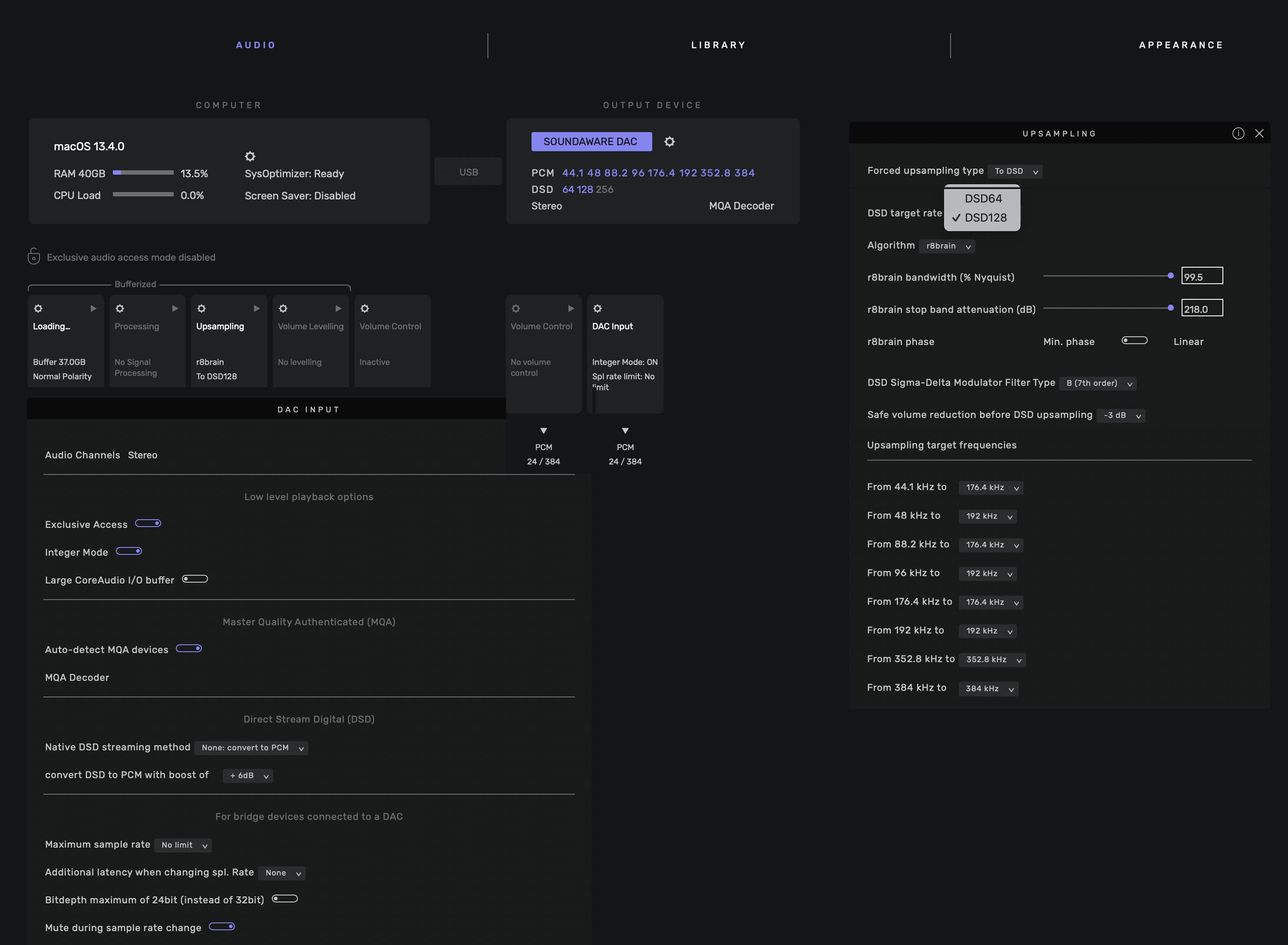
Like any self-respecting rain, the PA1's regen function played invisible to macOS and Audirvana Origin. Either saw right through it to instead register the USB device connected to the PA1, in my case a Cen.Grand DSDAC 1.0 Deluxe DAC with analog volume. Once that selected as the device my local library or the cloud streamed to, I was in biz. Nothing to it other than setting the PA1's rear toggle to USB. In this setup, Soundaware would battle my usual Singxer SU-6 which hits the DAC via AES/EBU. Do you prefer your USB dry-cleaned by Monique or Natasha, Philippe or Jason? Or do you think that as long as it gets done, details don't matter? To find out, I wired up both paths so I could switch them from the seat. All that involved was changing output devices in Audirvana Studio then using the DAC's remote to select its USB or XLR input. This compared digital pre-processing. D/A conversion remained unchanged as did the files, macOS bypass and pre-upsampling to 176.4/192kHz.
For other questions about the DAM-1, I needed Weng. That's because 'normal' and 'NOS' modes seemed reversed when in established digital parlance, NOS is short for No(n) OverSampling. Yet here it was in 'normal' that a PCM 44.1kHz file remained so whilst NOS upsampled to 352.8kHz. Likewise for DSD128 generated in Audirvana's DSD resampler. All modes other than NOS left it unchanged whilst NOS converted it to 88.2kHz PCM. In AllDSD mode, incoming PCM processes as DSD256 yet Audirvana indicates that the DAM-1 can't receive DSD above 128. Meanwhile native DSD64 and upsampled DSD128 remain unchanged to not benefit from the deck's 256 mode. And what about the curious case of the replacement toroidal transformer in the PA1 accessory box; and the load resistor terminated in a 2.1mm power socket that came with the DAC? The latter fits its auxiliary 5V/3A port where it lights up blue in use. It apparently forces the power supply to run just a bit hotter. Why? And how does this volume control execute? Whilst awaiting answers from overseas, I got to work on answers I could supply myself.
 Whilst sized identical to stack, the PA1 lacks the DAM-1's top bevel to be slightly mismatched even where it places the model signifier and power LED.
On flying, the manual's phrasing could seem more of a downer than upper. There are many warnings on how sensitive this kit is to shock absorption—their term for resonance control—and cabling; how one can improve the stock power umbilical with aftermarket or DIY leashes; how some functions require mode reselection or reboot before they take effect should the USB driver not be recognized properly; how in rare cases the display may work abnormally and such. Whilst the admirable intention is to cover all bases, the wording could be a bit of a cold shower on a new buyer's enthusiasm.








The manual did confirm that Soundaware's take on NOS implies 352.8/384kHz upsampling while normal applies none. I wondered what the NOS abbreviation signifies according to them. Not Ordinary Sense? Finally, the DAM-1's display contrast and fixed back lighting is of very low contrast. The above shots required very low ambient light and serious retouching to get this visible. The next photo shows unretouched daylight. Even the camera couldn't read the display. Forget it at four meters in the seat. There it was useless. I hate useless.
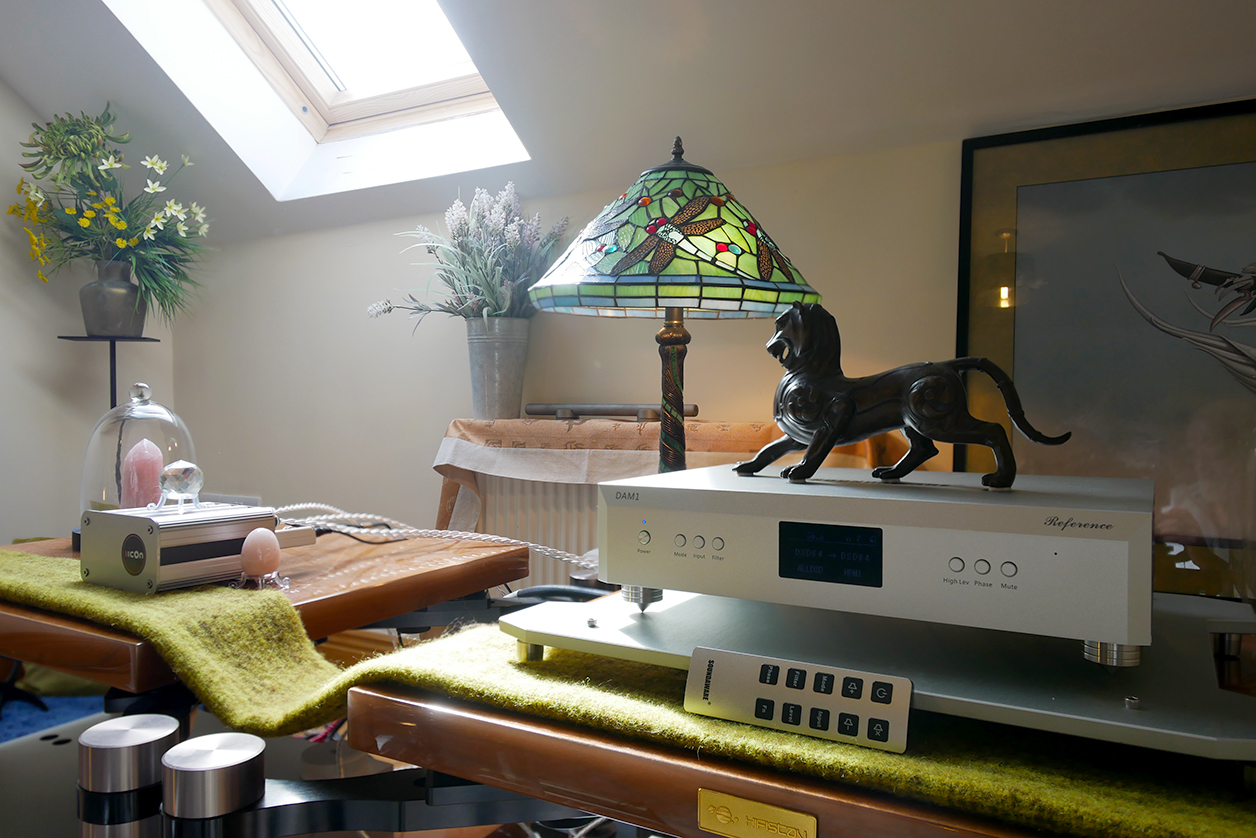
As though to press that fact home, the display can turn off entirely with a brief push of the power button on the front panel or remote. To my eyes the display even close up also felt quite pedestrian. Especially for SPL trim a temporary zoom à la Ferrum/Luxman would briefly show volume in the largest possible numbers. That's wearing my cantankerous critic's cap to be cross and critical. Now we'll cancel the crabby coin collector as from here on out, it was all honey, no stingers; except for one more mosquito bite.
Here comes the upstairs setup. Source was a Shanling M3 Ultra as battery-powered USB-C SD transport into Soundaware's D300Ref. That forwarded I²S down a 6-meter HDMI cable to the DAM-1 whose power supply occupied the shelf below it. Its RCA outputs fed an icOn 4th-order Linkwitz-Riley active 80Hz filter. Its high pass saw a Crayon CFA-1.2 in fixed gain powering MonAcoustics SuperMon Mini, its low pass a Dynaudio 2 x 9½" force-cancelling subwoofer. I controlled volume from the seat with Soundaware's remote.

With hardware sorted and software on microSD card, what did my wetware think about sonics? First the mosquito. Did the DAM-1 have a vinyl emulator? It was a brief noise transient at the end of a track, another at the beginning of the next like a needle drop/lift. It behaved as though a circuit disengaged at digital zero then relatched as signal resumed. It happened in both downstairs and upstairs systems over USB and AES/EBU. It disappeared with I²S which displays as 'HDMI'. Was this a temporary glitch? Would it resurface during my second downstairs sessions? Weng confirmed that it's no issue they've ever encountered before. That's good to know. As with no gapless, some buyers could otherwise consider it a deal breaker. I subsequently only managed to replicate it intermittingly on USB but never on I²S. I likely had a gremlin in my setup somewhere.