Silver versus grey fox. Because I like a remote control even at 1.5 metres, each amp's own attenuator sat wide open and the analogue master volume was in the DAC. 31dB of signal cut for the P1x equalled 20dB for the Silver Fox. Soundaware's voltage gain was clearly the hotter curry. The first sonic difference I cued into was relative damping and warmth. This connection might seem tenuous if we equate warmth with tonal balance. I call warmth bloom hence lazier stoppage. If our hifi had a reverb faucet, opening it fully would mean maximally swimmy bloom like a cathedral with stacked overlays of tonal endings lingering above/behind subsequent tonal beginnings. Turning it off would mean a dry skeletal sound of clipped gait; like moving a hifi into the backyard, anechoic chamber or hearing a marching band. In musical notation, one quality is called legato, the other staccato. The Silver Fox's virtual reverb dial sat higher. It was texturally fuller, bloomier and had more connective 'spacey' tissue but on timing was looser and on perceived precision and separation softer and blurrier. Particularly its bass rang more; over ultra low-mass ribbons of exemplary stoppage. Listeners used to ported bass whose MO is resonant, whose dispersion omni to cause time-delayed reflections, often call an absence of resonance and delay leaner and smaller. I call their presence underdamped and bloated. Regardless of bias, the physically far bigger amp had the looser rein. If you're familiar with PCM and DSD, you'll appreciate if I call its gestalt more DSD whilst the P1x took up the PCM counter polarity. Neither was extreme. Describing differences zooms in closely. That enlarges. Afterwards we must step back to reset proper proportions. Just so, this flavour distinction tracked. The class A amp felt slightly drier and more resolute, the class AB amp warmer and more resonant.
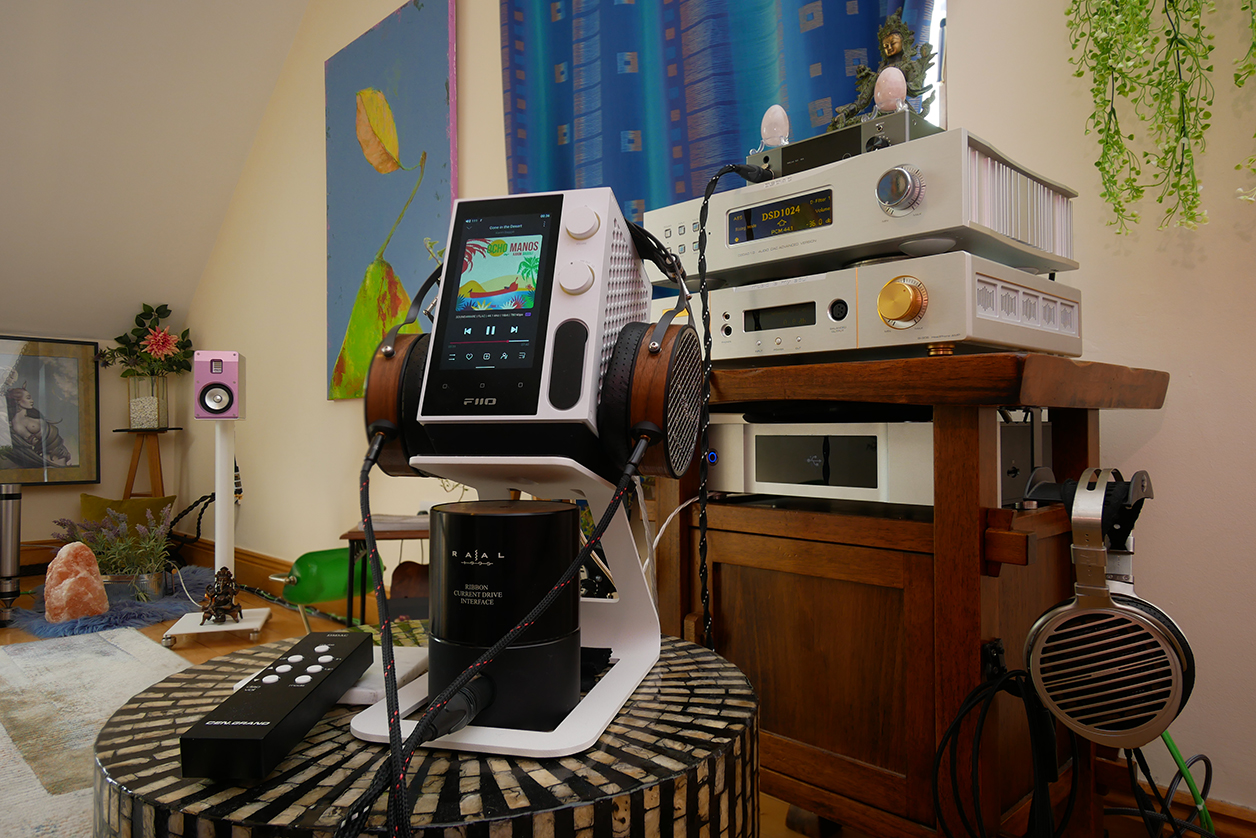 At €699, FiiO's feature-packed high-power R7 exemplifies current standards from PRC kit.
A parallel observation was a shift in overall perspective. The Cen.Grand put me more into the action. It reduced subjective distance; or what for in-skull headfi goes by distance. The Soundaware felt less immersive or intimate. Its view was more classically "stage over there, audience here". Everyone protects a preference. That's the point. Preference is no categorical better/worse. That was this game of seesaw. One went up, the other down in an endless trade around the same pivot. Considering the bigger deck's twice-plus sticker and hearing no other offsets big enough to matter hence mention, that was a big equalizer for the P1x. My initial downstairs suspicion proved out. It really was directly competitive. P1xcellent!










THR-1 versus P1x. In this contrast session of more Shaolin Kung Fu, the P1x output devices exerted the keener contrast ratio. Black values were deeper, the overall mien had more grip and overt authority. I heard more muscle and rhythmic tension. Kinki's lateral Exicon Mosfets were lither and airier so more rapier fencers than slugging boxers. I felt more rhythmic flow than charge. The colour palette had more white. This was a bigger flavour shift. As a quasi Exicon addict—three of my amplifiers use these parts—I nurse a weakness for their fleetfooted sophistication and comfortably dry sunny tone with excellent resolution. The P1x rocked harder, saturated deeper and focused down firmer to perhaps express its demonstrably higher power? Personally key in its gestalt makeover was not defaulting to the warmer, cuddlier, richer class A archetype. I retained my favoured more speed-than-comfort vibe of the Kinki aesthetic plus greater weight, urgency and locomotive drive. I can't pretend that switching saddles was any hardship; whatsoever.
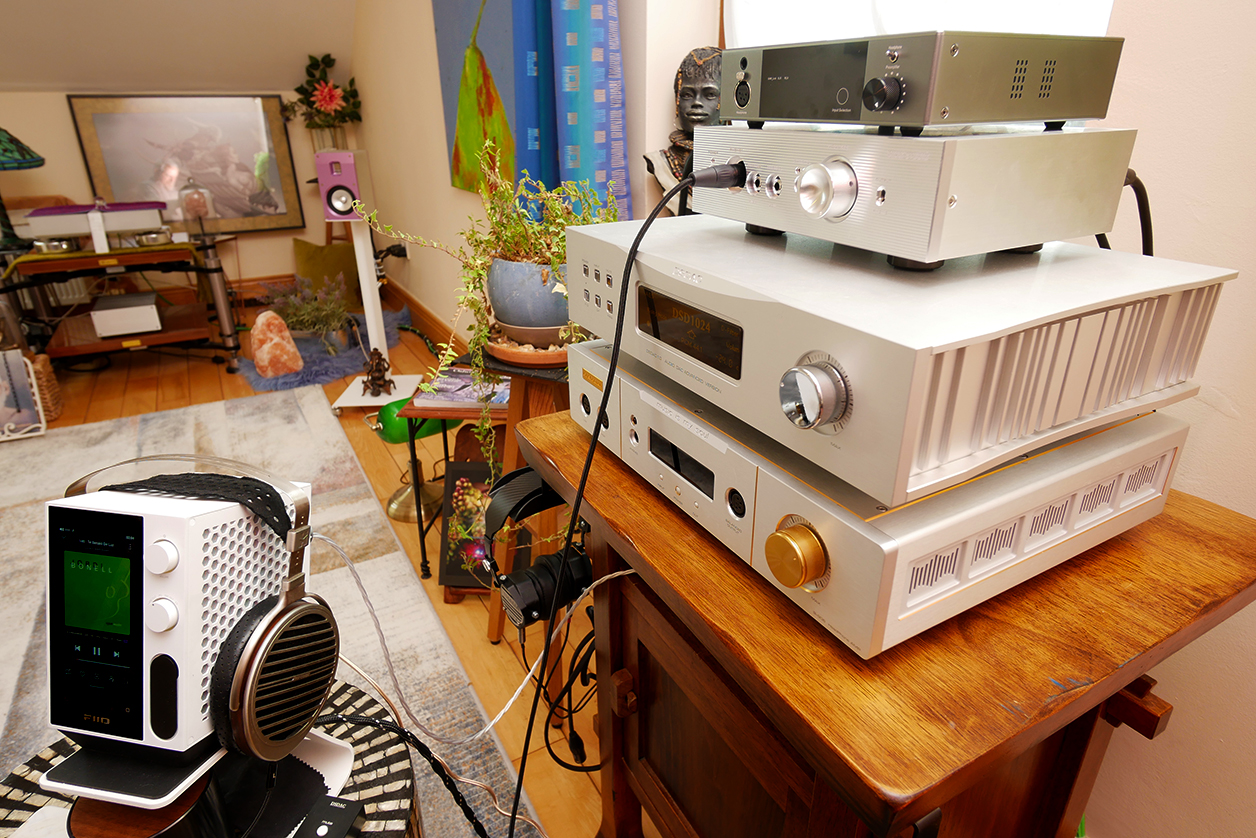
 Count the peas, please. The modest styling, scratch-prone 'spy glass', limited socketry, lack of a remote, display and frontal standby switch all made the ~€2K ask seem stiff; initially. Once I spent proper time with the P1x, I quickly came around to its price positioning by what its sound competed against. Not everyone wants to flash the cash with a polished ride. Some derive great pleasure from driving a seeming jalopy which leaves the ritzy rides sucking fumes and eating gravel when the light turns green.
Mind you, I'm not equating the P1x with a jalopy; just yesteryear's style. And I didn't assess its preamplitude because I no longer do preamps; and because on principle, I can't condone this price against the lack of numerical display or infrared wand. But for headfi I neither care myself nor on behalf of potential buyers. I would simply say that the P1x is a headamp before it is a big-rig preamp. That seems fair phrasing.
But what a headphone amp it is. Given its handling of Susvara and Immanis and how much voltage gain it still left in the bank, I can't think of a load which it won't drive with aplomb. I certainly didn't try an IEM of grotesque sensitivity since that concept would be too wrong to ever suggest never mind practice. None of my proper loads detected any noise whatsoever and regardless of 'on' time, the chassis never got more than lukewarm.
To recap sonics, my ears heard excellent control without overdamping, profound blackness, high contrast and resolution with excellent top-end detail. They didn't hear brightness, edginess, bloominess, softness or warmth. Against my inventory of class A speaker amps, nothing in fact gave away what I'd have expected of the claimed pure class A bias. Truth told, that was a relief. I no longer bat for that team unless a specific transducer needs more plumptiousness and weight. The P1x did weight without plumptiousness. I thought that a mean trick. In the spirit of constructive criticism, I'll also say that to correctly reflect its sonic standing and make their deck fully competitive with current contenders from the Middle Kingdom, Soundaware still have work to do. That includes their website, communications and on/off PR. They're not A-listers yet. So I'll call the P1x a Harvey Keitel type; a strong fearless character actor who runs circles around the pretty boys when it comes to his craft. And that's a real compliment which for the right shopper leaves nothing left to be done. It's for those who want it all—and I strongly suspect this includes otherwise willing dealers—that after the already eight years since I first covered the brand, Soundaware still haven't arrived. In this world rather than the circuit designer's office, it's not just all about the sound. It's about minting a complete package. In most recent memory, Laiv Audio's launch of their Harmony DAC is a perfect example for what that means in 2024…
Postscript. As I prepped the deck for its return, I decided on a lark to remove the owner's manual from its ziploc bag. And wouldn't you know it, there was a hard plastic sheet with a 'front' and 'back' sticker suspiciously sized/shaped like the spy glass. I now attacked that with my thumb nail et voilà, a sticky film came off. Underneath was a shiny immaculate surface. Whilst the smartphone-style sheet protector does rather suggest that the exposed acrylic is scratch prone, fairness demands that I correct my initial impression. What looked scratched and dull already was merely translucent protective shipping foil. My bad! Also, whilst repacking the P1x, a closer look at the box's origin address showed Nanning Hongli Dingshen Trading not Soundaware. Presumably the latter is the brand, the former its factory in the Science & Technology Research and Development Park of Nanning, the capital of Southern China's Guangxi Zhuang autonomous region.