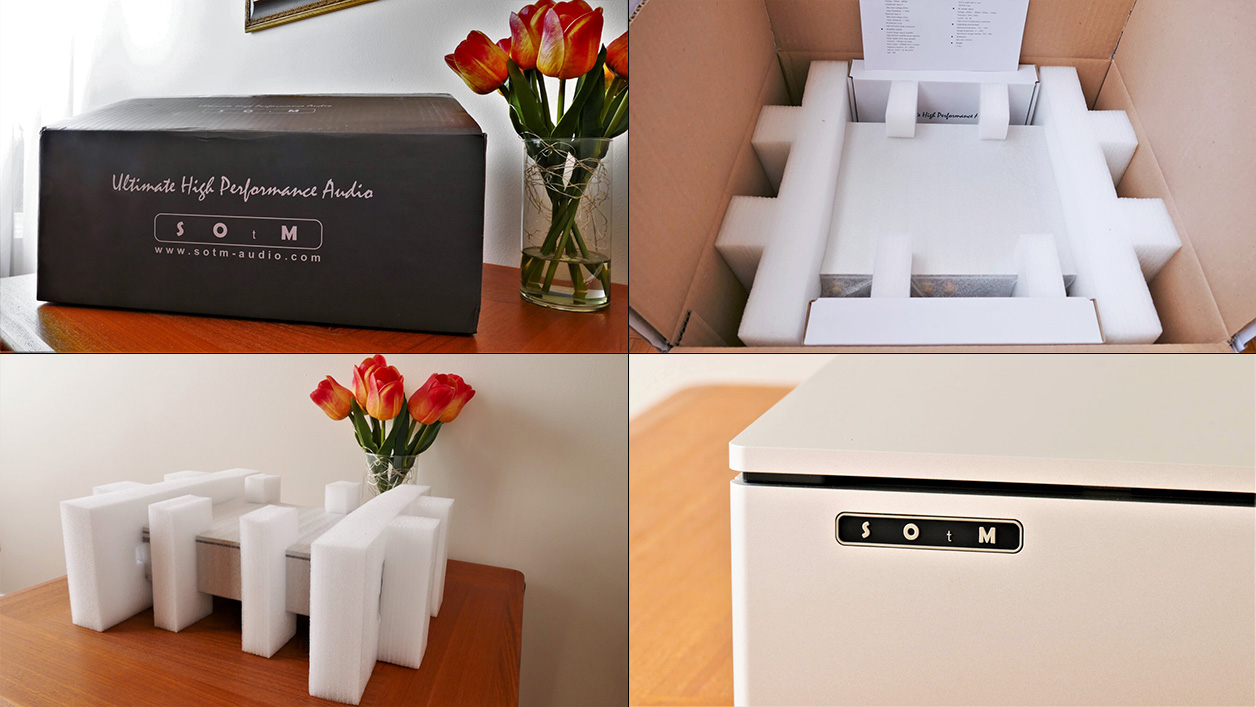
The SPA1000 is relatively compact and built to SOtM's specifications as a serious construction with understated aesthetics that match its Ultimate series companions. The casing is comprised of a folded aluminum sub chassis surrounded by internally fastened 5mm aluminum plates with rounded corners, recessed logo and a flush-mounted power switch overlay for high visual refinement. The top plate is a standoff affair with damping pads to provide ventilation and mechanical decoupling for vibration control. Resonance management continues on the vented bottom panel with not 3 or 4 but 6 strategically located feet which are weight matched to damp case vibrations and isolate it from the mounting surface. The amplifier comes in the traditional choice of black or silver. The loaner was silver with more of a champagne hue for added elegance.
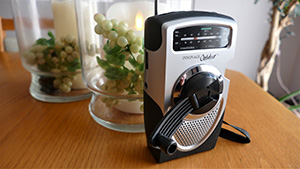 The Spartan fascia features a conservatively styled logo in the upped left corner and an unobtrusive relay power button flush mounted on the lower left. Power up/down is initiated by a light touch of the button, status indicated by a green LED located beneath the top cover which flashes during boot-up and goes solid when fully powered up. The business end has balanced and unbalanced inputs and hefty binding posts. The two RCA inputs are quite moderately spaced to not accept really fat plugs. All connectors are high-quality gold plated and custom made for SOtM. Remote 3.5mm i/o triggers activate via slide switch. A mains rocker controls the standby switch in the front. Power connection is via standard IEC and SOtM include a short length of reasonably thick AC cable which will do until you upgrade. A ground terminal is there just in case and that other switch to counter potential AM radio interference. All class D amplification is subject to this theoretical possibility due to switching in the kHz range although practical incidences are rare. SOtM forearm against this very small chance by allowing the user to change the internal switching frequency. To test this, I pulled out my trusty hand-crank AM radio but encountered no issues. So the switch didn't move.










Under the hood, much attention was lavished on the power supply with a massive high-current toroidal transformer employing active noise cancellation. To quote, "it is a DC/DC converter designed in house for the switching output stage so it actively responds to power voltage fluctuations to deliver constant DC voltage." Mr. Lee also sought to tackle power pumping when a speaker's back electromotive force modulates the amp's power voltage through the feedback loop. To combat this, his power supply circuit uses a differentiated function to remove that unnecessary back flow.

Signal integrity here is synonymous with fully balanced circuitry to immediately symmetrize the RCA inputs. As previewed by our editor, the power rating is moderate for class D, rising from 100 to 200 watts into 8 and 4Ω respectively and due to power supply limitations, falling back to 100 watts into 2Ω. This should be more than adequate for most but power hungry low-impedance monsters like the Apogee Scintilla will still look elsewhere. Signal to noise figures weren't available at press time but subjective noise levels in use were extremely low under all listening circumstances.