
In all seriousness, listening to the M15.2 drew me right back into our Danes' alluring tweeter tech. It has me ponder whether in 2025 I shouldn't add a Raidho X1.6 to my stable? Whilst that's otherwise meaningless—why would you care what I listen to?—if I add that if so, the M15.2 made me, it suddenly matters. So I mention it. I am, I admit, an audio extremist. I enjoy both frequency extremes maxed out. It's why down low I've adopted active subwoofers dovetailed via precision-analogue active hi/lo-pass crossover. It's why on high my best headphones use thrice-paralleled ribbons, my favourite speakers dipole Mundorf AMT. Still on the maxed-out subject, the M15.2 is obviously a prime candidate to add a compact ~€1.5K subwoofer. For similar coin to a €3.5K/pr 30.2, one could do an M15.2 + sub + active Sublime Acoustic xover. Without extremism on expense or visual impact, that would be a really impressive full-range system for regular listening rooms not in McMansions. One must just come to terms with M's ovalescence. I confess to being so brainwashed by the classic look of round drivers that the main driver's eggy trim never quite grew on me. That of course all goes away with one magnetic grill. Snap.
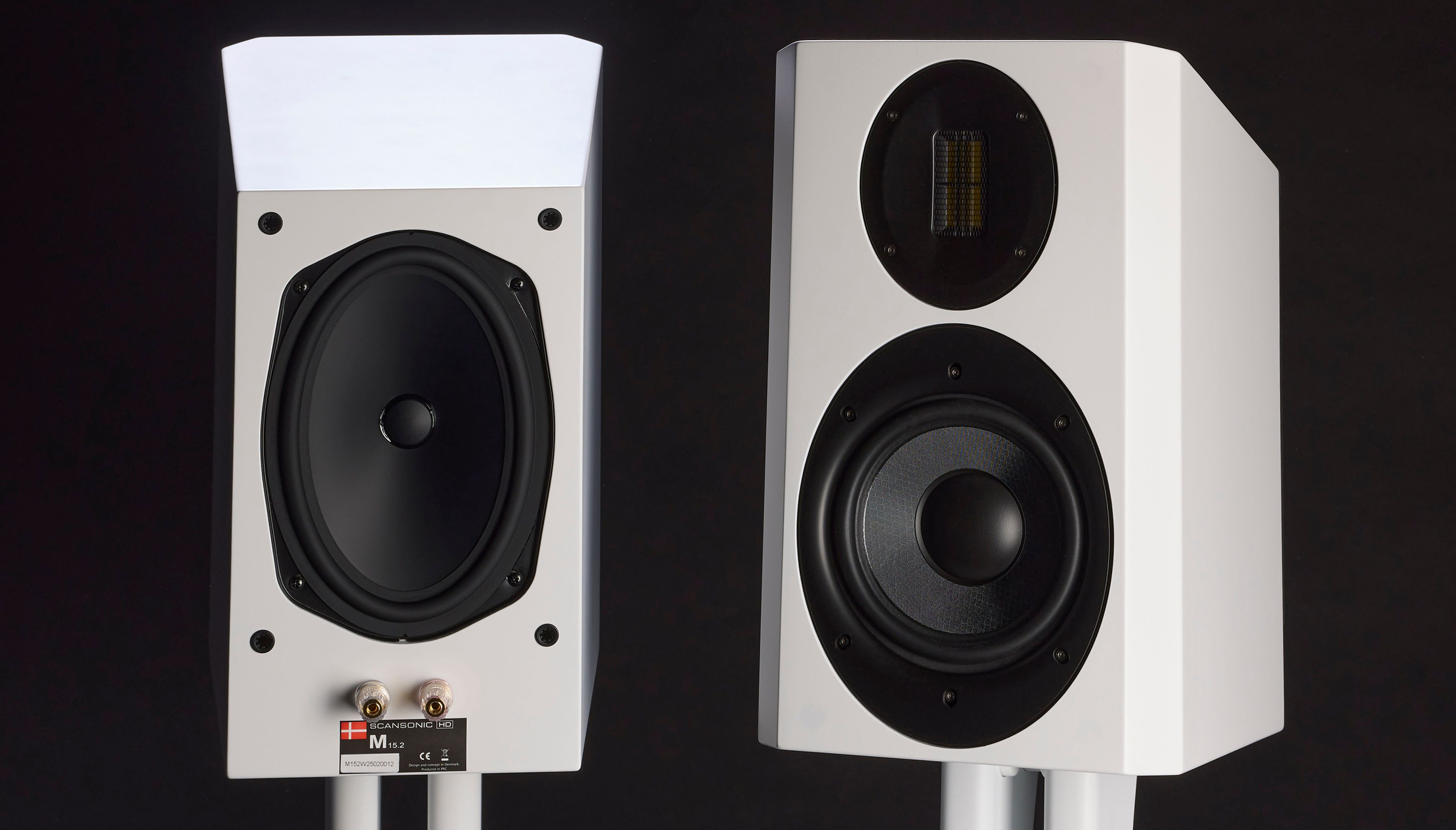
As the entry into Scansonic's newest range, the M15.2 offers more with its form factor, planar tweeter and passive radiator in lieu of the almighty port. Its tuning is musical not medicinal to emphasize substance and density over separation and analysis. Its thin-film HF unit is a bit of magic not only at this price. With black and white satin plus matching optional stands, it hits the two main contemporary preferences. M for thoroughly modern too is part of its menu. We already know the front grills to be magnetic so there's that. Mmmm. That's a lot of munificence which strikes be as mixing it up rather mega for the money. Before being accused of milking the poor 'm' for mere multiplicity, get this man his mojito. Cheers.
PS: To circumvent potential confusion on ribbons vs. planarmagnetics, the way I understand the terms is that a true ribbon is always a fully conductive long/narrow aluminium foil fastened only on its two short ends, with magnets running adjacent to the long free edges to not shadow the membrane. A ribbon presents as a virtual dead short given its very negligible resistance. That requires a transformer to raise its impedance to something a hifi amplifier can safely drive. A planarmagnetic driver adheres conductive traces to a non-conductive substrate to act as voice coil. It then drives the membrane which is edge-clamped on all four ends with a magnet array fronting one or both sides. Double-sided drive is often called balanced. The routinely serpentine traces of planarmagnetics create benign amp-ready impedance to require no transformer. By that definition, today's thin-film tweeters aren't ribbons. Other brands disagree and continue to call tweeters with non-conductive substrates ribbons. To each his own.