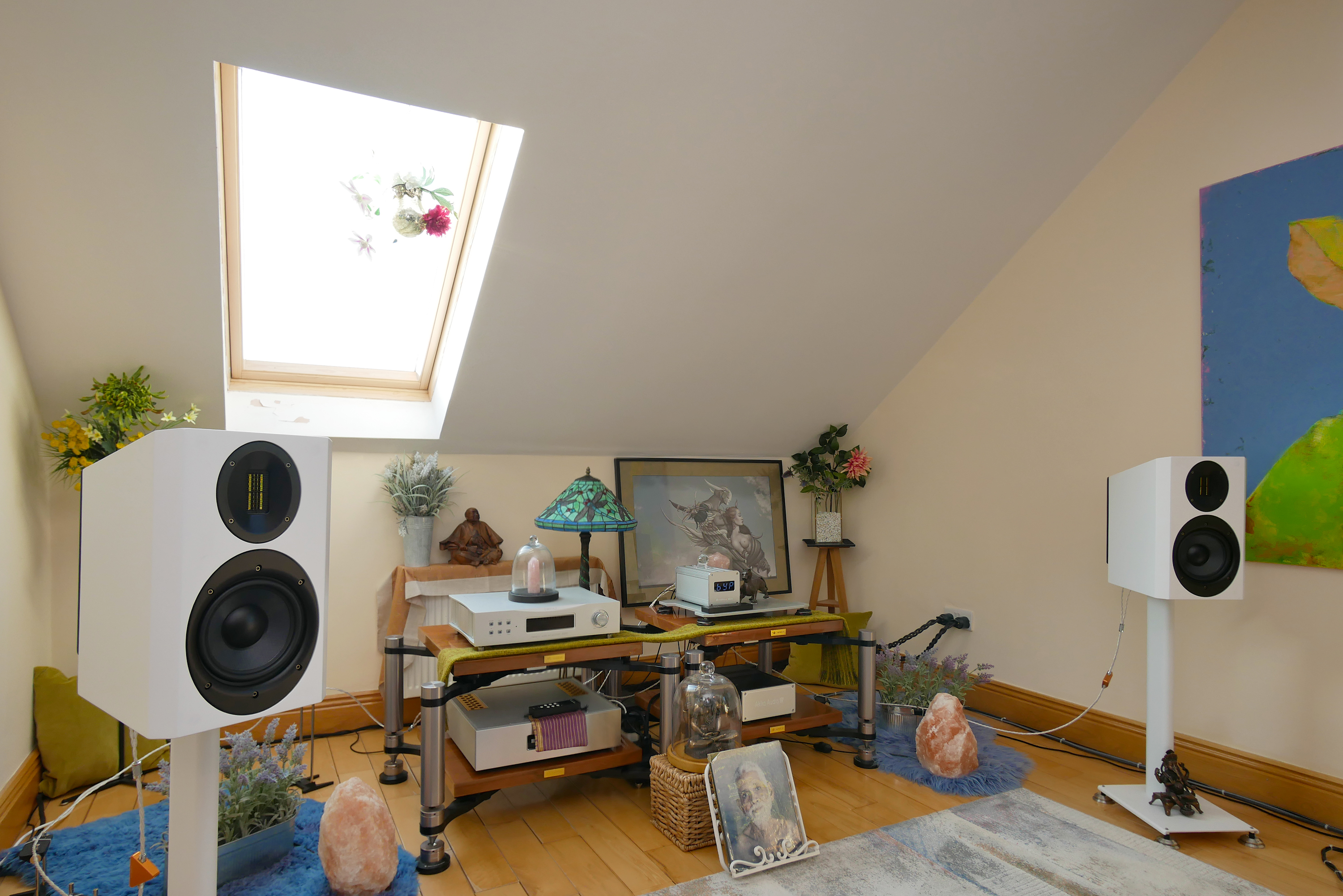
To take the musical measure, I bypassed my usual active analog crossover. That subtracted the left sidewall Dynaudio 2×9½" sealed force-cancelling subwoofer from the equation to run the Scansonic full-range. After all, anyone pursuing the monitor over its bigger M siblings presumably does so because its size/bandwidth is most appropriate for their room. But with one remote button press, I could reinsert the sub from the seat to check on differences in bass reach, control and textures. This would be a short exercise in keeping things honest. No passive speaker I know of competes with properly (!) dovetailed active bass. I'd not hold that against the compact Danes. The with/out sub comparison would simply quantify what remains beyond their grasp; and what the oval passive radiators do to/for bass textures and timing. But first the other end of the highs. Like the Raidho models I hosted, this downscaled planar tweeter is very extended but of a golden not platinum hue to never telegraph sharp or etched. This captures not just the initial metallic flare of cymbals and triangles but the follow-on brassier heavier elements. You'd never call the M15.2 zippy, nervy, top down or lit up yet when the op – um, strikes, you'll hear surprising and elegant illumination not polite cloudiness. Ditto for the small dip in the presence region. As we descend, there's more transient softness to paint with a fatter tip and prioritize body over separation. Despite the extra cone surface of the rear radiator, the low end isn't emphasized like a somewhat unnaturally hung Buchardt. Here we're good to ~40Hz not 30Hz. I heard the primary benefit of 'bipole' bass—a misnomer when at this cab width, the LF radiate omni regardless of the radiator—as more density and weight not raw reach. So don't expect a bottom-up but midrange-out tuning if that makes sense.
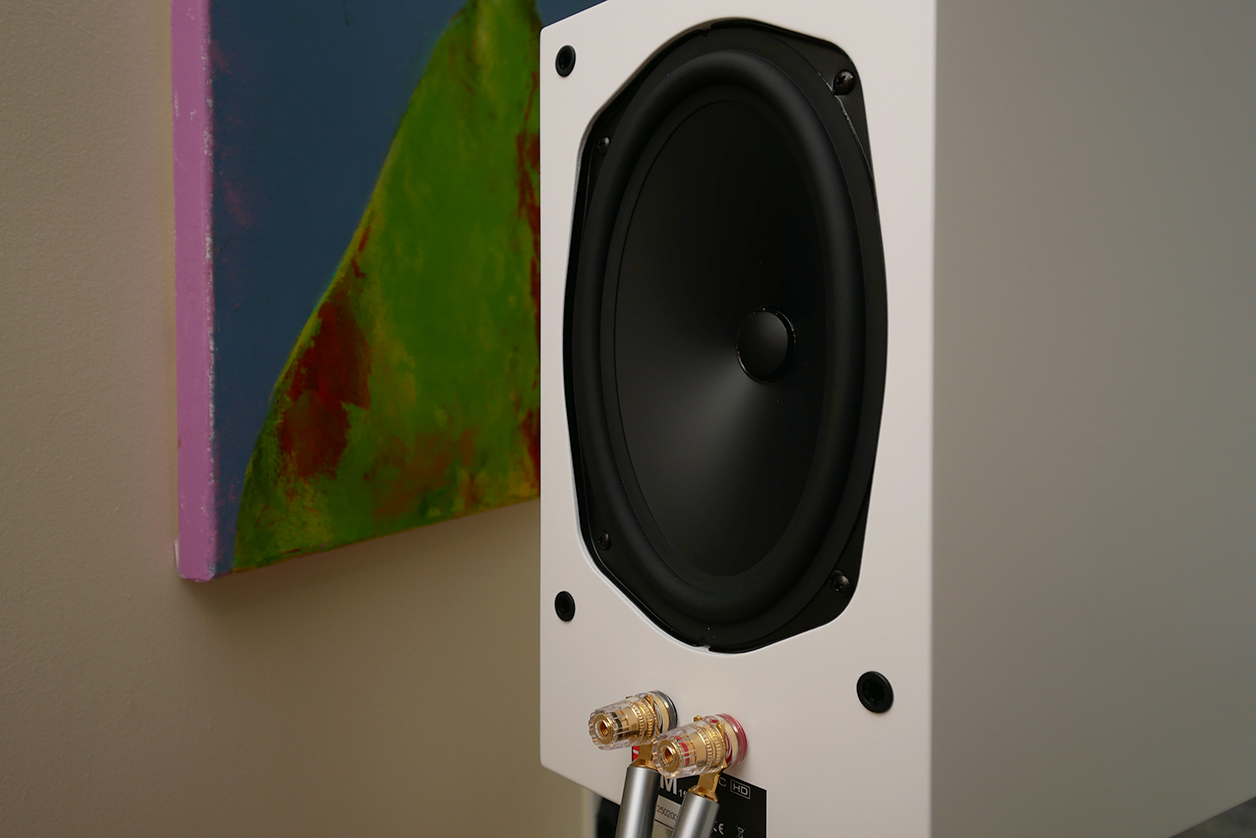
 The front grills attach with magnets, the rear grills with rubber grommets.
Doing my stay-honest switcheroo of the Dansk sub from Dynaudio's Pro division, I had the expected appearance of the 1st octave sometimes called sub bass. Yawn. Cap'n Obvious on deck. The more relevant distinctions were the tauter more damped textures and snappier timing from a sealed fully active alignment. The M15.2 played it more relaxed and warm. With plucked strings, it had the typical effect of shifting my attention away from the leading edge onto a sound's bloom. That gestalt isn't edge-of-the-seat or 'front-loaded' timing as we'd get from a 1st-row seat close to stage. It's subtly more diffuse, resonant and thick as us seating deeper inside a venue creates. Et voilà, that hygge hug I predicted going in. It proved factual not fanciful. Alas, those visual "ribbons" of yellow tweeter membranes counteract us moving too deep into the virtual venue. For that their responsive reflexes are too informative. Just so, Raidho-level resolution isn't what the M15.2 is about. Again, yawn. If it were, Dantax Radio as the parent company of both brands would be in the sales-prevention business for their upscale division. Before this begins to smack of damnation by faint praise, let's call this enough honesty or relativity for a day to discuss this Scansonic purely on its own €1'500/pr merits.










As soon as we do, we ask ourselves what said budget buys us elsewhere on cab and driver sophistication. With AMT the current rage, that's usually as exotic as it gets in today's class. With three of my residents armed with AMT—two with dear Mundorf issue, one of lesser pedigree—none have the subjective extension or golden hue of the M15.2. My boxes start out at €2K, then hit €6K and stop shy of €10K. That puts the Scansonic in heady company. And I said 'boxes' fully deliberate. All of mine are that; rectangular boxes or bass bins. None go the extra mile of Scansonic's form factor which is harder to make. Enter the ubiquitous port which, crickey, shows up in triplicate on my lot. They're all ported. Here too Scansonic do us one extra with their passive radiator. With that established, back to our Scandinavian sonics. Dennis Had, long-retired founder of Cary Audio, coined the term 'deep triode'. It stood for copious amounts of 2nd-order THD from classic no-feedback SET amplifiers. By contrast, modern variants of the breed would be called 'light triode'. They go for less colouration from lower distortion. With copasetic speakers, it's less about comfort sound and more about resolution without leaving the comfort realm altogether. That's key also to the M15.2. It's about a comfort sound with rather above-average resolution particularly from its tweeter. It's thus not warm yet dull, thick yet pudgy and whatever other polarities we could conjure up in this sector. The warm/thick attribute factors but is tidily kept in check by the planarmagnetic's more informative contributions and faster reflexes. Whilst that could read like an underhanded way of suggesting mismatched transducer tech in classic true-ribbon style where a dynamic mid/woofer doesn't keep up with a tweeter's reflexes, that's not the case. Scansonic deliberately tweaked their tweeter's behaviour to not run too far ahead to cause discontinuities. It requires triangulation with standard textile domes to notice the planar's advantages. As married here, they're embedded – real but not self-referential. Where the model name's 'M' stood for 'more' in the beginning of this paragraph—buying more advanced tech for a given layout—now it stands for 'middle' as in, balanced. Its three drivers perform nicely balanced. They walk the middle path, not the showier extremes.
Having said that, after cross-checking with my Raal true-ribbon earspeakers, I revisited the Scansonic speakers on the same 'deep treble' tracks containing super-fine HF trickery which most speakers merely hint at or skip altogether. Ultra low-mass über-vented aluminium ribbons within centimetres of one's ear drums are capable of treble minutiae which distance losses, ambient noise and slower heavier speaker tweeters fail to resolve. At SPL somewhat higher than background, Scansonic's planars did not. You, I and our accountants know full well that there's no way in hell the M-range tweeter is as good as Raidho's finest. The laws of commerce just won't have it. And yet, it already performs clearly better than the majority of HF transducers and certainly the vast majority we meet in this price class. It doesn't produce the firefly-swarming global shimmer of upper harmonics I recall from my Raidho dates and which German colleague Ralph Werner noticed for himself in our recently syndicated X2.6 review. To quote, "… we now enter resolution with an exclamation mark because one of the X2.6's core strengths is never getting boring. While other speakers with a friendly presence tuning can sometimes come  across as too polite for lack of resolution—translation: boring/uninspiring—the X2.6 was the exact opposite. Not just but also because of the proprietary thin-film tweeter, it dished out such a cornucopia of detail and rendered overtones so accurately as to have an uncannily positive impact on the overall sound. Leonard Cohen for example didn't just 'hum' at me in a darkly sonorous way but bared his rough brittle textures to convey that sense of 'realism' we audiophiles chase with albums like Dear Heather. It was a similar thing with the cool song "Party Girl" by Michelle Gurevich which I recently discovered by chance on the compilation Agnes Obel: Late Night Tales. It felt super intimate and utterly appropriate for this minimalist melancholy number. Of course not just voices benefitted from Raidho's first-rate resolution. So did instruments. The more overtones there are, the more fascinating tone modulations and timbres get. How the glockenspiel in Björk's "Frosti" on her Vespertine album shimmered in such finely fanned-out manner was simply fantastic…"
At €21'000, Raidho's X2.6 is 10 times plus the wallet spasm. It's thus relevant that already the M15.2 opens that same treble skylight a good crack whenever specific high tones occur so not as a constant milieu but occasional flare. Given where we play today, that's quite extraordinary and in my mind the highlight of the M15.2; what retail calls USP or unique selling point. Or to get crass, most manufacturers would call that tweeter far too advanced for purpose and use something less capable to keep their costly fare suitably exclusive.