
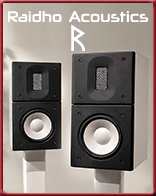
My extended night at Oscar's would, until the loan expired, live up what I couldn't afford to hear on my own nickel. To now wrap the intro and get past appetizers to the main plate, let's reiterate that unlike certain competitors, the TD1.2 drives no off-the-shelf rubber. Its drivers are exclusive to Raidho and not even minorly modified OEM stock. As shown with the actual model crossover, the parts for the compound filter are exclusively from Mundorf. The speaker/stand interface applies roller-ball decoupling. The terminals are single-wire, the port is on the top end of the narrower spine. Each monitor weighs 15kg and measures 20 x 36 x 41cm WxHxD. The matching stand weighs 4.8kg and measures 32 x 78 x 42cm WxHxD. The final assembly thus stands 114cm tall.
 My bed made in red.
To segue into sound, let's set the stage with a recent industry feature dubbed Unattainable. Here goes:  From CNN Entertainment, September 9, 2022: "Zac Efron was ripped when he appeared in the 2017 film version of Baywatch but now he's speaking out about how difficult it was to get into that type of shape. "That 'Baywatch' look, I don't know if that's really attainable," Efron told Men's Health in an interview published on Wednesday. "There's just too little water in the skin. Like it's fake; it looks CGI." The actor currently bulking up for an unnamed role said that shaping up to play Olympian-turned-lifeguard Matt Brody "required Lasix" and "powerful diuretics"… "I started to develop insomnia and fell into a pretty bad depression for a long time. Something about that experience burned me out" said Efron who added it took six months to start feeling better. "I had a really hard time re-centering. Ultimately they chalked it up to taking way too many diuretics for way too long and it messed something up."
The list of manufactured beauty and fitness ideals is extensive. It includes anorexic runway models, heavily retouched fashion shoots, young fit actors whose on-screen characters (seem to) consume copious amounts of alcohol, junk food, drugs and cigarettes as though such lifestyles would take no toll. To attain their chiseled fitness and absentee body fat in the first place entails unnatural diets and obsessive workouts; or CGI, image retouching and extensive cosmetic surgery. Famous model Linda Evangelista's disfigurement from a CoolSculpting procedure gone wrong is just one aberration we learnt of because the former super model spoke up.
The impact on mental health which the unrealistic pursuit of arbitrary man-made ideals creates is probably far worse than the occasional courageous celebrity exposé suggests. As long as it remains big business to manufacture such ideals then sell products and services that promise to attain them, little will change. We've all read about what enforced celibacy has done within the Catholic church; seen how the refusal to age gracefully can get grotesque with celebs obsessed with elective surgeries. Skin whitening is a multi-billion dollar/yr industry. Modern teens get collagen lip and other injections. Influencers starve themselves for weeks to get into an undersized dress for a globally broadcast event. Shredded bodybuilders and actors like Zac Efron must severely dehydrate to look ripped. None of it is natural, healthy or sustainable without extreme behaviors. Does high-end hifi promote similarly unattainable ideals whose pursuit creates unhealthy extremes?









There's the bogus ideal of an absolute sound. How can anything be absolute when music style, venue, seat and amplified/unplugged performances differ grossly? How can it be absolute when recording/mastering hardware plus editing decisions run the gamut yet are utterly non-transparent to consumers? Aren't room size and shape, listening distance and playback SPL more factors which skew absolutes? There's the bogus idea of realism. Hifi is just an illusion. There's nobody there except us and our system. Then we try to reproduce multiple original sound sources over just two speakers. That's more improbability. Half the time we listen to ensembles whose size exceeds what our rooms could host live. Realism gets even more bizarre with headphones then reaches its apex with orchestral fare. There's the bogus idea of fidelity when we can't know what's on any recording without first using hardware to decode/unpack it. Fidelity doesn't exist in a vacuum. It relies on a relationship to something/someone. If that something is unknowable per se—like staring at a CD without knowing what it'll sound like—how can we know whether we're more or less true to it? There's the bogus idea that numbers correlate with the quality of our experience. Such specs are our equivalent to believing that somebody's 'perfect' body guarantees deeply fulfilling sex and a long-term loving relationship. What if behind their idealized physique hides a deeply insecure psychology with annoying habits, insensitivity or far Fargo worse?

Such musings can help us inspect our expectations. My #1 hifi aim is to remove energetic reluctance between me and playback sound. Despite their flaws, good high-eff widebanders come close to the desired quickening, immediacy or directness. In the dynamic domain, good horns show a way. Because I don't listen very loud, their kind of dynamic twin turbo plus required size aren't for me. My hit of suchness must come from elsewhere. For electronics it's led me to passive-magnetic volume controls; lossless DAC-direct mode via 16Ω output impedance and variable reference voltage on R2R ladders; and direct-coupled class A/B amps of very high bandwidth running Exicon lateral Mosfets. For speakers my ideal solution is still less defined. So far I've settled that a 2.1 hi/lo-pass labor division at ~80Hz really works to let compact monitors handle the above, a big cardioid subwoofer the below. Ripol bass minimizes room reflections, their impact on the time domain and riding room modes. Its principle is velocity conversion not pressure generation. Putting dual 15" woofers to work on the same type amp as the monitors must help the seamless mesh in its own way. Other than no longer needing/wanting 'full-range' mains, what other qualities or tech should my ideal speaker pack to let me hear music with fewer intermediary buffers that behave like energy brakes?