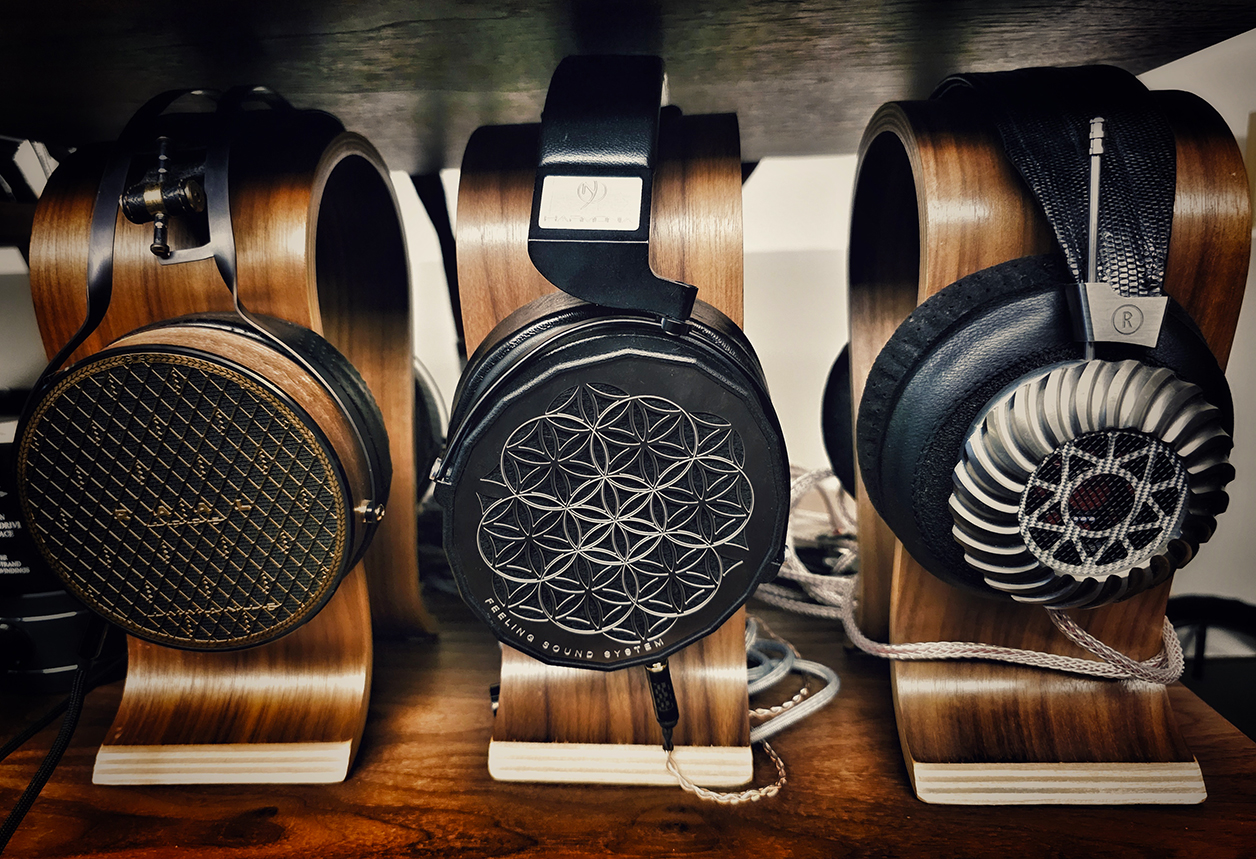
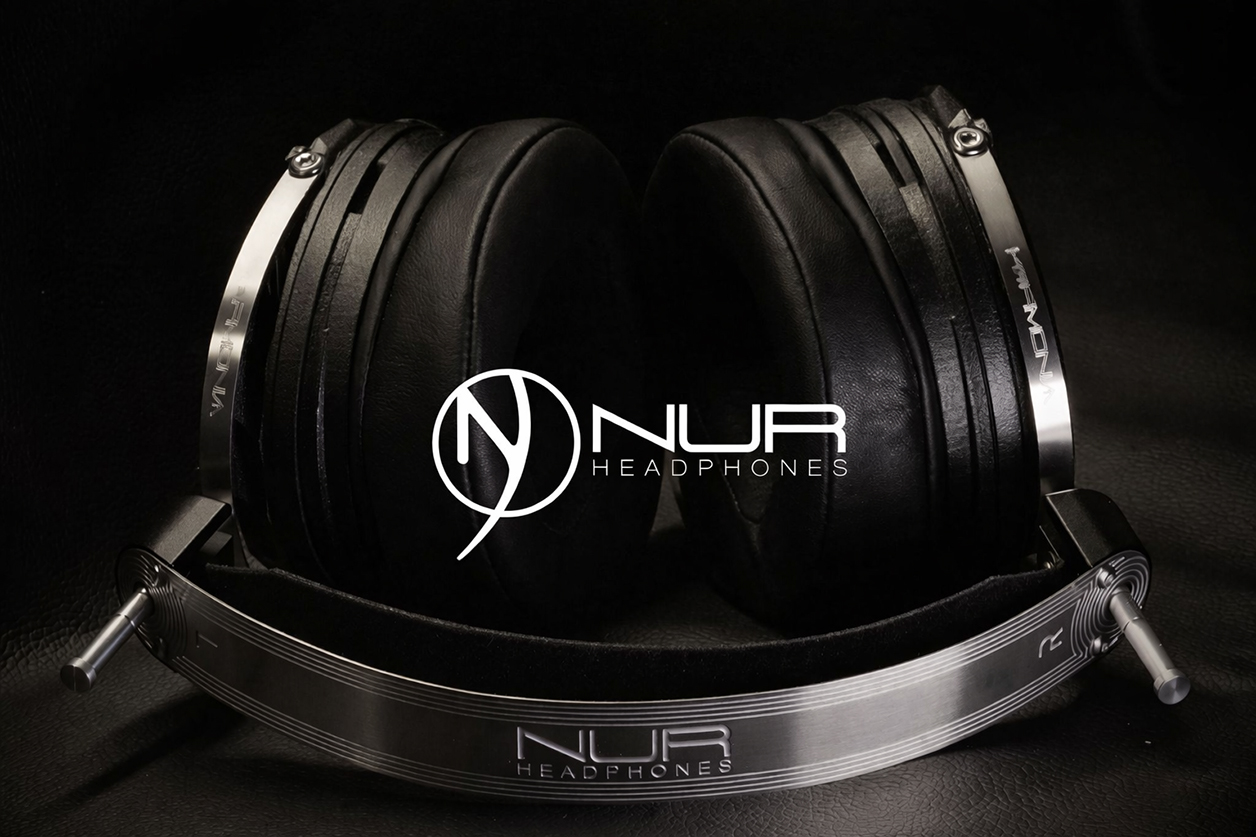
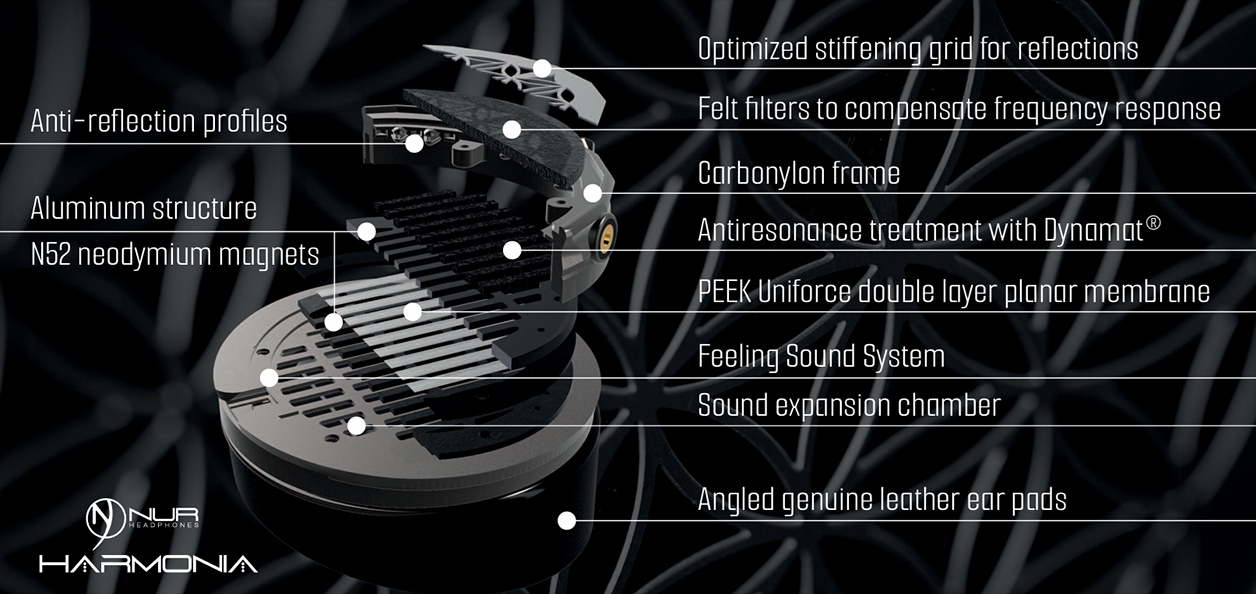
The build is premium, very solid and functional though without much concession to luxury per se while every element of the assembly was selected for well-defined engineering purposes. From the stainless steel outer grille whose "Flower of Life" motif minimizes reflections while still providing stiffness to the short-fibre-reinforced carbo-nylon plastic frame and sound expansion chamber—two complex mechanical pieces realized with 3D printing—held together by the aluminium structure, Harmonia's body was designed for a high rigidity-to-mass ratio to reduce colorations assisted by various acoustic treatments. While I admire 3D printing for realizing shapes impossible for CNC machining, for a headphone of this level I would have preferred a fully metallic frame even at the inevitable cost and weight penalties. The driver is a 105mm isodynamic with powerful N52 neodymium magnets and a 3µF Peek membrane. As do many smaller brands, Nur use a driver package from Fine Acoustics customized to their needs. The substantial 630g weight would be hard to undercut when the drivers with their aluminium elements come in at ~280gr/ea. but the headband makes for uniform distribution which, combined with the plush leather pads, allowed multi-hour listening sessions without fatigue or soreness. After almost six years with the Abyss AB-1266, I'm used to heavy headphones and have never been bothered by them. Rather, my issue is excessive clamping force where Harmonia provided a pleasing sense of embrace on the ears and jaws that is so integral a part to the full-sized HeadFi experience. While writing this review, Angelo informed me that a revision of the headband for both the structural part and elastic band has released to further improve wear comfort. To all current owners, this replacement below is available at a modest cost.
The stock cable was designed in collaboration with Italian boutique brand 1221 Hi Fi Lab. It is a 6N OFC 8-core braid where four conductors are copper, the other four silver-plated copper. The cable is not particularly fancy yet has a pleasing multi-tone aesthetic that blends well with the headphones; and nice ergonomics thanks to light weight and flexibility. Harmonia publishes a frequency response of 8Hz to 50kHz and sensitivity of 107dB at 48Ω which on paper suggests a relatively easy-to-drive planar.
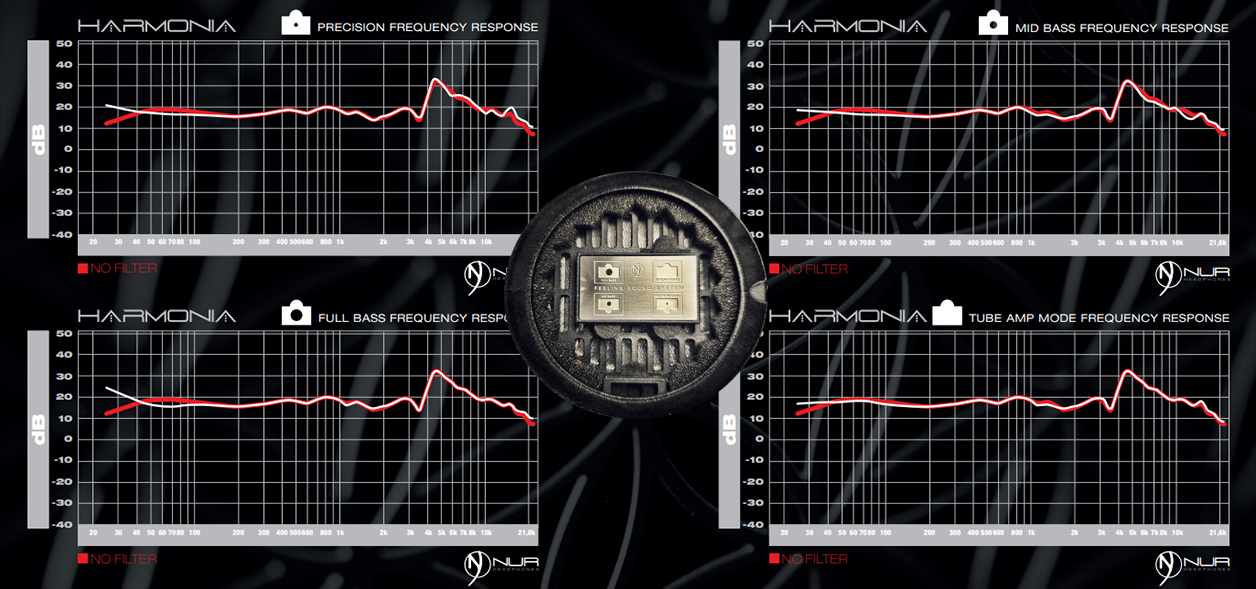
The FSS Feeling Sound System is a unique feature to fine-tune the acoustic response from about 200Hz-20Hz. It consists of two sets of four felt pads of variable pressure resistance easily slipped into a dedicated slot which regulates the pressure drop between enclosure and expansion chamber. Up to two pads can stack to form a true modular mechanical EQ system. To access the slot we must remove the earpads which is an instant move whilst putting them back fiddlier. A magnetic system would have been ideal for frequent filter rollers. The airflow effect of the pads modulates by varying the size of a hole. The logic is that by moving from the no-filter to strongest filter configuration, bass extension increases as does damping. This alters the profile from snappier yet slightly less linear to tighter and deeper. FSS is no gimmick and noticeably changes the sound signature. Here is a more specific breakdown:
Further customization of the response is achieved by stacking two filters in the same slot, an exercise I didn't have patience for. However, it was clear that FSS is capable of changing the presentation enough to cover a significant part of listening modes and/or to adapt to music genres, a feature which to my knowledge no other full-sized headphones on the market have developed to such an extent.







During my three months, I experimented with the various filters and several amplifiers like the Lotoo Gold Touch Ti DAP, Solaja Master 300B SET, Riviera Labs AIC-10 and SAEQ Astraeus hybrids and finally the Aries Cerat Ianus Protos TriodeFET. What struck me from the very first note and remained valid throughout can be synthesized in one word: welcoming. Harmonia is a rare example of a technically accomplished ultimately very resolving piece of kit that manages to cast a benign spell over everything. This treatment conveys not as massive editorializing, homogenization or over-smoothing but rather as though looking at our music with a maternal approach, the natural spontaneous attitude of seeing the good in every creature. People who always see the best in others are often loved in turn and this is just how my connection with Harmonia clicked. My first reaction was as if the HifiMan Susvara and Audeze LCD-4 had a baby. The Nur sound is built and centred on a smooth inclusive midrange supported by a plush slightly warm bass foundation expanded and elevated by a tasteful treble where airiness, definition and resolution conjoin in gentle fashion. With such a profile, Harmonia presents as a natural-born all'rounder whose enjoyment of music is not driven by some outstanding feature or technical capability, rather from how well balanced the overall mix is. For this reason, trying to break down the performance of these headphones piece by piece as I will attempt is not necessarily the most meaningful way to describe them – or do justice.
Bass is full, satisfying and of good even great articulation with appropriate filter and amplification, never overbearing or excessively bleeding into midrange obscuration. With the lull bass filter, Harmonia challenges best-in-class headphones like Abyss AB-1266 TC or Audeze LCD-4, only missing the last bit of subwoofer-like ear-chamber pressurization which the top performers in this discipline can deliver. With its balanced mix of bass reach, speed, heft and control, Harmonia make listening to percussions or heavily plucked instruments, electric or electronic bass very enjoyable with plenty of energy and drive. Pop, Blues, Jazz even electronica all benefited greatly from these attributes. The midrange is Harmonia's major strength. This is the most human band in whose soil roots music's core emotional connection. Clearly this was given top priority and paid off in a very inviting, organic and harmonically rich presentation. The obvious result is that vocal tracks are a joy to listen to thanks to a thoroughly natural grounded timbre minimally coloured by a warmth infusion and a certain forwardness of localization, both helping to create the physical liaison between listener and singer. More generally, acoustic instruments stand out for their credibility not just of timbre but transient structure, size and harmonic projection.