The nth degree. If we're locked and loaded, further labours in the digital fields mean n=nano. If we want the mth degree for mega not Masons, the speaker/room frontier holds massively larger returns. Other than DSP-controlled active streaming speakers which package the lot, a broad swath of signal-path stations exert varying sonic influence. It stretches from polishing up the digital domain for smallest returns to fixing acoustic-mechanical flaws once drivers move air in enclosed spaces for biggest gains. Where resides the nth degree? In digital's least significant bits. That means just above the noise floor. It's the place of plankton. Here live the faintest ends of decays as the least of the recorded reflections. Ditto the highest upper harmonics in the overtone envelope of performers. Trailing edges map space like a comet tail lights up a night sky. Made audible, the highest harmonics broaden timbre variety. Tone colours gains more specificity. By lingering, tonal fades stack overlays. It's like depressing subsequent piano keys with a lifted damper pedal; like surrounding sparse wispy vocals with artificial reverb for extra fill. It enriches textures unlike an overdamped semi anechoic milieu. That clips off sounds for blunt foreshortened endings. Really, the apparent emptiness between images isn't interstellar vacuum. It's populated by plankton; an Indian summer's floating spider webs called gossamer. Once properly illuminated, audio's proverbial blackground isn't nothingness. It's nano presences of subtlety. They even impact our temporal perception of feel. Already microscopically longer lingering adds fluidity. Cut-off sounds march through time more clipped. A dash more staccato than legato. More edge than flow. For the nth degree to magnify, we need proper conditions. High overall system resolution means minimal self and ambient noise. It means low time confusion from reactive crossovers, misaligned drivers, phase shift and limited bandwidth. We need superior tweeters capable of tracking super-fine upper harmonics and air. We also need free attention. To overstate, if our thoughts are still louder than tiny sounds, our awareness won't notice them. Wanting to be attentive enough needs desire. Enthusiasm. We do it because we love it. Yet between people there are varying degrees of engagement, listening skill, noticing and what relative values we place on what we notice. Even a given individual's capacity varies with listening sessions. Now we have the small print for today's exercise; and where to focus.
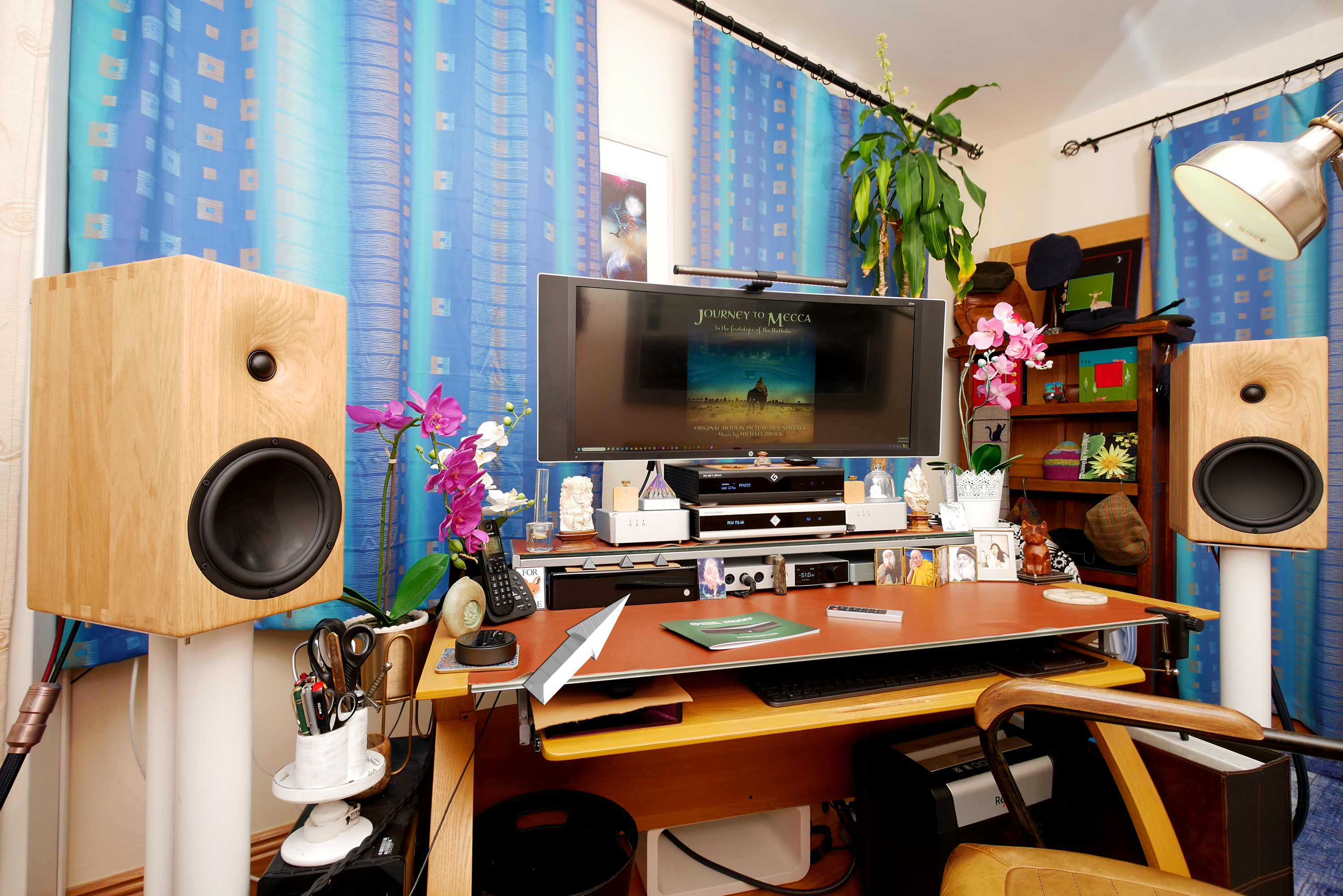
On heightened spatiality—defined depth layering with highly focussed images in 3D space—my resident switches already excel. I can't claim that the muon² overtook them in said discipline. What it did do was deepen tone colours and the flow-state feel of music moving through time. This was audible enough to notice and appreciate, just not by a margin that made reverting to my status quo a let-down. I acclimated back quickly still in possession of €8'000. Parachuting into my no longer basic but carefully curated conditions didn't leave much room for further gains in the planktonic domain. The surprise was of sufficient room that I noticed when it was suddenly occupied by still more harmonic micro data and textural give. Think of a celebrity chef's insistence that an assembled plate of food be served toot suite. To them, any time spent on the server counter—or the august Escoffier forbid, under a heat lamp—incurs losses in freshness, taste and texture. Would a McDonald's regular notice? Would a Michelin star inspector? I don't view my ears as well trained as those of a good recording engineer. That'd be our sector's equivalent of a Michelin taster. But even to my ears, the muon²'s advantage was sufficient enough to matter. It's simply important to keep that observation proportionate to its expense; to how much more it achieves when applied to signal-path junctures that respond with far more untapped headroom. The proper sequence matters. First we attend all the big issues. Once sorted, previously masked smaller imperfections rise up. We address them. Once sorted, even smaller limitations might surface. Rinse and repeat. We keep peeling this onion until our hifi funds or interests run dry. It's reminiscent of an old advertising slogan. What to get the man who already has all? The muon² network switch is what to get a hifi that already has everything. Coming last means that we already removed thick layers of crud atop the final thin layer which muon² targets—network streaming. Its error protocol mostly guarantees bit-perfect transmission; unless we suffer Internet bandwidth issues as drop-outs. That's how I see the proper sequence; and how we maximize today's returns which attenuate vastly out-of-band noise and how that impacts our D/A conversion thus the quality of the analogue domain.









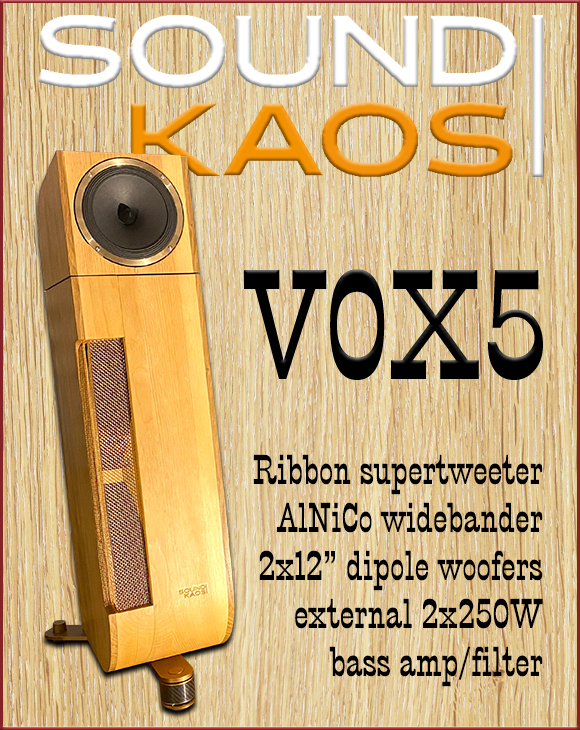
Meeting Mister Biggs? Bigger system. Bigger bandwidth. Bigger staging. Bigger SPL. Bigger scaling. Knowing where to focus, would Mr. B throw his weight around; or rather, that of muon²? Would I play catch? For these sessions I ran quality recordings from my library's classical clarinet chapter, be it Weber's Concertos played in the French style by Pierre Génisson or more Germanic by Michael Collins; Martin Fröst's faux but fabulous Vivaldi; Sabine Meyer's take on Schubert's Octet; or the devilishly virtuoso Françaix Concerto impeccably performed by Kevin Spagnolo. Having played them except for the Vivaldi whose commission occurred long after I set aside my blackwood, I can inhabit these works far more fully than a casual tourist. Given my setup's 20-metre CAT8a stretch between desktop and main system, the usual office switches remained in play. This comparison was between the two switches on the far end of the LAN line; and muon². Once either fed cloud files into my dedicated music iMac's network card, those files processed with Audirvana Studio's exclusive protocol to bypass MacOS. Its r8brain engine applied x 4 upsampling to 176.4/192kHz before the files exited USB into a LHY isolator of single i/o. That acts as noise buffer between Mac and DAC just as the switches do between router and PC/Mac. The R2R converter is a Sonnet Pasithea. Analogue gain sets by remote with a balanced quad of silver-wired attenuation autoformers in a Hattor Audio ARP-S. After that the signal hits spl's Crossover MkII set to 4th-order/100Hz. Its high pass meets a pair of Kinki Studio EX-B7 monos driving Qualio IQ. The low pass sees a pair of NC500 monos from Nord Acoustics. Each of them drives one of the two 15” woofers inside a sound|kaos Gravitas D15 folded-dipole sub. The latter's RiPol or 'super-dipole' dispersion pattern in conjunction with a pair of active PSI Audio bass traps active below 150Hz is my very effective room treatment for LF. It stands in for what otherwise would have to be massive passive traps.
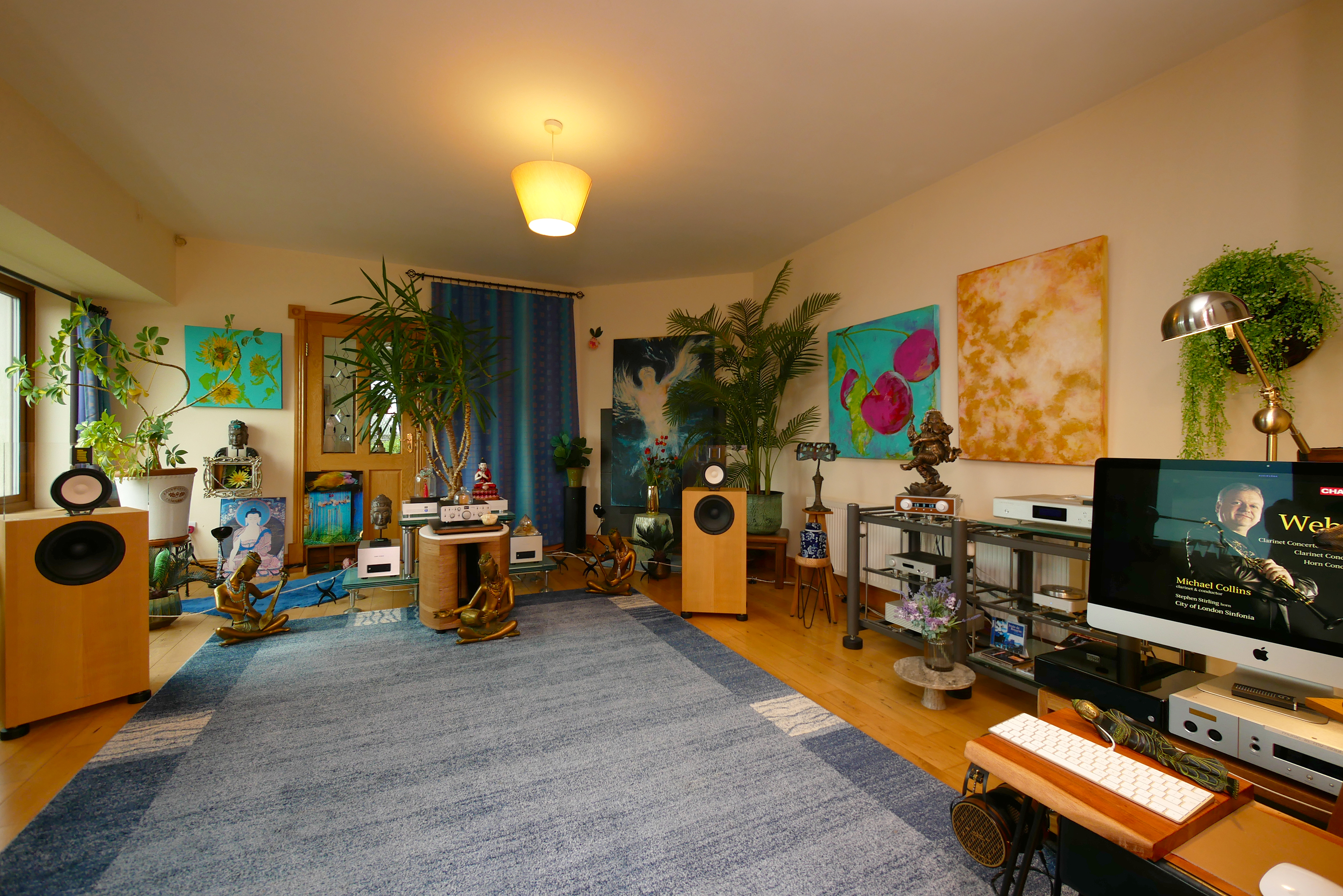
To track air, gossamer and other minutiae of the nth degree, I had a combination of 6" Papyrus-cone SB Acoustics Satori run as dipole widebanders well past 10kHz before handing off to a dipole Mundorf AMT on a shallow slope. Unusual HF surface area of the combo plus the 5:1 velocity-transform principle of the pleated tweeter plus open-backed operation create high treble dynamics and insight—deeper and steeper than Buchardt's soft dome on the desktop. In short, the table was set for Mr. B to show off; if he had anything. He did; a rerun of the office expanded in magnitude particularly on the overtone score. How best to explain that effect? Hello kitchen for one of my quickie bowls. Peeled cubed cucumber. Cubed carefully rinsed ready-to-eat beets. One finely minced shallot. Crumbled feta cheese. Garlic granules. Mix. Add chili oil with peanuts, balsamic vinegar, tamari and honey. Mix. Eat. The hot, acidic, salty and sweet injections punch up the humble main ingredients. They add zest. Rather than cancel each other out, they build tension between flavour polarities. Likewise for the audibility of higher harmonics. They inject a sense of added zest. This differs a lot from 2nd-harmonic dominant SET sugar. Rather than homogenize in the name of prettiness, recorded upper harmonics that step out to inform timbres deepen our music's flavour profile. It's on that score that muon² made its presence known with a slightly more generous hand.