Landing zone N°1. Muon² first parachuted into my office. Here it augmented my two existing fibre-slaved switches then replaced them.
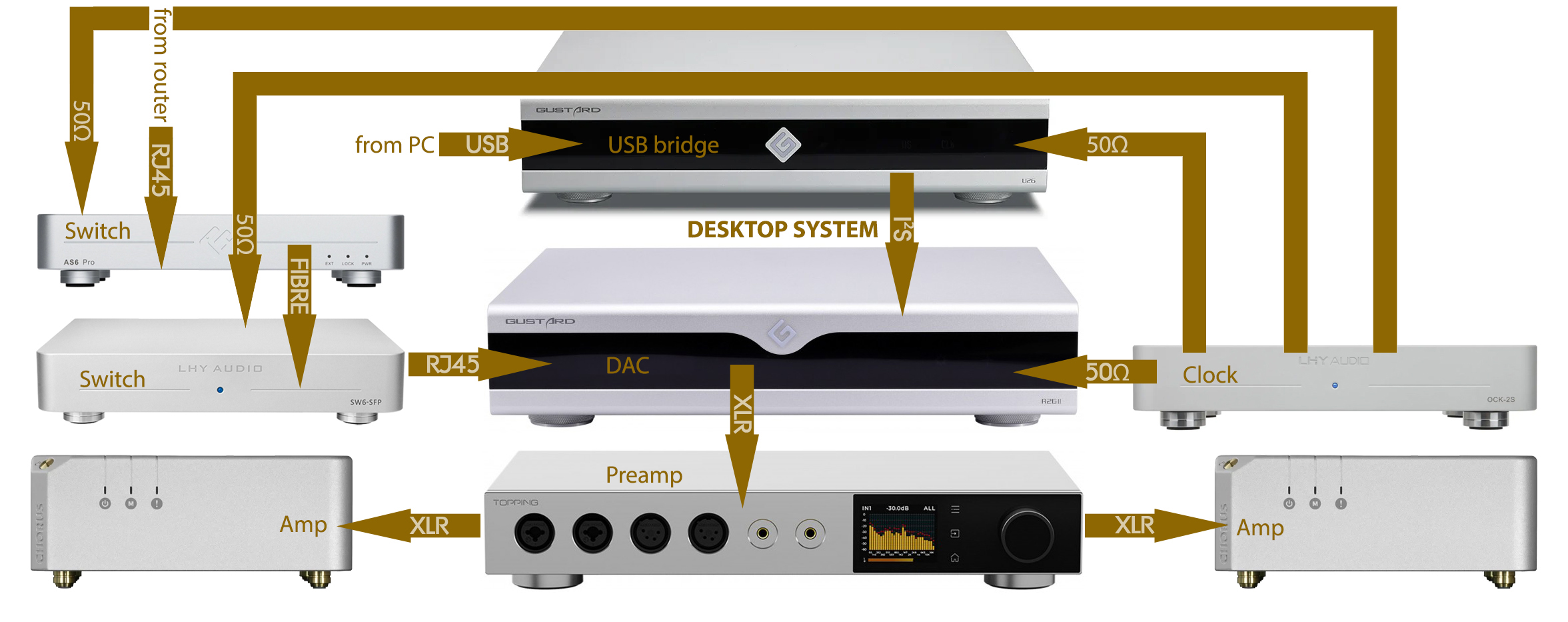
Zone N°2 was the main system across the hallway. This derives its LAN signal via 20m CAT8a off the office's 2nd switch. It then sees the below LAN distributors [€1K for the duo] before it hits my dedicated 27" music iMac's network card. The lower right and final box on this system's LAN spur converts Ethernet copper to fibre and back. That galvanic isolation spans more bandwidth than Ethernet's ubiquitous tiny transformers. Looking at my unapologetic box count for the network—two in the office, two more in the main system—we see that my beer budget of doing things in small stages pursues serialized benefits. Four in-line noise filters do more than one. The costly single visitor would have to ramp up its noise-reduction efficiency by at least x 4 to make any competitive math work. Without a clock input but great concern for vibration management, it also represents different thinking¹ on the matter; such that no photos of the permanently sealed circuitry exist. It takes no degree in psychology to opine that the more coin is charged, the more punters want to know what exactly they're paying for. If a high-value outfit like LHY can show us all the parts, it doesn't seem unfair to ask why not their British colleagues. From Jason Kennedy's review we learn that for data processing they worked with an industrial switch manufacturer to tailor a switch to their requirements. So the actual networking circuit was outsourced, the power supply and resonance-attenuating addresses are in-house developments. In Denmark, Ansuz too prefer HDF so non-metallic chassis to aluminium whilst in Lithuania, LessLoss champion Panzerholz and bog oak. Where multi-cascaded switches go, Boenicke Audio's all-in-1 serializes six. I'd first heard of the concept with South Korea's SOtM who for very best results at the time proposed three of their switches in series. With muon²'s sticker, that obviously becomes prohibitive. Could it then condense perhaps even further concentrate the effect of my four switches in one chassis for fewer power cords, network cables and overall clutter?
_______________________
¹ From Reiki Audio: "… Poor quality clocks in the post-streamer digital domain can introduce jitter which manifests as an often audible deterioration in sound quality… Ethernet clocks are a completely different beast… and there is no mechanism whereby Ethernet clock accuracy can impact sound quality… Up to the streamer, jitter refers to variations in the delivery of data packets which can cause network performance issues typically for overloaded networks in corporate settings that struggle to receive and forward data frames/packets but rare in home networks. Any competent clock will minimise the variation in packet delay but crucially, any such jitter that does exist can have no impact on sound quality as your streamer extracts the audio files from the buffered data frames… At this point clock accuracy for the minimisation of jitter does indeed become important—but not before…"
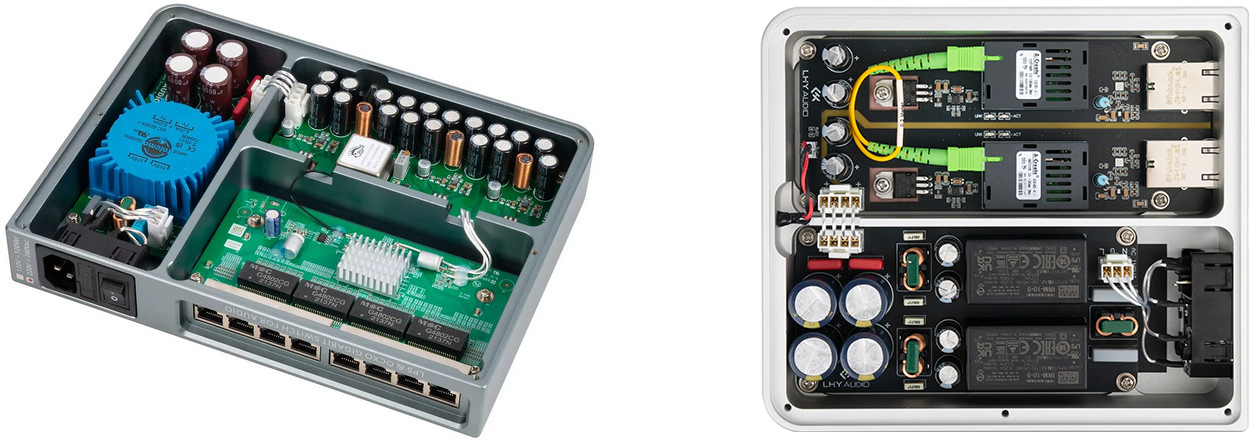
LHY SW-8 & EFI in the main system.










For more background, co-founder Richard Trussell's professional CV includes electronics engineering on defence-based radar systems and IT systems management. His empirical observation is that stripping noise from our musical data stream which enters via the AC loom, as cable-related antennae and circuit-generated effects prevents it from showing up on our DAC's ground plane where it interferes with conversion timing. The limitation of the HF transformers on an RJ45 connector's eight pins in a network switch is being high-pass transformers. They cannot block RFI above the actual Ethernet signal or they'd block the signal itself. Fibre-optics cut airborne noise but generate their own noise in the electron/photon/electron conversion process. Network Acoustics recommend fibre for its cost effectiveness of long runs between router and switch but not for insertion downstream from a switch. The optimal placement for muon² is in front of our streamer—via short copper cable. Network Acoustics see a place for fibre but their copper-based implementation as more advantageous. After all, no DAC to date can process photons directly. The muon² makers prefer less processing to more; and in that picture, fibre-to-copper conversion would be another noise-generating process. In their world, we needn't fiddle with fibre—though muon² does sport an SFP port should we beg to differ. Servers from Aurender, Eversolo, Hifi Rose, Lumin and Melco arrive with SFP inputs. They give their owners an opportunity to A/B between copper and fibre, electrons and photons. Live and let live.
… to be continued…