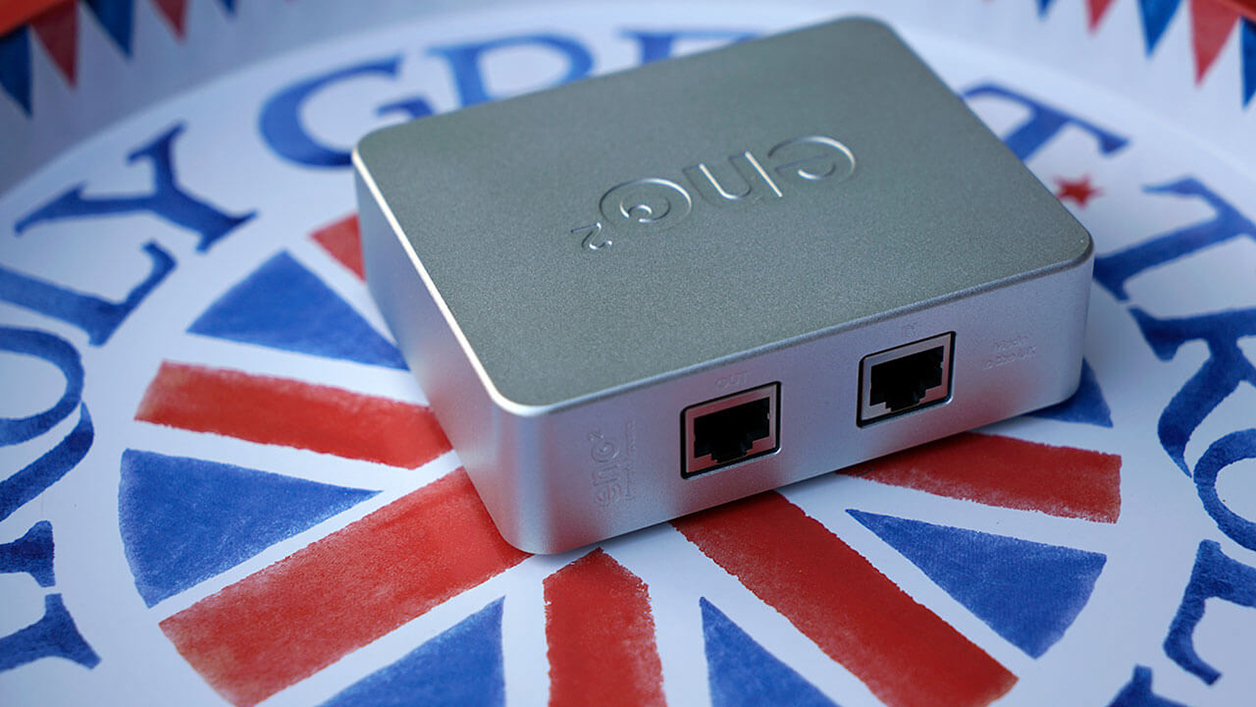
 Most significant however was the gain in resolution particularly in the spatial representation and on several levels, for example on Vivaldi's "Cello Concerto in G minor" with Ophélie Gaillard on cello [Vivaldi: I Collori Dell' Ombra]. Before the first movement begins any orchestral sounds, we can already hear something. The empty silent venue is not entirely silent after all. The previously somewhat undefined ambient noise takes on three-dimensional form with Eno2. You can now actually hear into the recording space before the music begins. You might dismiss it as a small detail but it suggested that small very quiet signals now got through thanks to the Ethernet UHF noise filter.
And it is precisely these small details that ensure the illusion of musicians performing in their own not our room for our private concert. With the small Network Acoustics box, the differentiation between bare stage space and sounds clarified. What would otherwise often blur together now appeared completely natural and self-evident.
Fantastic.
 But a lot more happened on and within the stage. With Eno2 it usually seemed a touch wider but above all deeper. As silly as this may sound, the front was further forward, the back farther back. While it wasn't the case that the imaginary frontal stage edge always zoomed towards the listening seat, solo instruments and particularly central voices often did take a small step forward. At the same time, the rear boundaries of the venue seemed more distant often noticed with percussion as though the drum set had moved back a meter. It also factored in recorded reflections and reverb tails which now spread out more freely. It was very beautiful how low chords on a piano slowly drifted away in a larger deeper space. The fact that this deeper space appeared more transparent and better layered was due not only to the increased blackness of the background, the profound calm and freedom from grey haze, but equally to more accurate three-dimensional framing of individual images. This applied to Gaillard's cello as well as voices like Laura Marling's on Patterns in Repeat. Admittedly the tinkling on this recording is a bit boring but the voice captured very directly and intensely. With Eno2 it seemed even more tangible, not frayed at the edges but rather held together in compact concrete fashion. This was listening in 3D but—importantly!— without artificial touch. Quite the opposite. Streamed music never sounded as natural to me as it did now.










At fairaudio we hope to provide a closer look at the sound of tested gear to outline its character and suggest whom it might suit and whom not. Today the latter is difficult. Eno2 produces no tonal shifts which are always a matter of taste. Of course a tuning device for just under €1'400 isn't the first thing we start with when building a system. There are more important topics to sort first but you probably already figured that out. Once you own a high-quality transparent system, this could very well be an interesting tool. Not only do the impulse response, structure and contour in the bass and lower midrange improve. The spatial representation in particular takes a significant forward step. Thanks to a deeper blackground, quiet signals like ambient recovery come through more clearly, at times almost eerily so. Furthermore, the stage appears expanded especially in the bass dimension and individual voices and instruments render more accurately with more 3D quality. The result is exceptionally natural three-dimensional acoustic imagery. The music plays on point with considerable drive. Everyone can decide for themselves—there's a convenient 60-day return policy—but I'll be keeping the Network Acoustics Eno2 even at the risk of further complicating my streaming setup.
Facts: