Continuing with unique tech, customization through the app which reliably connects via Bluetooth is almost endless. One can pick which input gets mapped to which frontal button, customize the display, adjust each input not only for gain but right/left channel polarity, independently. I am not sure what practical scenario requires that ultimate flexibility but it's there regardless. It is a bit of a party trick to demonstrate on the fly what happens to soundstaging when left/right channels are in opposite phase. What's the expected sonic reward of all the custom engineering Mola Mola invested in R&D by discarding off-the-shelf solutions? Simply put, Tambaqui's goal is to be musical in a way most other DACs despite their shiny technical specs can't quite match. Getting somewhat ahead of myself, it means that you won't hear a hint of cold, sterile digital signature. There's an effortless ease to the sound, a fluidity that most DACs regardless of price struggle to attain. Tambaqui lays bare the essence of a recording: dynamic, clear, nuanced but above all, realistic. The key is not simply resolution but accuracy. Here Mola Mola take it a step further. They pursue real resolution as that which uncovers what's on the recording to the highest possible degree without any sense of artificial enhancement or tuning trickery. We'll unpack this as I get to more detailed listening notes. Tambaqui's volume control is digital and not as transparent as Lumin's Leedh code. At high cut, feeding Tambaqui a digitally attenuated signal from the Lumin sounds better than doing it all in Tambaqui. The difference shows in dynamics. Tambaqui's volume control gets flatter sooner. At 20-30% attenuation they are the same. It becomes audible beyond 50% and significant beyond 70% of signal cut.
For now, let me wrap my intro by saying that of course no DAC exists in isolation. Its job is to interact with the rest of our system. Here Tambaqui quite obviously demands partners commensurate with its abilities. That revealed some of the weaker links in my system which Lumin and Furutech kindly agreed to address with some of their finer gear. I'll dive more deeply into sonic impressions once Lumin's U2 and Furutech's cables and noise suppressors arrive. But already in my current system, Tambaqui's impressive abilities shone. The musical space it creates is expansive like a delicate web of interwoven textures that feels simultaneously vast and intimate. The most complex recordings reveal their layers and nuances with extraordinary ease as though each performer occupied its own distinct yet connected space within the overall soundstage. There's no congestion, blurring or confusion of directionality, just that pure open window onto the music which reviewers often talk about but which in my experience is very elusive. Dynamic contrasts from the faintest whispers to thunderous crescendos feel organic and authentic, rendering the experience far more akin to a live performance than playback of recorded music.












Beyond technical wizardry there's a deep almost ineffable quality to Tambaqui's gestalt. It has an inherent musicality that transcends analysis yet somehow demands words to describe Tambaqui doesn't just show us the music, it makes us feel it. It invites us into inhabiting the many moments of a performance. It's an emotional experience as much as a technical one. When I listen in the early morning hours with everything eerily quiet inside and out, when the noise floor in my music room drops to levels impossible during the day, Tambaqui creates an illusion of thereness unlike any I have experienced before. This Mola Mola is not simply a tool for reproducing sound with extreme accuracy. It is an instrument of musical expressions designed to bring us closer to the artist's intent, to the nuance, timing and subtle expressiveness of a performance. It does this by presenting every recording no matter how simple or complex through a lens of seemingly perfect clarity. That means uncoloured by digital artefacts. For me it is quite frankly a new frontier and a novel appreciation for what must be among the current top art of digital conversion. I am looking forward to seeing how much further this journey will take me in the coming weeks.
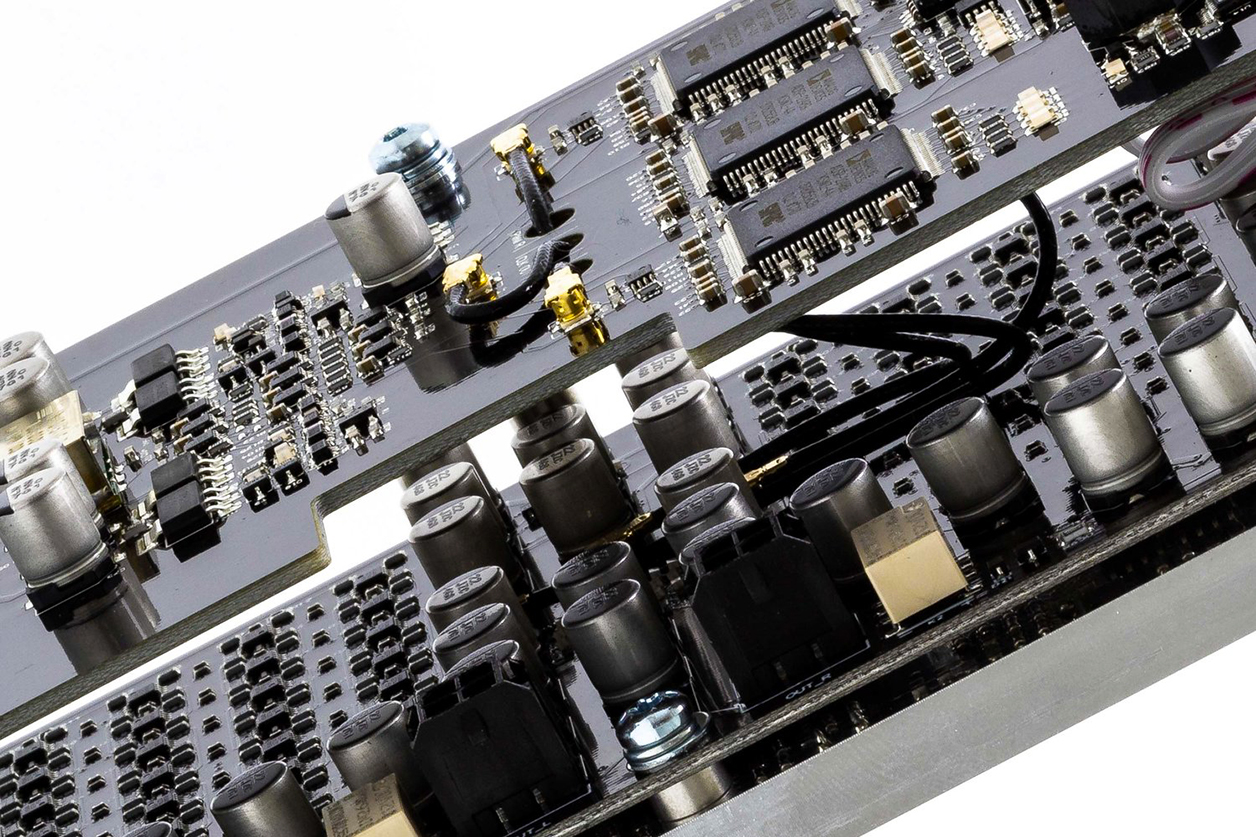
Publisher's addition. Here is a video from the US importer GTT Audio who provided Frederic's sample with an overview of the sunfish brand. To extrapolate, since the passing of founder Jan-Peter van Amerongen, engineer Jan Willem has led Hypex's very large Malaysian factory Seetek whilst Bruno Putzeys left for Purifi. The power module of Mola Mola's Perca amp and Kula integrated is already five generations removed from the original Hypex nCore boards and their x iterations to now be called Trajectum. Far from recycling tech in the brand's post-Putzeys era, its large team of in-house engineers keeps pushing their proprietary solutions farther with design and manufacturing resources far beyond typical high-end boutique brands. Hypex are in the large-scale OEM business, Mola Mola is their in-house brand where we might argue that some models pull double duty as proof of concept for the OEM tech available to other manufacturers like NAD. An embedded video of the Seetek facilities shows their sheer scale of operation.