
Country of Origin

 Reviewer: Frederic Beudot
Digital Source: Aurender A10 streamer, Lumin P1 mini [on loan], Denafrips Pontus DAC, LHY SW6 Ethernet switch, Jay's Audio CDT2 Mk2, Holo Audio Cyan 2 [on loan]
Analog Source: VPI Scout 1.1, Zu-DL103 MkII, Genesis Phono Gold
Amplifier: Triode Labs 2A3i, Enleum Amp 23R
Speakers: Ocellia Calliope .21 Twin Signature, Rogers LS 3/5a, Zu Essence
Cables: Zu Varial, Ocellia RCA cables, Zu Event MkII speaker cables, Absolute Fidelity custom XLR to RCA interconnects
Power Cords: Zu Mother, Ocellia power cables, Absolute Fidelity power cable
Powerline conditioning: Isotek Nova
Sundry accessories: Isolpads under electronics, GIK Audio room treatment
Room size: 18 x14 x 10'
Review component retail: $13'500

Too late to the party? That was my concern about today's gig. Would the band have gone home already? "Thanks for your interest in publishing a review of Tambaqui. This could interest us." That was Bill Parish of GTT Audio & Video, the company's US distributor. Apparently the music played on strong three years after Herb Reichert's gushing Stereophile review in "Gramophone Dreams #55". It's a reminder that good things remain good even if they didn't launch yesterday. And, the rear-panel's ¼" and XLR4 headphone sockets remind us. Tambaqui includes volume control to potentially eliminate a classic preamplifier and work amp-direct for a shorter signal path of lower distortion. A few weeks after a speedy sample landed on Frederic's door, he wrote me this: "The more I listen to Tambaqui, the more I realize how extremely sensitive it is to associated ancillaries; more than any electronics I've heard before. Differences in power cords, interconnects etc are so revealing that anything which can further lower the noise floor without hurting tonal saturation should be beneficial. I realize that I probably don't have cables and power filters commensurate with this DAC's level of extreme performance. It seems that you have a long relationship with Furutech. Do you think they could provide a bundle of their products (USB cable, power cable, XLR⇒RCA or RCA⇒RCA interconnect, power filter) to see how far we could push that Tambaqui DAC? I'd feature them in the Mola Mola review and a dedicated review if they're interested." Minutes later I cc'd Frederic on an email to my Furutech contact Graeme Coley. Whilst the answer and its details were entirely up to him, rendering the intro was still in my hands. That's how accelerated upstream resolution can show up limitations further down the chain; and how one special DAC can make a man happily ask to review a tailor-made cable loom. If that made-me-do-it subtext is too obscure, let's just say that for most audio writers, reviewing cables generates the least interest. Volunteering for such a gig thus is a tell in its own right; to wit, Frederic's educated suspicion that his existing loom and power delivery kit still acted as resolution barriers once faced with a source playing in a league well beyond his usual fare. This informs the audiophile rule that our system is only as good as its weakest link/s. It's why regardless of Graeme's reply, this private email from my writer deserved mention. But with Graeme game, Frederic had a lot more to say on the subject. Thank you, Furutech. – Publisher










In a world where brands like Topping, Gustard and even Denafrips seem to put out new kit each year; where social media reward reviewers for being first to post often rashly formed opinions – does it even make sense to cover 4-year old Tambaqui? Isn't it obsolete? What could I possibly contribute to its story already told? That last question is for you to answer. Let me explain now how we got here. My interest piqued a few months back. Then I first heard Tambaqui in a familiar system comprising Martin Logan ESL 15 powered by a Musical Fidelity NuVista 800 integrated normally fronted by Esoteric and Aurender electronics. That system is always revealing and grandiose of scale but rarely connects me emotionally. Yet that day I was stunned by how majestic and deeply realistic the music felt. The only difference was the Mola Mola. A few hours later I was truly smitten and on a personal mission to hear venerable Tambaqui in my own room. After being so impressed with Holo Audio's Cyan2, I was also curious to see whether I could pass the red-faced test of gushing over Tambaqui costing exactly 10 x more. If we're to talk Tambaqui and make sense of its price, we must first acknowledge its radical reimagining of digital conversion. It's no me-too affair. It's a statement, a redefinition of what high-fidelity playback could, should and—if you're willing to listen—must be. A brainchild of Dutch engineering, Tambaqui is the result of years of painstaking development. It occupies a space where design, sound and philosophy converge into something far greater than the sum of its parts. Let's be clear, Tambaqui isn't your typical DAC nor does it conform to predictable traits of 'audiophile' gear. It is in every sense a next-gen device both technically and perceptually. The four years post launch don't even factor into its generational lead.
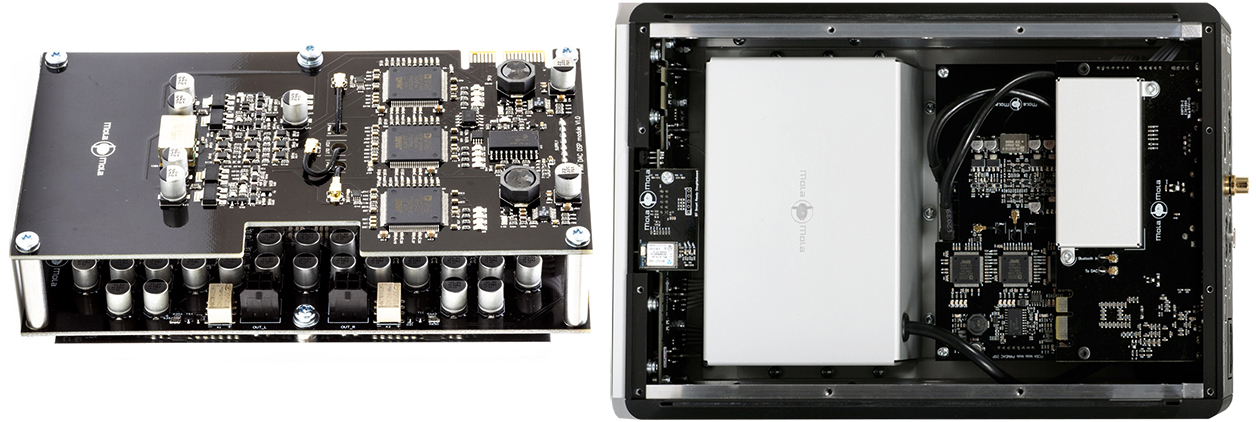
Mola Mola's ethos builds around complex engineering executed with simplicity; the most effective simplicity to be precise. Tambaqui bucks conventional conversion methods and opts for a clean-slate approach that fully integrates a proprietary architecture. At its core sits a highly advanced FPGA to process signal with minimal distortion and jitter for an exceptionally clean transparent sound. For those more technically inclined than I, the converter is actually a two-board stack. On the first board all incoming digital upsamples to 3.125MHz/32-bits then converts to noise-shaped PWM. On the other board are two mono DACs in which a discrete 32-stage FIR DAC and single-stage 4th-order I/V stage convert PWM to analogue with a 130dB S/NR. This is near the theoretical limit for 24-bit files and far beyond that of even quad DSD. Distortion remains below the noise floor even for full-scale signals and uniquely uncorrelated with the signal. Tambaqui features a wide array of i/o including USB, AES/EBU, S/PDIF, I²S and wired LAN for an approved Roon endpoint if you use that infrastructure. This flexibility allows for easy integration with various sources from computers to network players and other digital kit. Tambaqui supports up to 32-bit/384kHz PCM and DSD256 to be quite future-proof in that regard. One noteworthy design element is a fully discrete analogue output stage designed for superior linearity and signal integrity. This avoids the compromises often inherent in opamps and provides the DAC with the option to output signal at either 2V/5V to accommodate extra gain needs with the ability to direct-drive headphones balanced or single-ended.