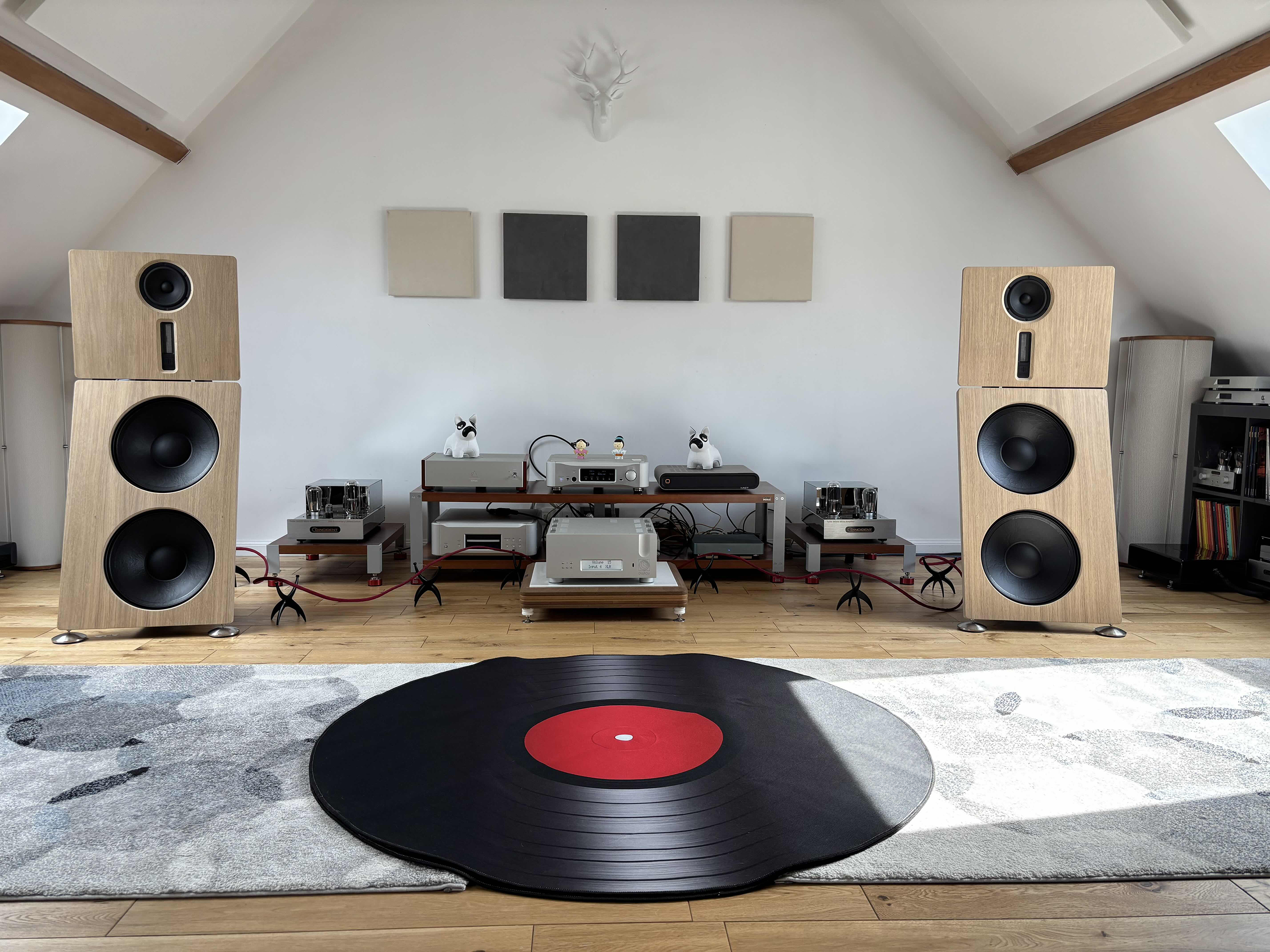
For this assignment I had to rethink the layout of my system to cater to dipoles. It meant removing my DAAD4 corner diffusers to not absorb parts of the rear wave since the open-backed concept makes deliberate use of the front wall. This undoubtedly becomes a built-in limitation as there is a definitive window of min/max front-wall clearance. In my opinion too close or too far would be futile. If one's space doesn't conform, one might set one's sights on the smaller Magnepan 2.7i instead whose bass is more easily controlled. That said, all speakers require precise placement to operate optimally and dipoles are no exception. Once properly positioned at 120-130cm from the front wall and toed in by just 8°, the anti-Matter revealed their full potential.
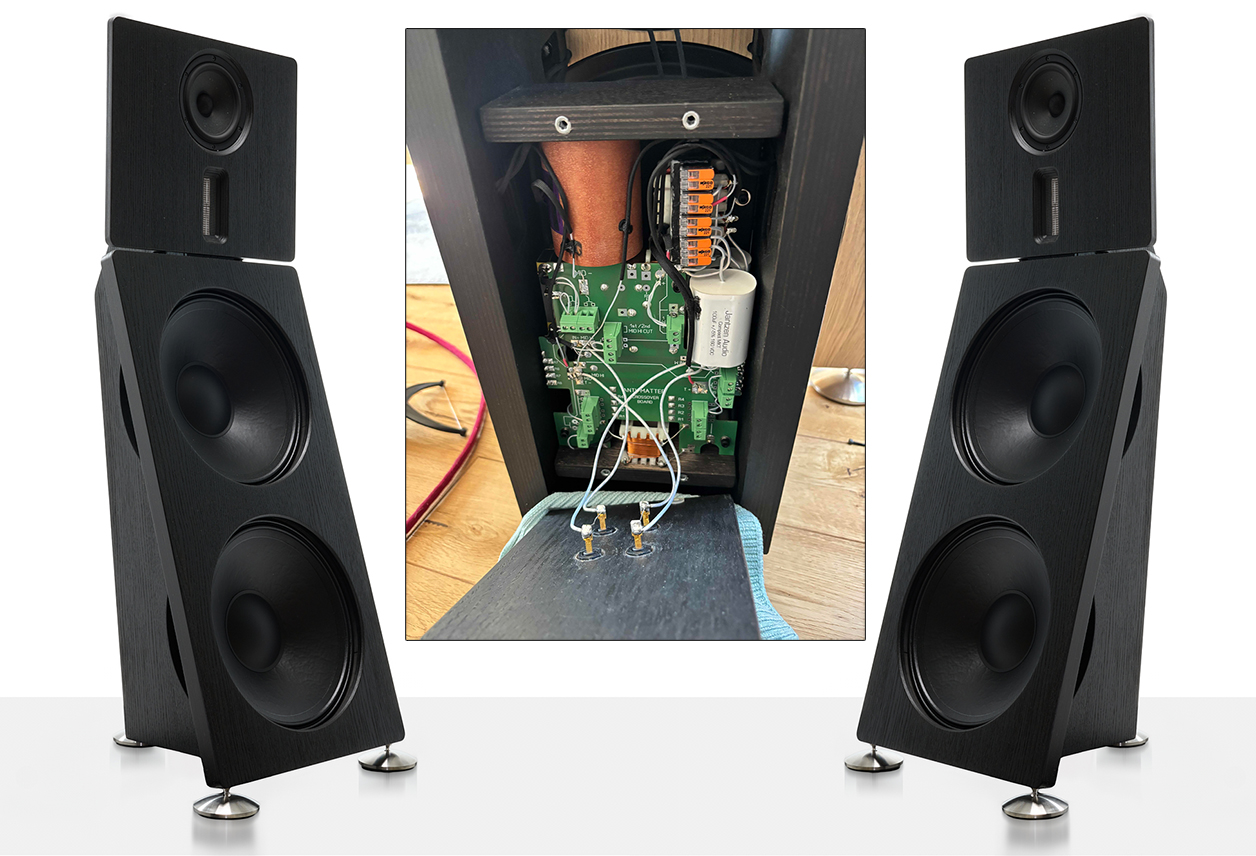
What first came to mind was their ability to generate a very rich colour palette while distilling air as a leading rhythmic agility. This speaker produced a very embodied dense sound a bit like a modern Magico. But at the same time I heard a finesse and fluidity which few speakers manage other than Vivid Audio, Børresen or Kroma Atelier. This gave the anti-Matter a fairly unprecedented consistency where I couldn't pick what appealed most because bass, midband and treble were equally excellent across truly generous bandwidth. But if I had to establish a hierarchy of the various frequency bands, I'd undoubtedly elevate the treble on the highest step of the podium for being particularly defined yet gentle, extremely textured but without any acidity. I really appreciated this achievement of Matter's own proprietary ribbon tweeter well beyond the virtual hegemony of Heil-derivative AMT or perhaps Swiss Piega tweeters. That said, the seamless continuation with the vocal band was arguably even more impressive, making female and male voices utterly addictive.







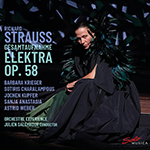 The anti-Matter thus really strutted its stuff on operatic fare, say Richard Strauss' Elektra with the Experience Orchestra under German conductor Julien Salemkour. This lovely recording with its very large orchestra has everything and I thought the Greek speakers particularly rigorous and precise for dipoles. They didn't just do the atmospheric enveloping thing but simultaneously focused a very accurate 3D image. With the matching Phaethon integrated amplifier, this tendency to develop a very analogue and natural sound came to its peak. The large amplifier with its 100 watts really made the anti-Matter sing. These operatic voices never became aggressive or bright despite the very real challenges in this particular music when played back at realistic SPL.
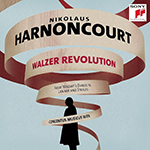 Listening to the "Radetzky March" with the orchestra of the Concentus Musicus Wien under Nicolas Harnoncourt released on Sony in 2012, I immediately enjoyed the magnitude of four 30cm woofers. Not locking them up in a box brought out a great feeling of naturalness without becoming oppressive or invasive. Everything was just at the right measure which obviously also depends on the placement within the room. In any case, I had the feeling of being at the concert, almost of being the lucky winner of the draw for the New Year's concert at the Musikverein. I found this depth and staging of the various orchestral sections supremely well rendered. The tonal palette was rich and nuanced, making it possible to appreciate the diversity of timbres of different period instruments. The "Schäfer Quadrille op. 217" by Johann Strauss was just as immersive. I was really taken by the magnitude that the orchestra brought to my room. The level of distortion seemed particularly low compared to the many speakers I've tried in this space. The quality of the tweeter really shone in the accuracy of the triangle at the start of the waltz of the "Paganini Opus 11". I find it quite rare to meet this level of quality and lack of distortion, never mind a ribbon tweeter with a generous motor that renders transients with ultra-precise acceleration and unlimited extension.
 Returning to voices and in particular Dulce Pontes on her collaboration with Ennio Morricone, I encountered very analogue comforting humanity. Roland Joffé's "Mission" theme was magical and whilst the voice of the Portuguese diva often stands out as a little coquettish as though her power struggled to embed harmoniously between midband and treble, this time I had proper density and sweetness again reminiscent of an unreasonably priced Magico/Soulution pairing rendered instead by something somewhat more democratic, accessible and possibly even more refined. And of course the contributions of the Ypsilon integrated shouldn't be underestimated where I really appreciated a sense of true evidence when one stops to ask silly audiophile or sound technician questions and simply surrenders to the music. With the Phaethon/anti-Matter combo, I really felt there and extra charmed because the price wasn't as extreme as one often sees at Ypsilon dealer demos.
On the latest Scheherazade album by Japanese pianist Etsuko Hirose with her own transcription, the anti-Matter offered unsuspected clarity in the lower midrange where I had the impression that the three ways merged to perfection. One would almost swear listening to a 4-way given the timbre variety and bandwidth with ultra-realistic attacks. Due to the low distortion, I enjoyed all the tonal nuances of the Bechstein D-282 concert piano as though I sat front-row centre at the Champs-Elysées Theatre. The apotheosis of the last movement passed admirably and I never felt like I was listening to a generic piano facsimile. The left hand had perfect legibility and there was no masking effect to damp down the beautiful resonances of the Bechstein's harmonics.