Yet Fanis finally determined to explore an open-baffle design to free himself from the constraints and high costs of cabinet production. According to him, the technical means to make a cabinet for a completely neutral speaker have already been more or less exhausted by Laurence Dickie's B&W Nautilus and his Vivid Audio descendants. Just so, a true black hole to swallow the total energy of all driver rear waves trapped in a speaker cabinet remains a pipe dream. Some of that energy inevitably reflects back through the light diaphragms of cones and domes. After a year of R&D, the principle of the electrodynamic dipole suggested itself as the ideal, lighter yet still relatively compact solution. This change of plans required a new ribbon tweeter that could operate open-backed, had a larger radiation surface and broader bandwidth compatible with 1st-order filters beyond the capabilities of the original Ypsilon ribbon.
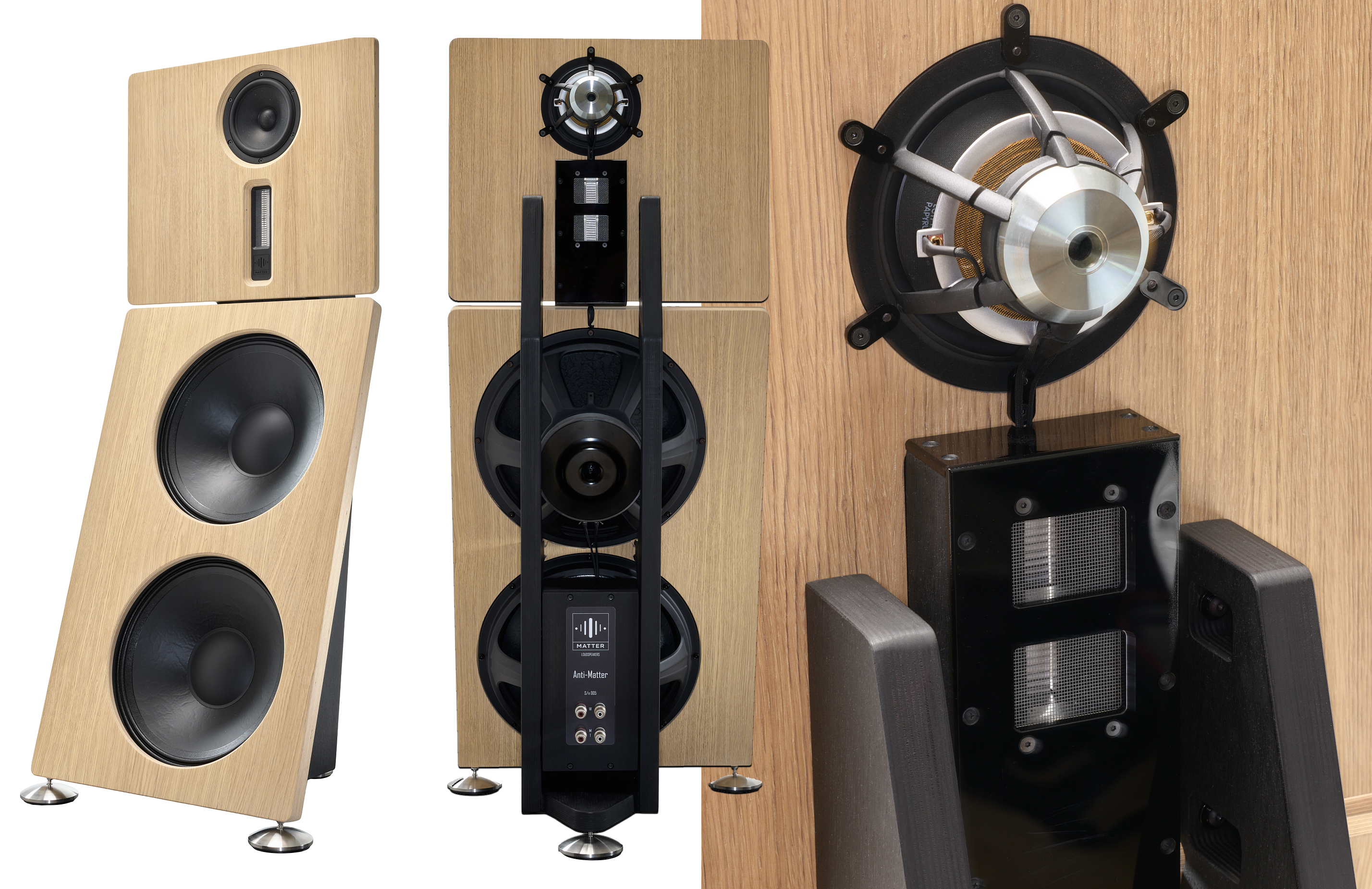
The ribbon became the central crown of the anti-Matter speaker. It weighs ~2.4 kg and is driven by a powerful neodymium motor preceded by an impedance-raising transformer. The diaphragm consists of a 16.5cm² laminated corrugated aluminium foil. More details on it remain deliberately guarded. To match it Fanis selected a 6½" Satori midrange and two 15" dipole woofers from SB Acoustics for their open-baffle suitability, brilliant reliability and consistency. He makes no modifications to these cellulose-based drivers whose membranes are light, of low resonance and extended response to work with shallow slopes.
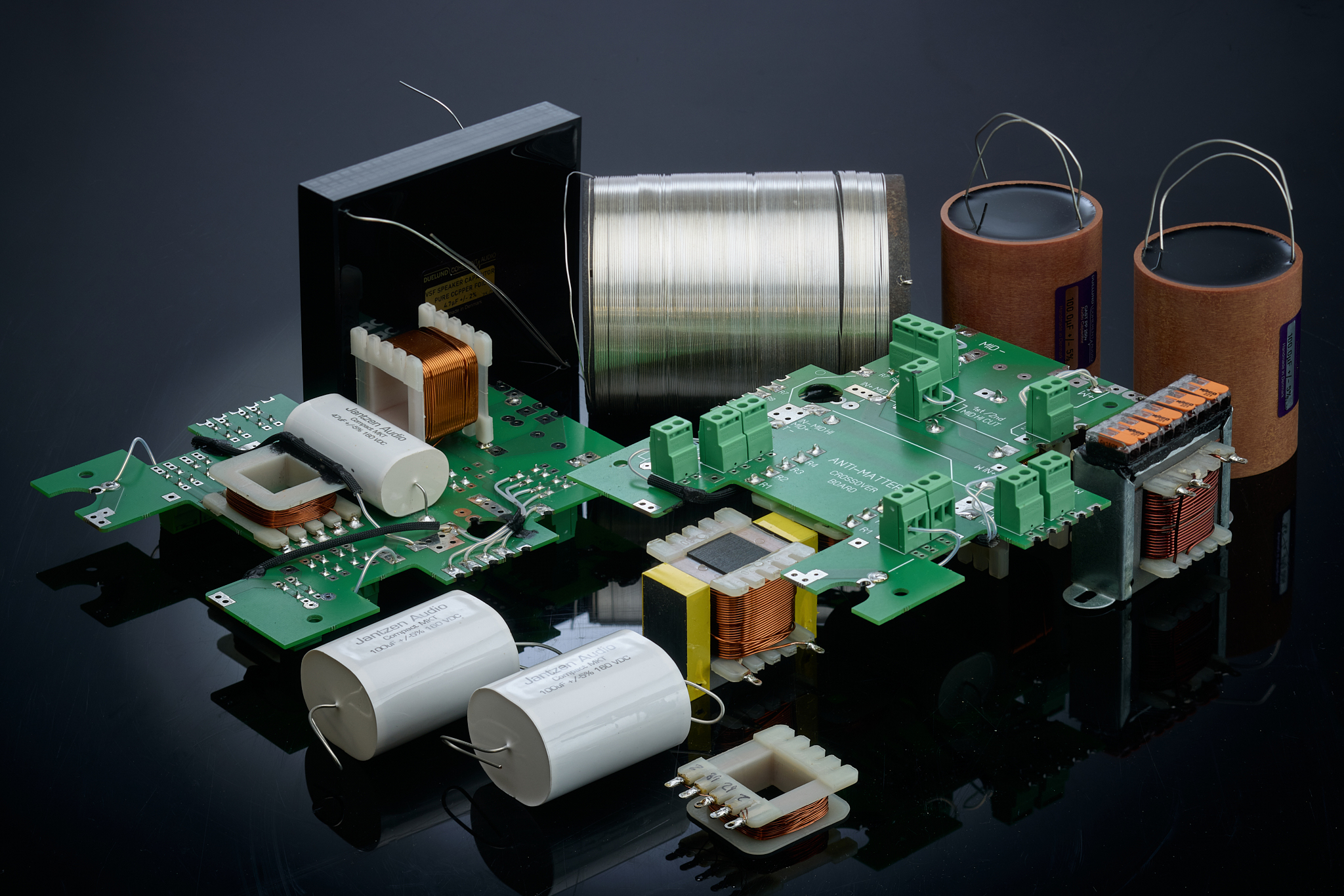
Much work was done on this filter network using copper-leaf caps for the tweeter, moulded polypropylene caps fort the midrange and Jantzen MKT issue for the woofers. The copper coils and resistors are Matter's own. The avoidance of electrolytic caps guarantees extended life and the filter knees sit at 300Hz and 3'000Hz. The woofer low-pass is 2nd order as is the midrange high-pass, the tweeter high-pass 1st order. A voltage divider on the midrange allow up to 2dB of cut in four steps.







Moreover, the midrange high-pass sports three different coil inductances and the tweeter can be cut by up to 2dB in 10 steps by modifying the series resistance to attenuate the 7-20kHz range and/or the parallel resistance to affect 1.5-6kHz. Finally, the tweeter filter can be switched to 2nd order for listening at very high SPL. All these configurations allow for just minor modifications but have an important impact on the listening experience to better match this transducer with a given room and its system. All treble and midrange settings are made with a screwdriver and jumper changes. That's not quite as simple as the adjustments on the back of an active speaker hence some might want to entrust this manipulation to the dealer who performs the install. If all of that weren't enough, the filter network also has the Ultimate configuration which allows the addition of the anti-Matter B, a dedicated open-baffle bass unit.
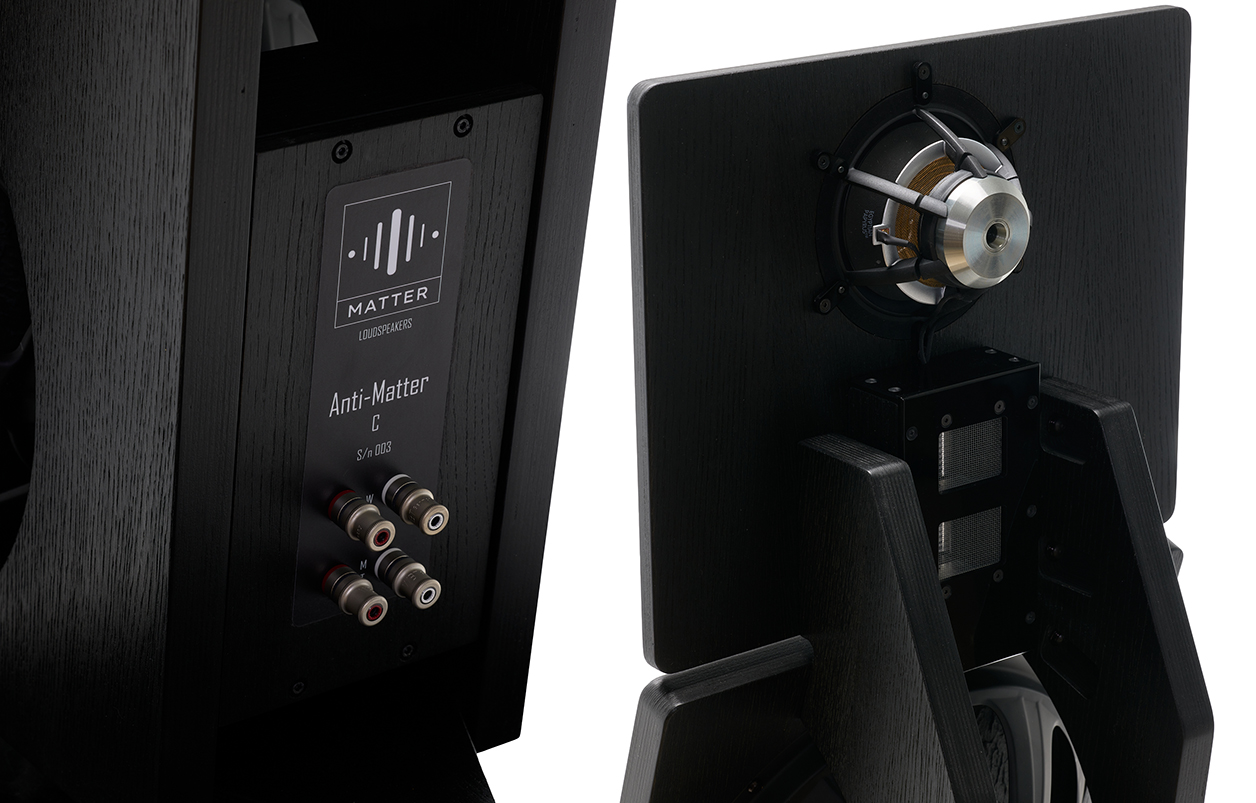
As to the overall structure, the baffle and frame brace are Birch Ply. The baffle is finished in natural Oak veneer or painted any RAL colour while the rear support is always oiled black Oak veneer. The hookup wiring is 4N pure silver, the terminals are NextGen WBT. The floor interface are stainless steel spikes and big spike shoes from Spain's Artesanía Audio. There's also a more compact version 6cm shorter and 8cm narrower. Sensitivity is 90dB, nominal impedance 8Ω from 120Hz-20kHz while the minima is 2.4Ω at 53Hz. In-room bandwidth is given as 30Hz. Baffle height is 131cm, depth 47cm but being dipole, some distance from the front wall is required. At 37kg/ea., these are reasonably low-mass designs for being full-range.