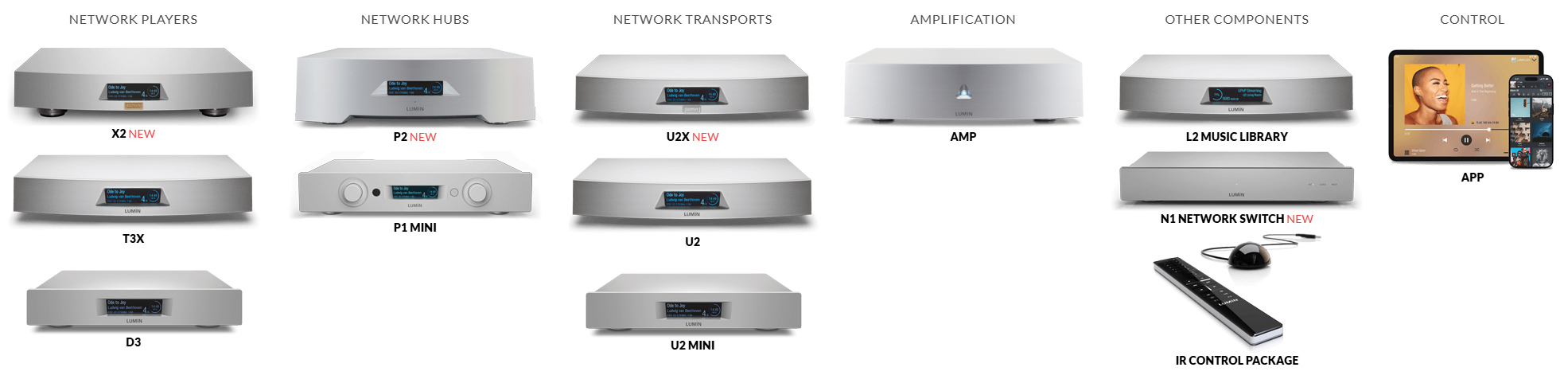
 Red Hot Chili Peppers: Californication. Another deliberately imperfect specimen which X2 cannot rescue nor attempts to. Instead it lets the musical architecture try to survive the mastering. Tambaqui's extra explicitness makes the recording's early digital-era limits easier to notice. A source like X2 can reveal them without making you want to hit 'stop' because it helped you understand something about the music. At this point you probably have a good sense that I found X2 uniquely special even when facing my more expensive reference. Otherwise why go into this much track detail? Even if we like them a lot, many pieces of equipment come and go. Only a few pull at the heartstrings. Like the Gryphon Diablo or the Esoteric P05/D05 years ago, X2 is one of those so well worth the extra review effort. Before I wrap, let me hammer down a few final details and get you on your way to your favorite Lumin dealer.
If you read my review of the AIM NAX Ethernet cable, the optical/Ethernet question has become almost anticlimactic. I tried X2 through conventional yet eye-wateringly expensive copper Ethernet and fibre-optics. I expected optical to be quieter and steal the day but the final result was more nuanced. When taking price into consideration, the much cheaper optical connection won for sure. But in a cost-no-object final system polish, the AIM NAX provided a compelling upgrade. When I asked Lumin why that might be, their answer was polite but reserved. Each system and listener needs to find their right answer. One is not better. They have different noise profiles that will better suit some listeners/systems than others. Well, knock me over with a feather. If I wanted non-answers, I'd have called my local senator.
Assessing the QRONO d2a digital filter option from MQA now available with X2 is far more difficult. Lumin's implementation derives from MQA-related filtering and noise-shaping but more generally applies it to PCM conversion. It is therefore not simply an MQA decoder dressed in different clothes. The idea is interesting because it attempts to alter the time-domain behaviour of the conversion process. The problem is that X2 is exceptionally coherent already. QRONO therefore sometimes feels like putting racing stripes on an already very fast car. Occasionally I preferred it though. On some recordings it seemed to clean up transients and take away harshness that didn't belong. More often though it subtly altered the presentation in ways I found less natural, more lethargic or neutered. Hi-Fi News reached a similar conclusion, finding QRONO more "different" than universally revelatory. My long-term setting therefore became simple: QRONO off. After several weeks with X2, returning to U2/Tambaqui to finalize my notes was like changing lenses. The first sensation was clarity. The second was precision, the third space. Tambaqui has an extraordinary ability to open up a recording. Its presentation is clean, fast and spatially articulate without ever becoming sterile. Tambaqui shows me more of the recording's internal architecture. On almost every track X2 has me less preoccupied by architecture. But there are moments when Tambaqui is plainly the more revealing instrument and undoubtedly the better reviewer's magnifying glass. It's just not always the provider of better insights.









Wherein lies an irony. If someone would ask me whether I will sell U2/Tambaqui to buy X2, I hesitate. That's not because X2 isn't sonically excellent. It's because Tambaqui remains sufficiently exceptional to deserve its own place while offering far more connectivity and functionality. Also, it has an intellectual honesty I find irresistible. Feed it a glorious recording and it gives you glory. Feed it a mediocre recording and it gives you mediocrity. Ultimately it will stay because it also accommodates my Jay's Audio CD transport via I²S and drives headphones without breaking a sweat— two things I need which X2 can't do. So the decision isn't really between good and better. If you are fine with X2's feature minimalism, it eventually comes down to your preferred interpretation of transparency. Tambaqui leans toward analytical transparency. Let me see exactly what is present. X2 leans toward experiential transparency. Let me understand what those things mean; together. In this class of electronics, such dichotomy will often if not always be the final question to answer. dCS will give you Technicolor sound—wide, cavernous and intense. Innuos will keep the cavernous but tone down saturation and edge sharpness just a bit. Tambaqui picks up speed and see-through resolution at a slight expense of saturation. LampizatOr turns saturation back up and slows things down a bit. At this level, the decision is between house sounds, not better or worse.

What does ultimately separate $16.8K X2 from $19K U2/Tambaqui? Not detail, dynamics, bass or treble. Perhaps soundstage sorting if ultimate in-sight matters to you. U2/Tambaqui remains an exceptional reference because it combines transparency with control and lets the recording reveal itself without imposing too obvious of a house sound. X2 approaches the same challenge from a more unified direction. It doesn't merely reproduce the individual ingredients convincingly. It is unusually good at preserving their relationships. That is why piano was so revealing, why Sinatra mattered as did a Village Vanguard audience. You get the gist. X2's great strength isn't that it makes everything sound beautiful because it doesn't. Its great strength isn't its broad digital connectivity because it has none. Its great strength is that it keeps the musicians' craft and their environment intact. X2 makes you believe the recording and playback chain a bit more often than other digital front ends I've heard or owned. In this equation the new discrete DAC matters because Lumin now control more of the digital signal path which should shape the future of the brand for years to come. The FPGA architecture matters because the conversion and filtering aren't divorced from that philosophy. The clocks matter because temporal relationships count. The analogue stage and transformers matter because whatever happens in the digital domain ultimately must become analog voltage/current before it becomes sound. None of these technologies deserve the last word though. The musicians do. And that's what X2 gives us.