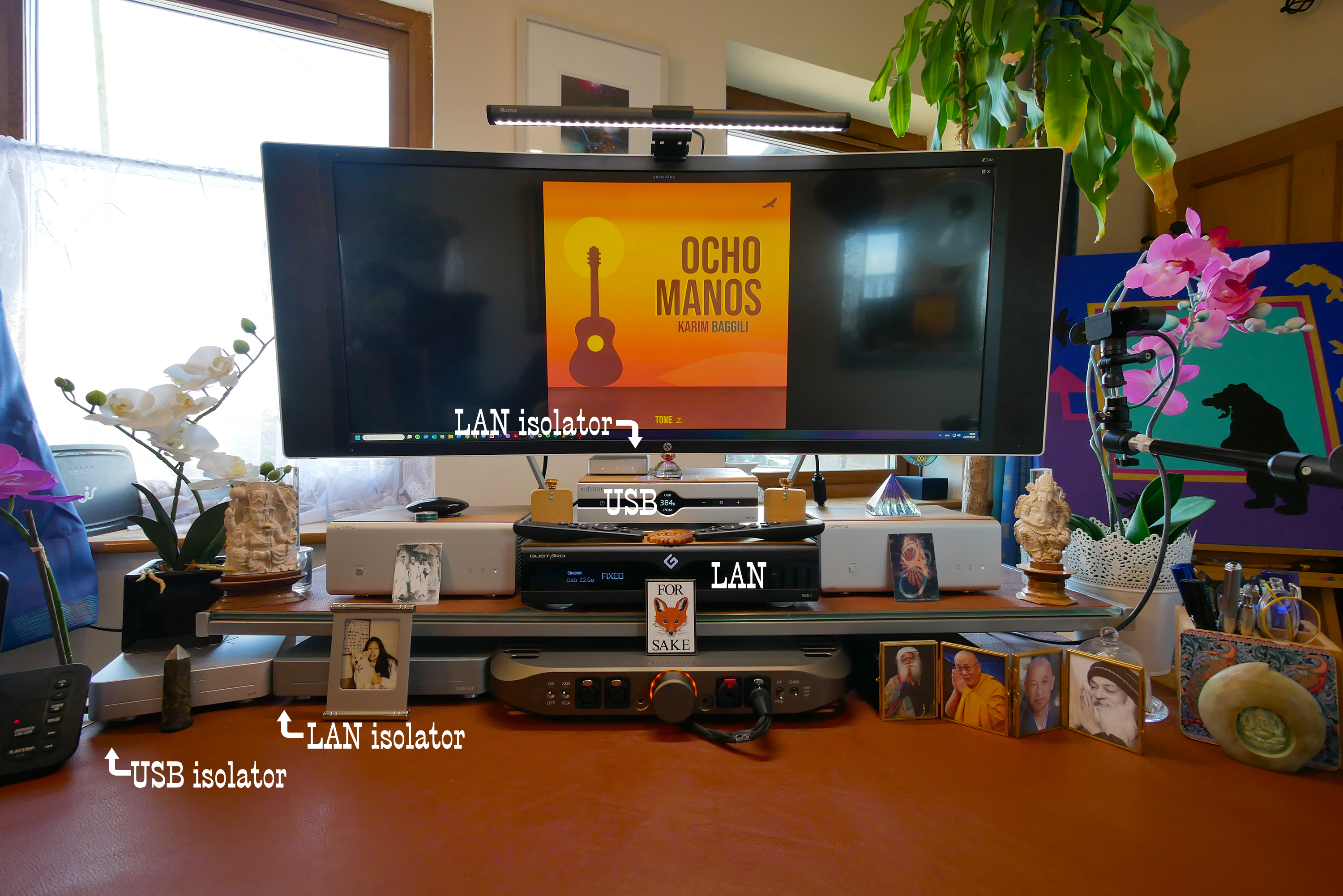
Here's the pre-arrival hardware mix, with the LHY SW6-SFP LAN distributor holding space for EFI before returning to the main system. Because I had the hardware, I added one wrinkle. Rather than feed the R26II Ethernet and USB, I dedicated Audalytic's DR70 to USB. Switching the bigger Gustard between USB and UPnP-based Ethernet could make the latter non-discoverable. Now both paths were dedicated, stable and switched by preamp. USB does Spotify Premium, YouTube and microphone podcast taping. Ethernet does Qobuz and local files via Audirvana. Happy days. Onto audiophile legos. Round 1: replace LHY's SW6-SFP 6-outlet switch with EFI. Round 2: replace my two series-strapped LHY switches in the main system with EFI. Round 3: compare COS Engineering's S6/LPS1 combo of network switch and external linear power supply in either system. On arrival day I read Alex Halberstadt's Stereophile review of the TP-Link MC220K Ethernet-to-fibre media converters. It kicks off with a visit to a friend who, after demo'ing his system for the writer, disappears into the next room and changes something. Upon returning and playing the same track, "now it sounded quieter and more resolved but also far more colourful, vivid and physical. I heard a better sense of texture and presence as well as enhanced musical flow. The music made more sense… when I asked my friend how he'd managed to so dramatically improve the quality of his breathtakingly costly digital front end, he said a little sheepishly that he'd inserted a pair of Ethernet-to-fibre converters between his network switch and the streamer. He'd bought them online for ~$85 including shipping." Alex then recreates the experience in his own system with the same results. Fibre-optics for Ethernet not Toslink are being rediscovered. Once more, EFI's unique selling point is doing away with two external converters, their wall warts and the fibre link between them. Instead it all happens invisibly inside one box—for just one LAN component.
There are things which we can measure but not hear—especially in digital. What's a DAC with a measured 130dB of dynamic range supposed to do in an inner-city room whose standing noise floor is 40dB whilst maximally compressed music doesn't eclipse 6dB of recorded dynamic range and the single-ended triode amp barely hits 80dB of S/NR? How about endless choices of digital filters which in most cases sound no different yet clearly exhibit divergent measured behaviour? It underlines that I entered this gig unsure whether my swaps would net anything. When I heard more difference than I previously had with my USB isolation, I was nearly shocked.







I didn't immediately have clarity on how to best put the sonic difference into a word or two. That took more thinking on what I heard. If we segregate sounds into beginnings, middles and ends—transients, sustains, decays—some gear changes how we perceive the leading edges. Sharpened they can improve focus, localization and timing. Softened the sound can feel mellower and smoother. Particularly tubes but also DSD conversion and kit voiced to mimic either can elongate our trailing edges. This enhances tonal overlay just as more room reverb enriches tone. Within reason it also emphasizes recorded ambience. If decays shorten, the sound gets drier and more separated but also clipped. EFI did neither. It affected my perception of the sustains' weight right after the transients. Though limited as such comparisons are, we might perhaps think in pugilistic terms. The impact of a trained boxer's check hook goes past its initial impact smack but follows through from the hip through the lead foot into the floor—a form of integrated afterburn which a beginner's jab from the elbow and shoulder lacks. Sonically this action meant more gravitas. So I did have my own term after all. Being pure DDD or digital-domain deeds, this obviously was no thunder 'n' lightning stuff. Just so, it tracked. Its delta exceeded my USB isolation, probably because it preceded it. USB merely routed cloud files out of my PC which Ethernet had already downloaded via my router. Think of how an effective water purifier installed at the entry of our water mains impacts not just the kitchen faucet. It also filters the shower head and the garden hose. Here it meant that USB too improved. This telegraphed as reduced difference between Ethernet and USB. Ethernet, DSD512 and Audirvana/Qobuz still had the edge over Spotify Premium/USB. But now it was smaller. Hence the copper-glass-copper chicane inside EFI created greater benefits than the earlier all-copper multi-port reclocked network switch from the same designer. Like Alex Halberstadt I'd just gotten the fibre-optic memo—again. Having bought in fully this time, now it was on my desktop. Happy days. But to extend from a personal punt to a more formal review, I had two more rounds to make.
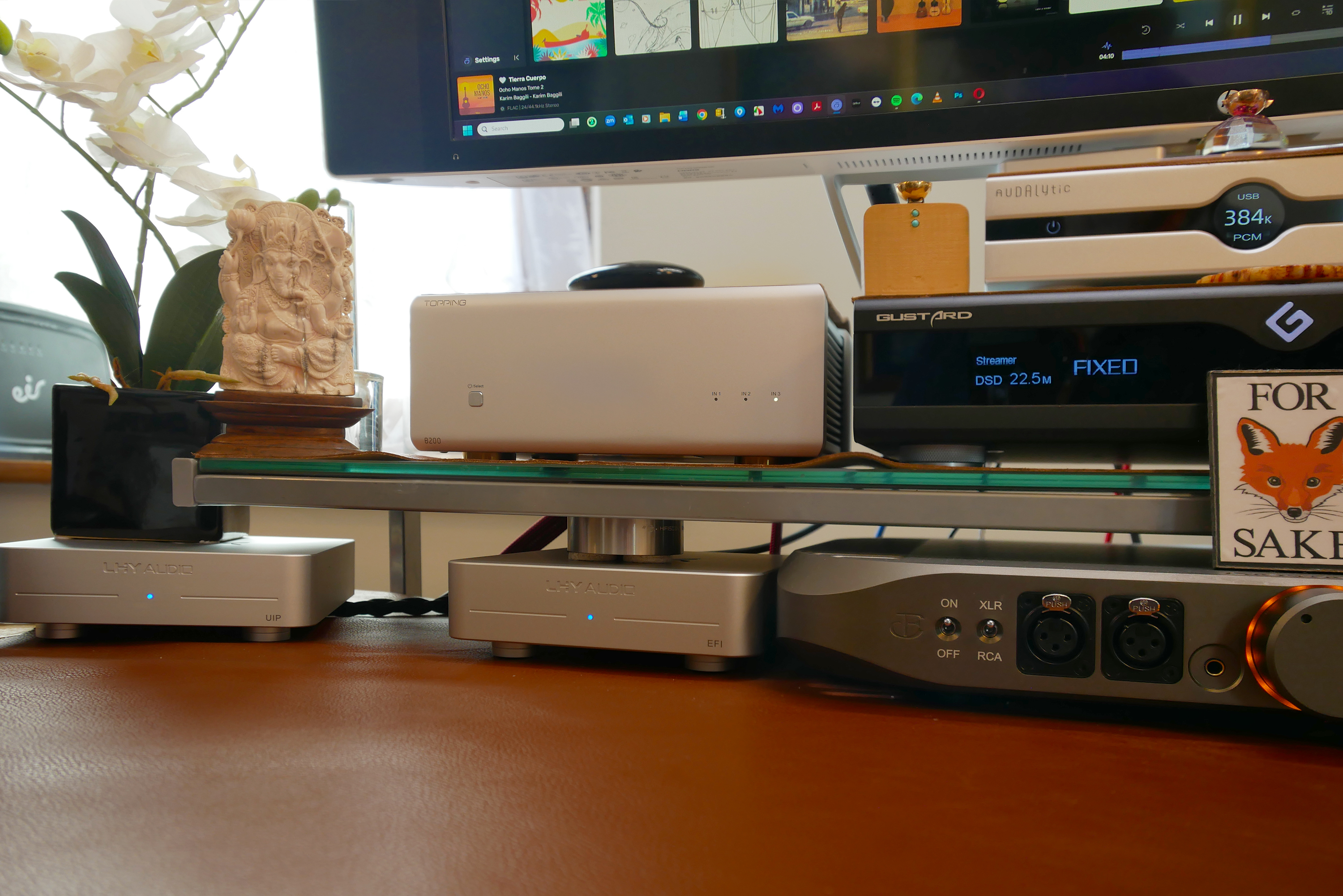
Before we move on, a brief intermission. If I purchased a €5'000+ audiophile streamer, I'd expect these UIP/EFI twins to make zero difference. That's because the job they so effectively do for me—as external add-ons to a prosumer workstation doubling as streamer—should already be handled inside any such costly deck. If today's EFI could still improve upon it, I'd seriously question why I'm being charged crack coin for a stripped-down computer disguised in a hifi-bling chassis. A €399 Wiim-level streamer certainly can't be expected to pack €1'000 worth of retail coin in Ethernet/USB isolation/purification with dedicated power suppies. Where I then see EFI's native habitat is somewhere between the camps of Wiim on the low end and Antipodes, Innuos, Lumin et al on the high; and with PCfi adherents in particular. End of intermission.