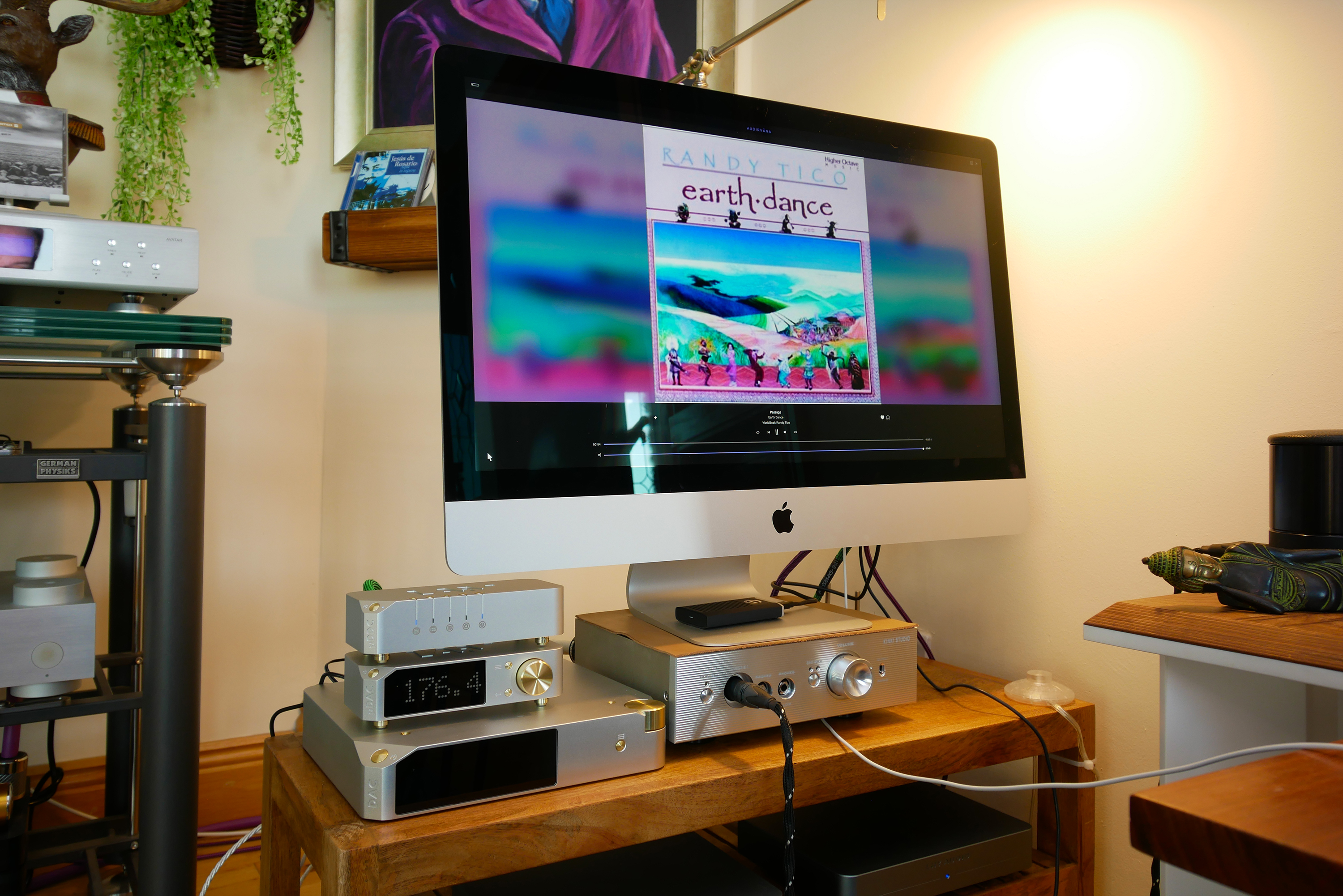
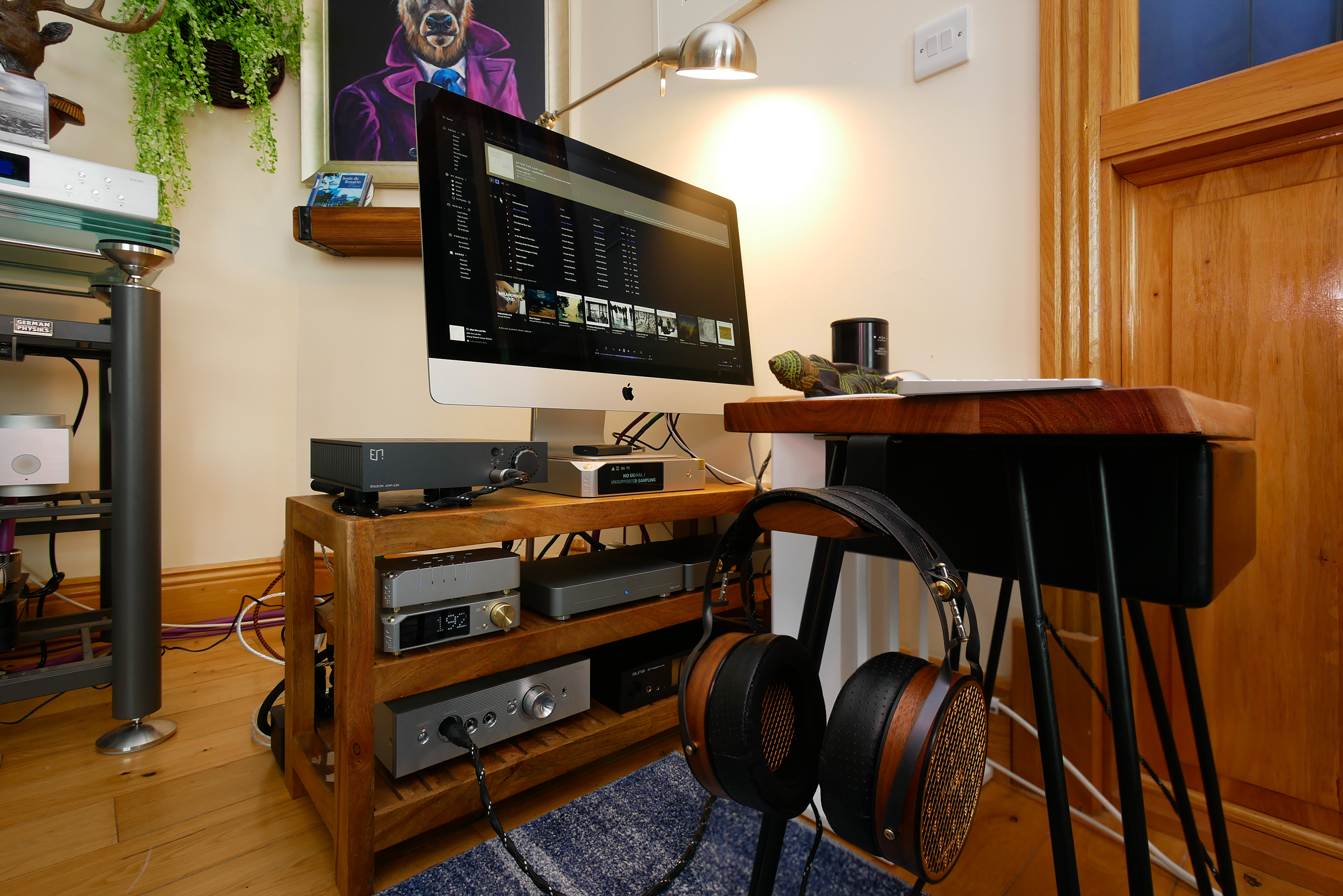
With the µDDC sample still on hand from its prior review, I built this short Laiv triple sandwich beneath my music iMac to settle another question. How close might the small µStack come to the 'full-size' Harmony DAC? Might it in fact hold its own ace up its tiny sleeve?
To see Alvin's tour of the µDAC's innards, click on the next image to launch the YouTube link.
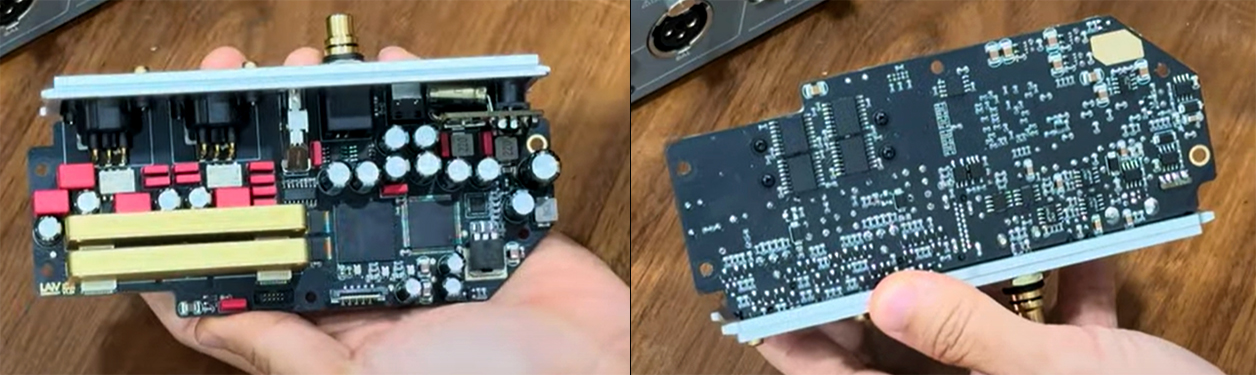 The quad of bigger chips on the underside are the galvanic isolation ICs in true balanced formation.
For my comparisons, I exited my iMac/Audirvana via USB which hit either the big or small Harmony DAC to then output XLR analogue into the Kinki THR-1; or in the case of the µDAC, inserted the µDDC to then exit on I²S. My sonic scopolamine aka truth serum was Raal 1995's triple-ribbon Immanis earspeaker. To drill down into what I assumed would be small differences, I wanted my highest-rez transducer.








So armed, the upshot was surprisingly simple. USB direct, the big Harmony DAC had the edge on tonal wetness and ambient recovery. The µDAC's textures were drier. They resolved fewer upper harmonics and reflective decays. But with its µDDC mate added, that difference disappeared. To my ears and the brain between them, whatever minor offset might remain proved academic. If that's how hard one must strain to generate a 'maybe', I'll call it too close and likely imaginary. In popular perception, the actual difference mirrored discrete vs IC so standard transistors vs opamps. Whilst the copious current feedback of opamps tends to measure sterling, it often does sound drier so more damped. If that's been your experience to have a reference, it nicely previews what to expect between Laiv's two converters. Adding extra isolation and clocking between my cloud stream routed by Audirvana and the µDAC's I²S input made the sound 'discrete'. How much linear vs switching power factored I obviously could't break down. Neither could I isolate I²S when that's the only way to harness the µDDC. In my assessment, going double µ + 1 x HDMI cable whilst chucking the analogue RCA outputs was on par with shelling out $2'700 for the bigger DAC. That saves money and allows for a 1-2 purchase over time. On a crowded desktop, it could also be easier finding holes for Laiv's Micro kit than their wider DAC. True, amps like my Enleum AMP-23R are RCA exclusively. They frown at the µDAC's exclusive XLR or need for hardware adapters. But when the sun shines on everything in its proper place, the µCombo makes a strong case for being the smarter money's choice. Snobs will frown at the wall warts to dismiss the miniaturized concept on principle. And that's exactly what it says under job description on their business cards. Snobs and the smart money are simply rare friends. If one can spend more to please the puritan police, it's the snob's way. It's how the ultra high-end stays alive. All is as it should be.
There's also the counter snob. In this instance I played him. So often it's a him not her, isn't it? That's because I did not try to front the bigger DAC with the same µDDC; or causing double trouble with my Singxer SU-6 in front of that for two I²S connections. For today I wanted to focus on the µ factor of keeping things small and tidy. On that front the µDAC comes closer to its bigger kin than the money difference might predict; and when augmented by the µDDC, closes that gap for all practical intents and purposes. Perhaps in a system more resolving than mine a gap remains? If so, is the owner of such a system likely to shop this strata in the first place?