Where the KTE LCR-1 truly shines is in its sonic performance. All this effort to find the right passive parts for a design that is hard to master pays off huge dividends in the sound. The first note will likely catch you off guard. There's an almost palpable sense of effortlessness in how the music flows. There's no excessive warmth but no artificial sharpness either. What you hear is music in its most unadulterated form. That's not to say that the LCR is devoid of character; far from it. Its presentation is very natural, neither clinical nor overly lush but always engaging, dynamic and deeply musical. If you read the first part of my review of the Mola-Mola Tambaqui DAC, you'd be forgiven for believing that I fell victim to the reviewer's sin of self-plagiarism known as cut'n'paste. Serendipity had both components in at the same time and whilst they do not sound the same—the Tambaqui sounds bolder, bigger and even more resolved—they nonetheless share a similar gestalt. They both aim to deliver unforced undistorted transparency as a way of getting the listener closer to a live experience. The Tambaqui takes this effect to even greater intensity but also costs 6 x as much as the Kitsuné. The only reason I mention a DAC in a phono preamp review is that listening to the Tambaqui for the last few months has re-educated my ears to appreciate and seek that level of realism in every component I review now. The KTE LCR-1 just happened to arrive at the same time, making this serendipitous juxtaposition very insightful.
Typically I favour a more holistic description of the sound of a component but LCR designs stand out for their tonal purity and it's worth expanding on this aspect in more detail. The KTE LCR-1 handles treble with remarkable precision by extending cleanly into the highest registers without ever sounding strident. The tonal balance across the spectrum feels even but with a special emphasis on maintaining the integrity of the upper mids. You'll hear more air around instruments like violins or cymbals but never at the cost of realism. Loud transient attacks sound quite natural but that's probably an area where my reference Genesis Phono Gold goes a little further, providing even more macro contrast where the Kitsuné retaliates with better articulated microdynamics. Midrange? Pure, clear and undistracted. Vocals male or female possess an almost haunting sense of presence, every breath and subtle inflection rendered with clarity. There's a delicacy to the presentation as if the preamp paid homage to the minutiae of a live performance. This is where LCR designs excel, pulling you into the music without calling attention. Try it with Leonard Cohen, Jacques Brel, Eva Cassidy, Adele or Dame Joan Sutherland and you will hear them in your room;. If vocal presence turns you on like it does me, you won't easily beat the Kitsuné.









And then of course there's the bass. Deep, controlled and tactile, there's a tautness to the low end that provides depth without overemphasizing warmth. Drums strike with punch yet there's a remarkable sense of fluidity when the track calls for it. The overall balance between bass and treble is one of the key reasons the LCR phono preamp stands apart. It never overpowers but instead complements the mids in a manner few replicate. Take all those qualities, pair them with superb imaging and the KTE LCR-1 will surprise you on large symphonica. Many more affordable phono stages struggle with unravelling complex heavy orchestral lines to often come out mushy. Not the Kitsuné. It excels at layering and separating instruments, giving each its own space and vivid tone. My Genesis Phono Gold initially gave the impression of going a little farther with layering but its bass was looser to occasionally obscure finer detail. I found the Kitsuné to provide some extra air and insight into complex music that was more to my taste. The KTE LCR-1 did such a beautiful job limning music from within and painting credible orchestral landscapes that I spent a weekend listening to every Mahler symphony recorded by Rafael Kubelik and the Symphonieorchester des Bayerischen Rundfunks in the 1970s. This is by far my favourite integral very dense and dynamically challenging series of orchestral recordings. Although the Kitsuné's macro dynamics weren't quite as explosive as my Genesis, each soloist in the orchestra was better focused and their unique timbre came through more clearly than with my reference, a testament to the level of transparency of this LCR design.
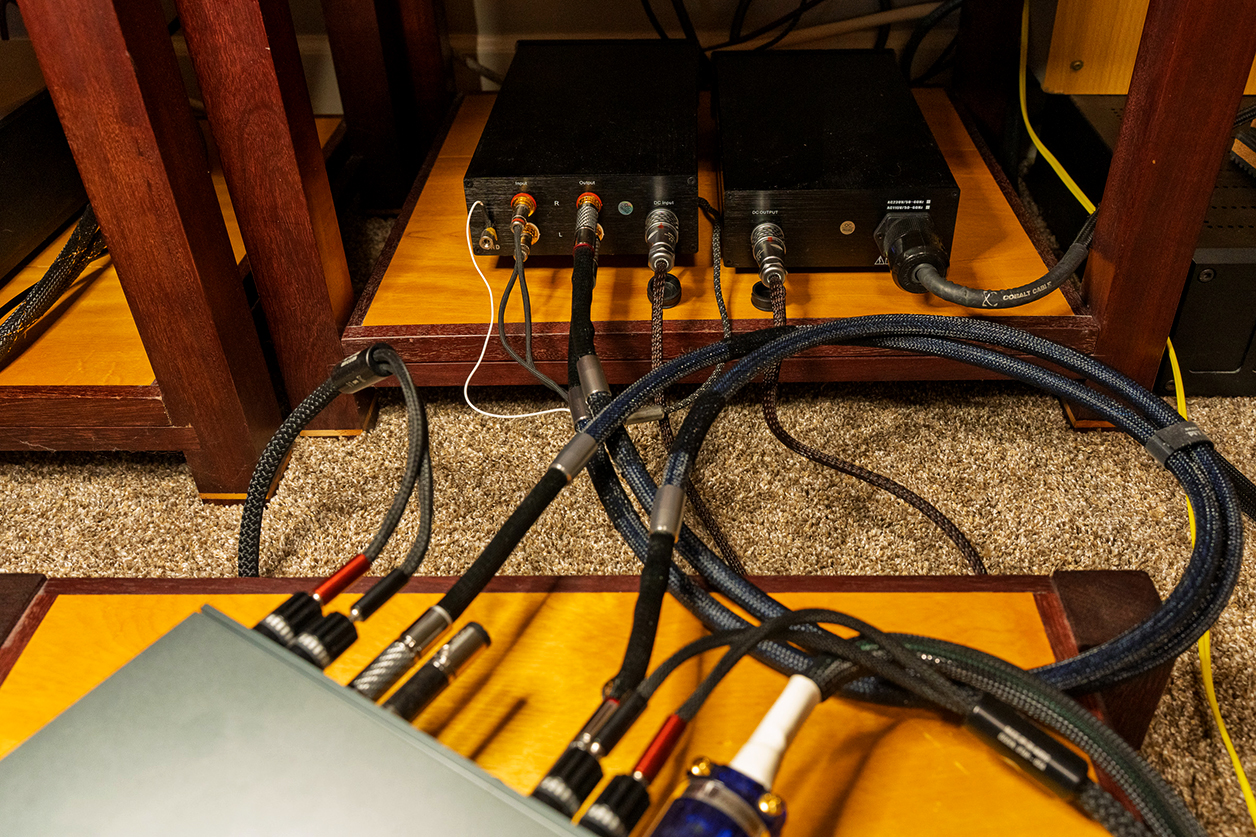
One area where many phono preamps falter is noise and hum. The KTE LCR-1Mk5 SE however is nearly silent. You'll be hard-pressed to hear anything other than music. As a result, microdynamics are superb. The LCR-1 brings out nuances in the quietest passages, from the distant pluck of a double bass to the faint reverberation of a snare drum while at the same time slamming a heavy rock track with ease. Here the far more expensive Genesis goes possibly even further—it's a close call— but the KTE LCR-1 won't play second fiddle to anything in its price range. Although discontinued since, the $2'500 battery-powered Nagra BPS preamp was my reference for years but didn't remotely approach the dynamic capabilities of this Kitsuné. In my intro I mentioned that the Lounge Audio LCR Mk3 would provide a backdrop but as good as their $860 base LCR and Copla step-up are, they couldn't hold a candle to the Kitsuné. It didn't take many comparisons to realize that the Kitsuné instead begged comparison to my $9'500 Genesis Phono Gold and its mandatory custom phono cable. The Kitsuné and Lounge share the LCR topology and overall neutral gestalt but comparisons ended there. The KTE LCR-1 went so much further in transparency, imaging, dynamics and tonal faithfulness that they were clearly in different categories. Since my review, Lounge have introduced more upscale versions of the LCR Mk3 preamp and Copla step-up but I haven't heard those to comment on how they might compare to a base KTE LCR-1 priced roughly the same.