When in mid July '26 Alberto Guerra of AGD ordered a syndication of Dawid Grzyb's review of his Allegro all-in-one, a subsequent email exchange contained this info pertinent for today. "Because of our professional rules and ethical standards, we won't comment on any competitor's products, brand, marketing strategy or technical choices. However, because this type question arises often, I recently decided to share what Claude the Anthropic AI model replies when asked questions we get in certain audiophile fora, from customers even dealers. Here is the answer Claude shared on a public forum. So, re-affirming our no-comment position on the work of competitors, "Purifi and AGD address the same problem—distortion in a class D output stage—from opposite ends. Purifi correct the distortion; AGD try to avoid it in the first place. The conceptual breakthrough behind Eigentakt/Purifi was Bruno Putzeys and Lars Risbo identifying a source of distortion that most class D designers had underestimated: hysteresis in the output inductor which they call 'iron distortion'. The ferromagnetic core has a memory effect. The flux at a given point on its B-H curve depends on the path taken to reach it. This nonlinearity is heard as a grainy sonic texture. Purifi's fix wasn't an exotic perfectly linear core when no such material really exists. Instead they applied what they call EigenTakt ErrorCorrection (EEC), a "full-output feedback" architecture. It's a correction circuit which encloses the entire power stage including the output demodulation filter inside a loop run at extreme gain of >75dB across the audio band, corresponding to a ~110MHz gain/bandwidth product. When the filter inductor produces a hysteretic artifact, the loop suppresses it with >75dB of compensation. Notably Purifi achieve this with ordinary silicon Mosfets at conventional switching frequencies. As one summary put it, their secret sauce is very high loop gain and a carefully designed stable feedback network. The payoff is THD+N around 0.0002% or lower, sometimes below the test analyzer's own residual around -140dB. Alberto Guerra who worked on the team which developed GaN tech at International Rectifier builds around gallium-nitride Mosfets in both his output stage and power supply. GaN switches far faster than silicon. This lets AGD run an unusually high carrier frequency. Where many quality amplifiers operate at 200-400kHz, AGD's run at ~800kHz, making PWM comparison much more precise. More broadly, GaN's speed reduces distortion and enables a very simple output filter. Guerra also leans heavily on supporting elements. He argues that roughly 50% of any amplifier's performance comes from its power supply, extremely short signal paths (millimetres not centimetres) and careful high-frequency PCB layout. Purifi accept that the output stage and its inductor will distort so wrap enormous carefully stabilized negative feedback around it all to erase that distortion. It's a correction philosophy with feedback as the hero. AGD instead try to generate a cleaner waveform at the source through very fast GaN switching and a robust supply, relying on comparatively less aggressive global feedback. It's a prevention philosophy that sits closer to the low-feedback tradition some audiophiles prefer. That difference is exactly why Purifi tend to post the lower raw THD+N numbers. Maximizing loop gain is the most direct route to minimizing measured distortion and Purifi push that harder than almost anyone. AGD's pitch is less about winning on the measurement charts and more about the character of fast switching plus minimal feedback. One caveat: AGD don't publish the same exhaustive THD+N-vs-power-and-frequency data that Purifi do so a precise head-to-head distortion figure for AGD is harder to pin down than the marketing-level comparison suggests."
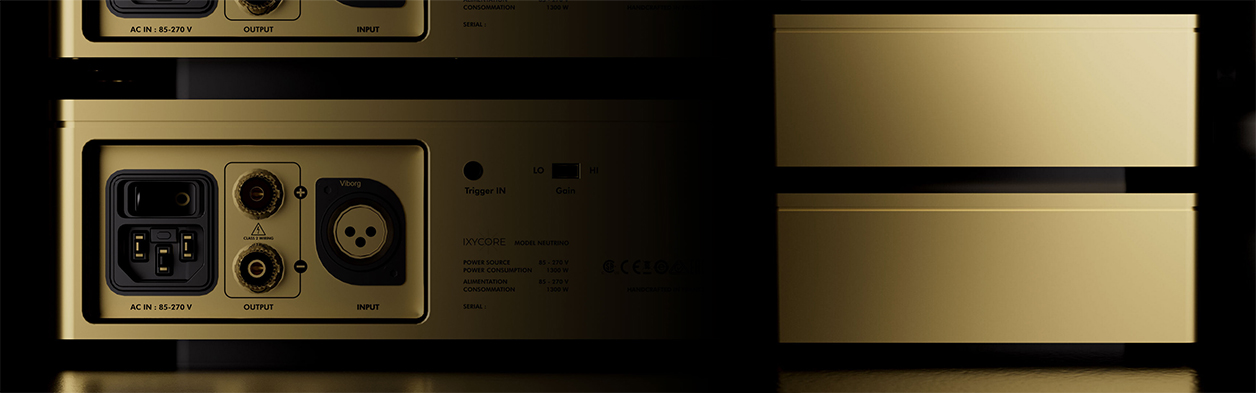
My takeaway from this paragraph is very basic. Ixycore seem to slot right between the design philosophies of Purifi and AGD. Like Purifi, Ixycore use very high negative feedback contingent on extreme gain; and also are aware of the output filter's inductive side effects to have specified a very special part. Like AGD, they exploit GaN's high speed at even higher frequencies. An open-ended side note is that 1st-gen AGD circuits switched their GaN outputs at ~400kHz so slower than what René's original circuit already did 20 years ago with classic silicon Mosfets. Today's Eigentakt silicon switches at 500kHz-700kHz depending on model. As with the sample-rate wars in D/A converters—DSD2'048, PCM1536—class D deadtimes, oscillator frequencies and THD can mislead. Isolated numbers tell less than half the story. How all sub assemblies of the oscillator, Mosfet/GaN drivers, Mosfet/GaN outputs, filter, feedback and power supply play together is the real story best judged by ear. As to why we'd want negative feedback that includes the output filter in the first place, René has a counter question: "how else would the amplifier know what your speaker is doing?" Now we'll set my Ixian crossover games aside to advance from Science Fiction to nonfiction as in, not imaginary but very real: Ixycore's Ixycore monos.
… to be continued…