


Country of Origin

 This review first appeared in March 2026 on fairaudio.de. By request of the manufacturer and permission of the author, it is hereby syndicated from the German original to reach a broader English audience. Ed.
Reviewer: Ralph Werner
Analog sources: SME Model 15 with SME 309 arm and MC Denon DL-103R, Dynavector DV-20X2 H, Transrotor Figaro or MM Shelter 201; other Flux-HiFi needle cleaner, Stack Audio Serene Mat & Stabiliser, VPI HW-16.5 record cleaner
Digital sources: Rockna Wavelight+, Antipodes K22 G4, MinimServer/MPD with JPLAY-App, Squeeze-Server/Player with Material iPENG, Roon plus Network Acoustics Eno2 Ethernet-Filter, Pink Faun LAN Isolator, Silent Angel Bonn N8 switch
Preamps: Electrocompaniet EC 4.8 MKII, BMC Audio MCCI Signature ULN phono
Power amps: Electrocompaniet AW 800 M
Loudspeakers: Acapella High BassoNobile MK2
Headphones: Audeze LCD-2, Beyerdynamic DT-990, Sennheiser HD 800S, Sony MDR-1000X, Teufel Supreme In
All-In-One: Ruark Audio R4
Cables: Dyrholm Audio Phoenix, fis Audio Studioline & Livetime, Boaacoustic Blueberry Signal.xlr, Vovox; Audioquest Cinnamon Toslink, Vodka 48 HDMI/I²S, Boaacoustic Silver Digital Xeno (USB), fis Audio Magic (LAN), Wireworld Series 7 Starlight Gold (caxial); fis Audio Blackmagic, Studioline
Rack: Creaktiv Trend 3, Stack Audio Auva EQ
Accessories: Audes ST-3000 AC isolation transformer
Listening room: 40m² with 2.45m ceiling
Review component retail prices: starting at €15'600

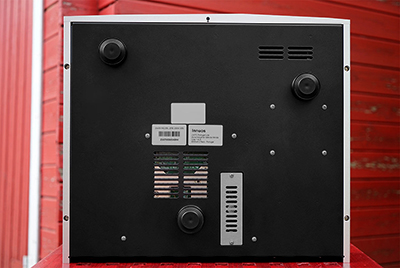 New peaks. Things at digital experts Innuos are really heating up. Not only does their staff now clock a good 50 people including their own Navajo software code talkers, their product line too is expanding. Shortly before we published our review of their Zen Next-Gen, news broke of the new server range Stream starting at €2'250. Then High End Munich 2025 dropped the new flagship Nazaré, surging in at a staggering €70K in fully kitted-out 3-chassis config. What arrived at our offices today is the Zenith Next-Gen, their current portfolio's N°3 so again anything but a budget option. We start at €15.6K but when packed with a 2TB SSD and optional I²S output as tested, our layout is €17'670. Déjà vu. As I lifted the latter-day Zenith from its box and onto my rack, I had a Yogi Berra moment. The machine looked exactly like the Zen Next-Gen here a few months ago – apart from the gold decal in the left corner of the lid which is grey on the Zen. All else is identical. My one hand didn't applaud because it doesn't exactly add variety to our photos. But my other hand did because it demonstrates rather bold understatement. The differences between these two servers hide beneath their bonnets out of sight. More on the differences anon. First the shared items which I'll only briefly outline to avoid repeating myself. Those who want to know more can find further details in the above-linked review. By the way: Zen NG owners can upgrade their device to Zenith Next Gen specs at any time. The same enclosure means a build like a bank vault. Superbly crafted 10mm aluminium plates provide a top-notch high-end feel as well as minimal resonance, a characteristic further enhanced by the 'quirky' placement of the feet and the internal isolation platform for the transformer. Vibrations and microphony effects aren't just undesirable in the analogue realm.
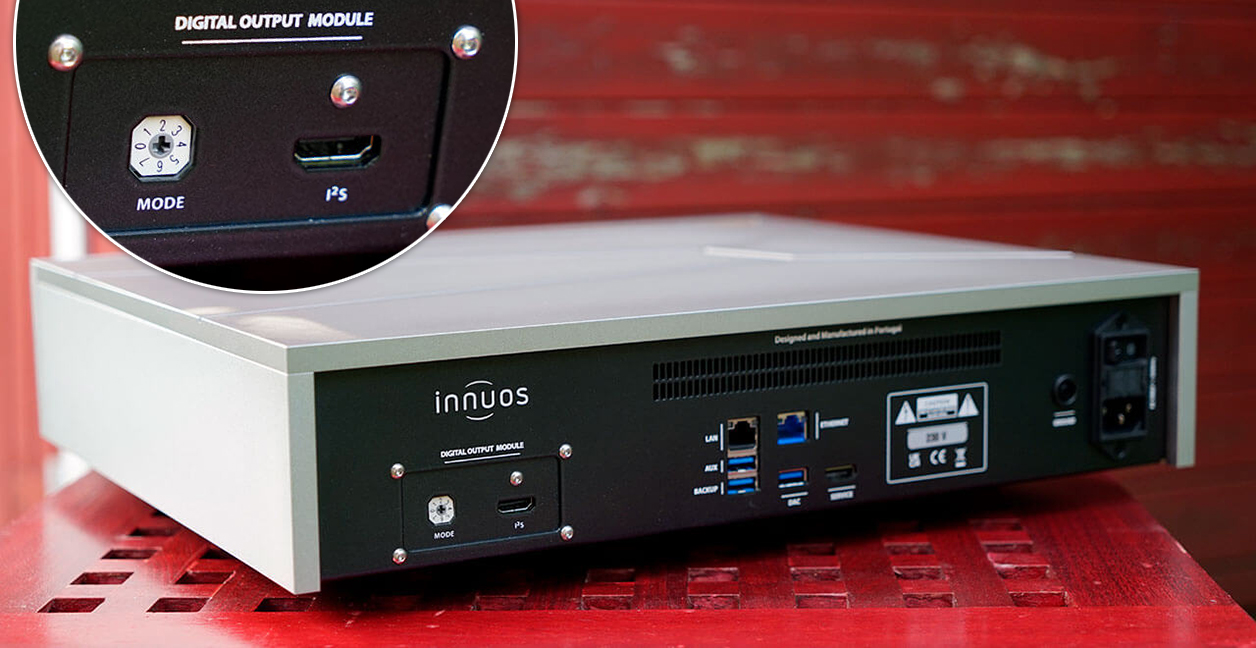
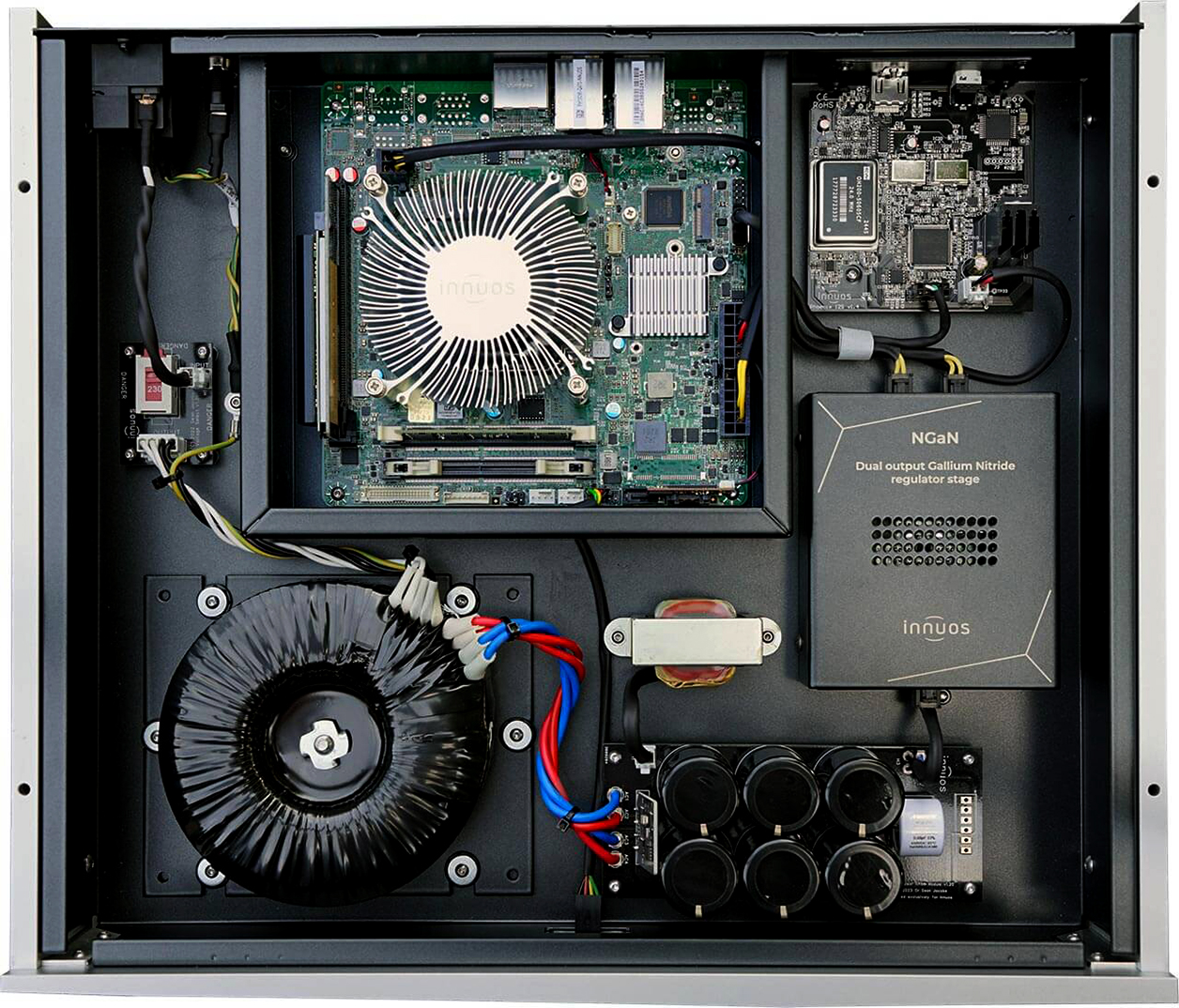
The rear panel offers the same connectivity options as the Zen Next-Gen. In addition to two RJ45 ports, a USB output for an external DAC includes always. Optionally we get one of three digital boards: USB with reclocker, S/PDIF or I²S as shown. SSD storage too is optional when some users stream exclusively from the cloud. The Zenith Next-Gen can hold up to 16TB of music storage. No differences factor in the software either. It's the same proprietary Sense system of all Innuos models which in my opinion strikes a clever balance between ease of use and sonic performance. Users can also run Roon or HQPlayer. Let's move onto the more exciting part: the internal differences between the next-gen Zenith and Zen. While the Zenith features the same PreciseAudio motherboard, it gained a more powerful processor: Intel's Core i7 instead of the i3. According to Innuos product specialist Stephen Healy, this isn't solely for increased processing power but primarily because of the i7's extra physical cores – eight instead of four. This allows for even better utilization of Innuos' proprietary AudioCore technology which dedicates specific processor cores to pure audio playback while others handle system tasks. This results in lower system latency and a noticeable improvement in sound quality.






The use of a so-called pSLC (pseudo single-level cell) SSD for the OS also contributes to lower latency. This SSD reacts even faster than the TCL-type SSD used in the Zen Next-Gen. "Both however are characterized by excellent durability, minimal power consumption and power failure protection which contributes to the robustness and reliability of our system," Healy continued. The most significant difference in the literal sense—the Zenith Next-Gen weighs a good 1.5kg more than the Zen NG—is undoubtedly the considerably upgraded power supply. At 300VA, the special toroidal transformer boasts twice the capacity while the filtering circuitry, equipped with Mundorf capacitors, has three times the capacitance so 130'000µF. Size definitely matters. But there's more. There are also differences in circuit design. While the Zen Next-Gen uses passive rectification, the Zenith employs the ARC6 NGaN power supply with the active rectification technology also found in Innuos' second model, albeit here in a slightly simpler version than the two-chassis Statement. This ensures that the current required by the Zenith Next-Gen is always available at very low impedance said to be particularly beneficial for transient reproduction. If you've heard one, you've heard 'em all? No chance! In my hifi career, I've listened to quite a few Innuos servers and streamers and like to think that I have a pretty good handle on their signature sound. But even though the Zenith Next-Gen is a true Innuos, it goes its own way – similar to the Zen Next-Gen but even more consistently so it seems to me.
 In terms of tonal character, Innuos tend towards a slightly pleasing sonority. This is partly due to a somewhat softer treble which I also recognized in the Zenith Next-Gen although it's really only a fraction of a sliver. Nevertheless, on "Far from your web" by Leyla McCalla [A day for the hunter, a day for the prey], the strings, vocals and banjo sound a touch brighter and more open through my ~€10K Antipodes K22 G4 music server. The difference isn't significant, though. It's simply that the Zenith Next-Gen, when in doubt, prioritizes long-term comfort over strictest adherence to tonal purity. That's about where tonal similarities with its siblings end – in particular the slight lower-midrange boost which the Portuguese usually like to flaunt and which was also characteristic of the Zen Next-Gen. In the Zenith Next-Gen that's nowhere to be found. It presents as neutral as the aforementioned Antipodes compared to which it might only be a touch less full-bodied in the bass, for example on Spain's truly lush bassline of "Love at First Sight" from Sargent Place. Just so, it compensates by being even more detailed. A similar effect factored with Marta's "When it's going wrong" where the Zenith NG delivered neutral taut bass with wonderful nuance. Its high resolution wasn't
  limited to this range but evident across the board.
To my considerable surprise, my Kiwi counterpart renders the piano's body in Cocorosie's "Terrible Angels" [Elevator Angels] somewhat softer, rounder and lusher whilst the Portuguese had it more sinewy, tight and differentiated which I attributed to its better-defined fundamental tone. Since Innuos usually prefer a touch of charm and relaxation across this range, here they pursue maximum clarity. While in my Zen review I had the impression that my Antipodes offered a touch more resolution in the midrange and treble, here the situation reversed. Whether it were the sonic textures of a bowed cello string or the decay of a delicately struck cymbal far back in the room, with the Zenith it felt rendered a bit more accurate. What was truly special is how beautifully it integrated. This treble doesn't blast you with the force of ten suns but is a little more gentle so golden hour not high noon yet we still feel as though being given more information. This was a difference not only to the Antipodes whose treble is stoically linear but even more so compared to the Grimm MU1 which is generally a bit leaner and whose equally superb resolution might impress some ears as having a slight studio quality. Not so with the Innuos Zenith Next-Gen.

12
