
Country of Origin

 This review first appeared in January 2025 on fairaudio.de. By permission of the author, it is hereby syndicated from the German original to reach a broader English audience. Ed.
Reviewer: Thomas Kopanz
Digital sources: D/A converter: Benchmark DAC1 USB, FiiO E10, SMSL DO20; Music server: PC with Win 10, Foobar 2000 including ASIO plug-in
Headphone amplifiers: Benchmark DAC1 USB, Burson Audio Soloist SL, FiiO E10, FiiO E17, iFi Audio Hip DAC, Loxjie P20, Nuprime HPA-9, SMSL DO200
Headphones: Audeze LCD-2.2 (Non-Fazor), AKG K550, AKG K702, Audiofly AF160, Beyerdynamic DT880 600 Ohm, Beyerdynamic DT 700 Pro X, Edifier H850, Fabs Fabulous Ears Basic Dual Driver, HiFiMAN HE-350 Massdrop Edition, KEF M100, Sennheiser x Massdrop HD 6xx (HD 650), Sennheiser HD 800 S, Shure SE215M+, Soundmagic E80
Mobile hifi: Cowon iAudio 7, Rockbox Sandisk Sansa Fuze V2, Sandisk Sansa Clip+, Xiaomi Mi 9 Lite (smartphone)
Accessory: sBooster VBus² USB voltage decoupling
Review component retail: €2'390, add €1'013 for external PSU
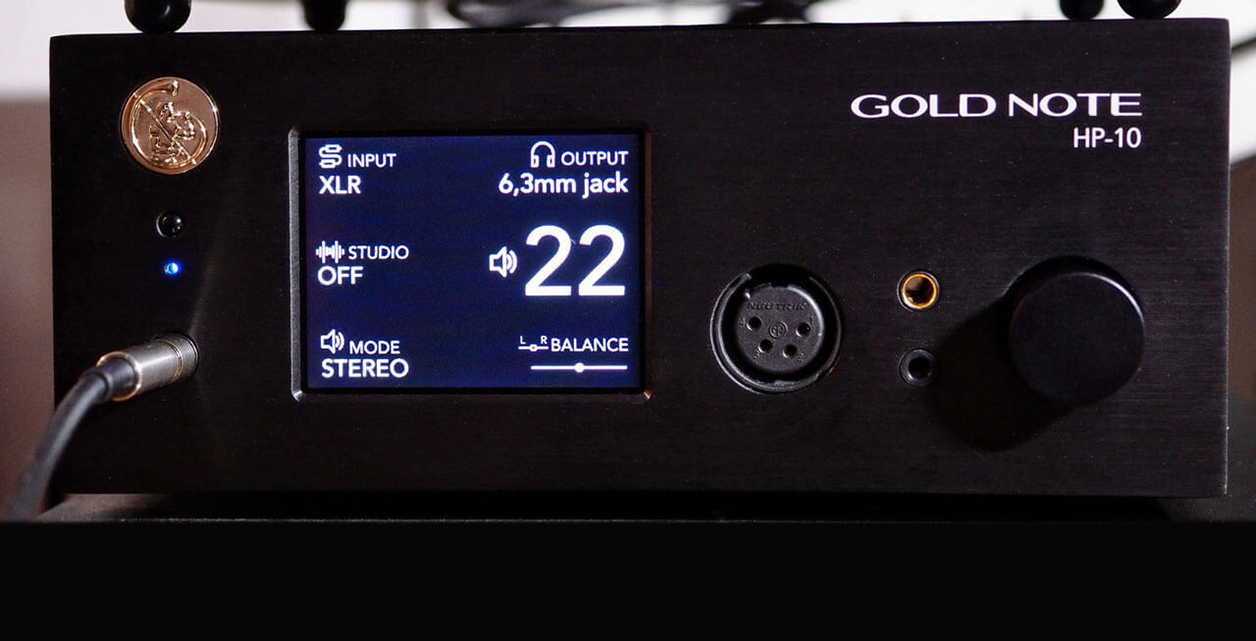
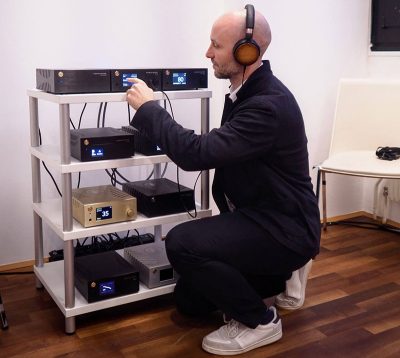 Artfully linear. Italian manufacturers. They enjoy a pretty fine rep in various upscale sectors. And so, some of my colleagues swear by their Italian amps and DACs. Gold Note have not yet enriched the fairaudio review archives but this Florentine firm is a nearly cult brand probably best known for its phono stages and streamers. Now they venture into the headphone amplifier segment. With today's HP-10 their first product of this type, our electronics specialist aims high to offer customers a universal solution for all conceivable headphone challenges. I listened to the Deluxe version with integral USB DAC and Bluetooth to find out whether it succeeds. Cute but not just? The fact that Gold Note have high quality standards was evident by their workmanship. The housing with generous cooling slits is made entirely of brushed aluminium. The test version was black but silver and—no surprise given the name—gold are available, too. In addition to the obligatory AC cord, the usual safety instructions and operating manual, there's a full-function remote that can control up to four devices. It can adjust volume, balance and dim the display. It can select i/o and navigate the multi-layer menu. The shift function allows the transmitter to control a second playback chain.
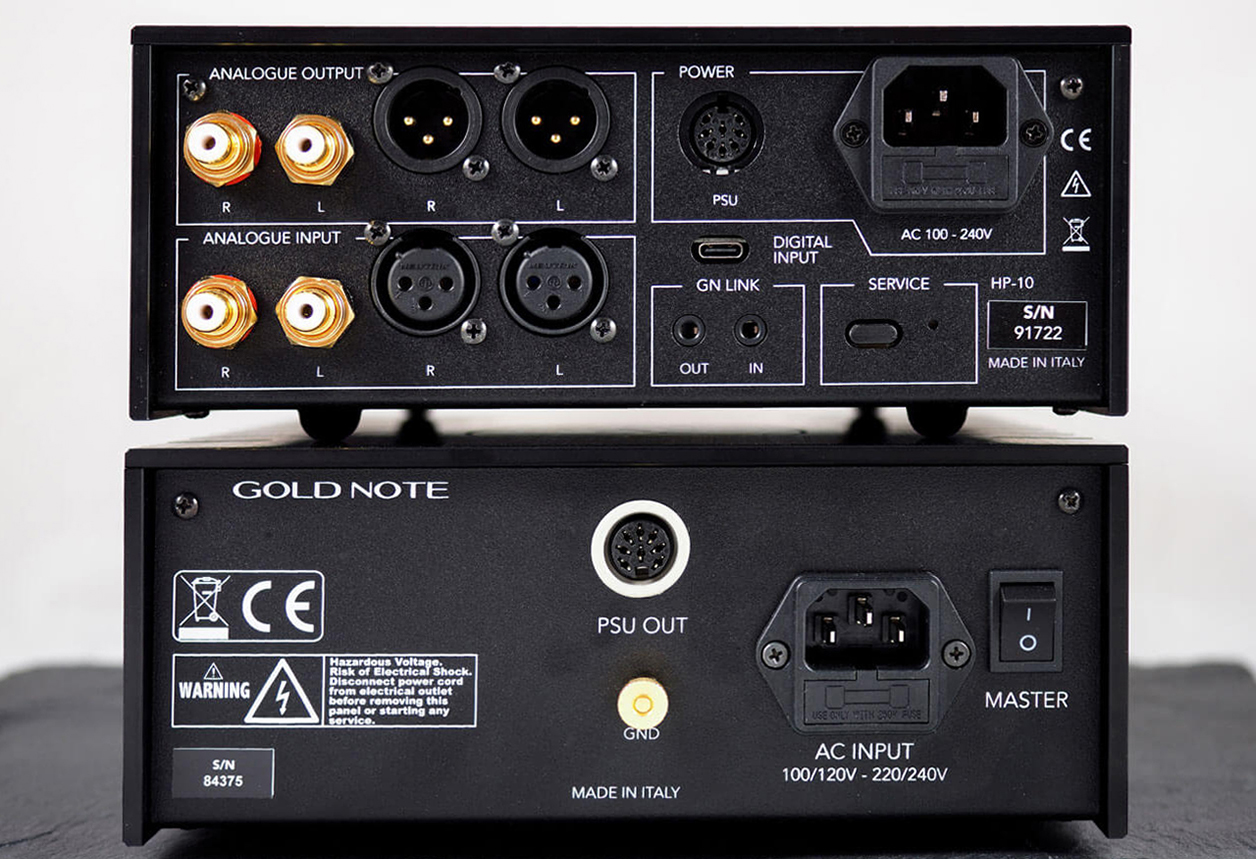
In'n'out. The connectivity options were a pleasant surprise. They reminded me of Germany's SPL Phonitor. With 3.5mm and 6.3mm ports then XLR4 and Pentacon balanced, the Italian amp offers the right connection for almost all common headphones. Sociability continues 'round back whose top row holds RCA and true balanced XLR analogue outputs. These can operate variable or fixed but not be used simultaneously. RCA and XLR inputs sit right below. Then comes a USB-C input for digital sources like laptops, PCs or streaming bridges. Coaxial S/PDIF is noteworthy by its absence. However, the HP-10 Deluxe has a trigger i/o interface so that several connected devices may be switched on/off at once.
The art of the upgrade. Finally, on the top right is the expected fused power inlet but also a proprietary 8-pin DC input. German distributor Besser Distribution was kind enough to supply me the matching high-end power supply PSU-10 Evo. This adds complex AC filtering to further improve the sound. We'll see; or better yet, hear. Double mono but no DSP? Things get exciting with the inner workings. The amp section is a dual-mono design whose channels separate strictly all the way to the headphone jacks. With the exception of the DAC, all sonically influential circuits are purely analogue so implement sans DSP. The Deluxe accepts up to 32/768 PCM and DSD512 over USB. There's Bluetooth 5.1 for SBC, AAC and Qualcomm's aptX up to 576kb/s. The LDAC codec unfortunately is MIA as it is with many other DAC/headphone combos.








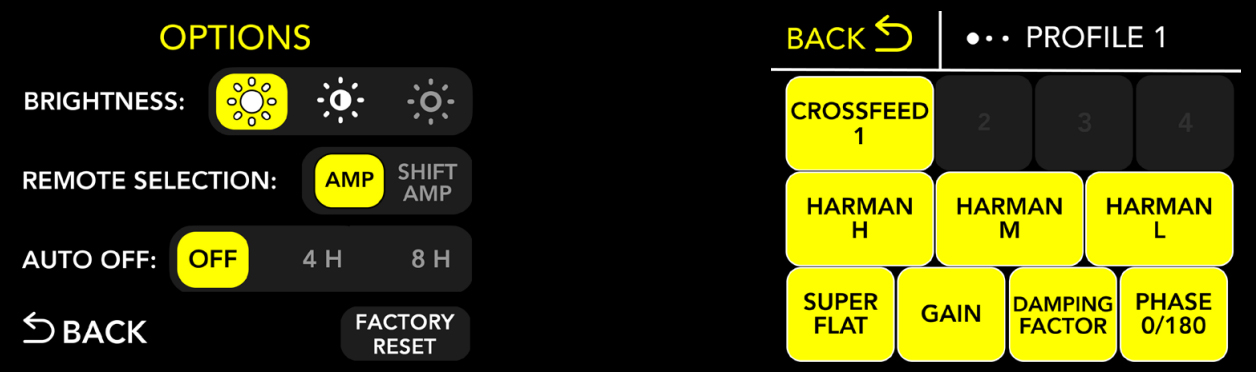
Touch me! In addition to remote control, the HP-10 can be operated almost entirely via its touchscreen. The stepped volume control also serves as nav button to confirm menu selections. In addition to input/output prompts and balance control, "mode" can set stereo, the left or right channel in mono, the right and left signals mixed for L+R mono or swapped channels for reverse stereo. Technical and audiophile treats hide in the "studio" settings. Here the HP-10 Deluxe offers one of the most extensive adjustment options I have ever seen in a headamp regardless of price. In addition to gain we can adjust damping factor for high/low-impedance headphones. Sub 0.32Ω output impedance is pleasingly low on all outputs so operation with impedance-critical loads unproblematic. It is also possible to invert absolute polarity with a separate circuit fronting the volume control. But there's more; a lot more.
 Crossfeed not fade.
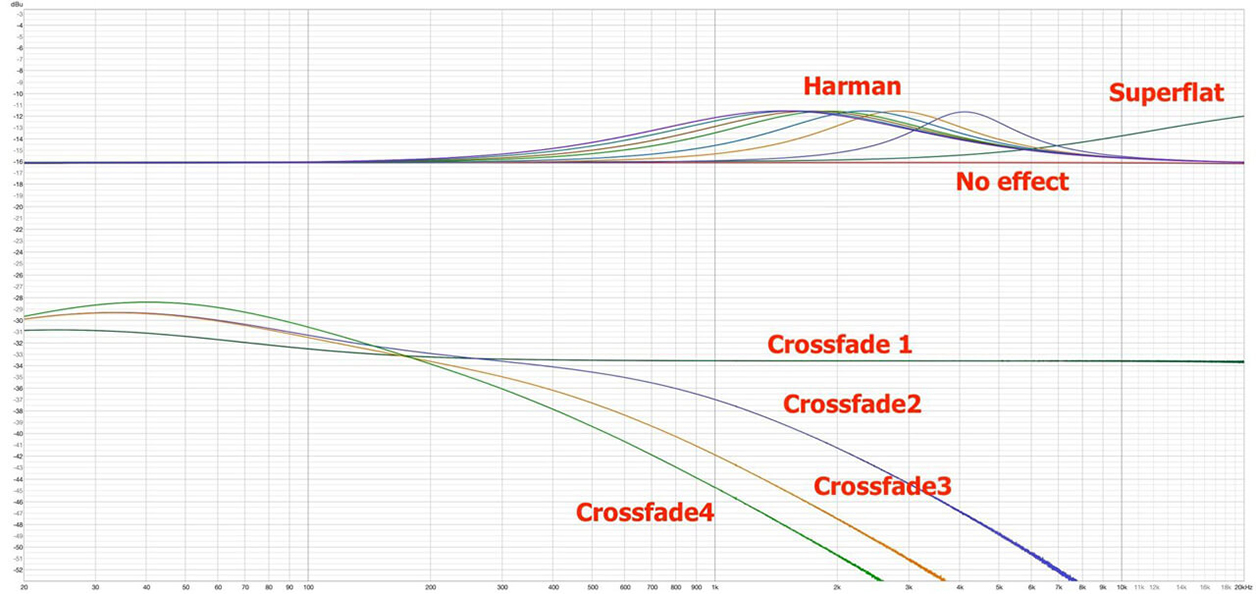
Gold Note certainly aren't first to implement crossfeed. Meier Audio, SPL, iFi and RME's DSP version already showed me its sonic advantages. As a quick reminder, xfeed intends to mimic speaker listening where both ears hear both channels. Hence xfeed bleeds certain left-channel information into the right channel and vice versa. This intends to enhance soundstaging and above all, avoid in-head localization and purely frontal projection. Xfeed usually requires an adjustment in frequency response as mixed signal in the LF can cancel. Gold Note counteract this with bass boost which depending on chosen mode comes in four doses. 20% channel bleed is active regardless. Crossfeed 1 offers a mix that extends across the entire frequency range. With the other options only one band is affected so either the highs, mids or lows. Again, this is all analogue. The Gold Note then has a unique selling point over even the very feature-rich SPL Phonitor X. It's the only headphone amp I know which implements Harman curves in hardware. At least that's what Gold Note call them. Alas, these aren't complete frequency curve adjustments as Harman developed them for the simulation of spatial sound reflections for HeadFi. Rather, Gold Note achieve a level increase in the upper mid and lower treble range. They offer three curves (Harman H, Harman M and Harman L) that can be combined individually and thus enable a somewhat broader-band increase. In conjunction with xfeed, this might actually simulate a speaker setup? Grouped settings store as a profile and we can program three different profiles to switch at will.