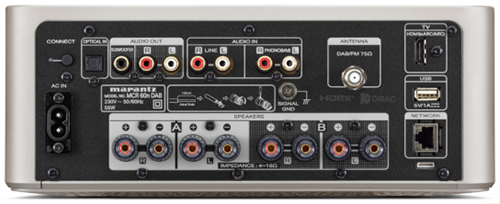
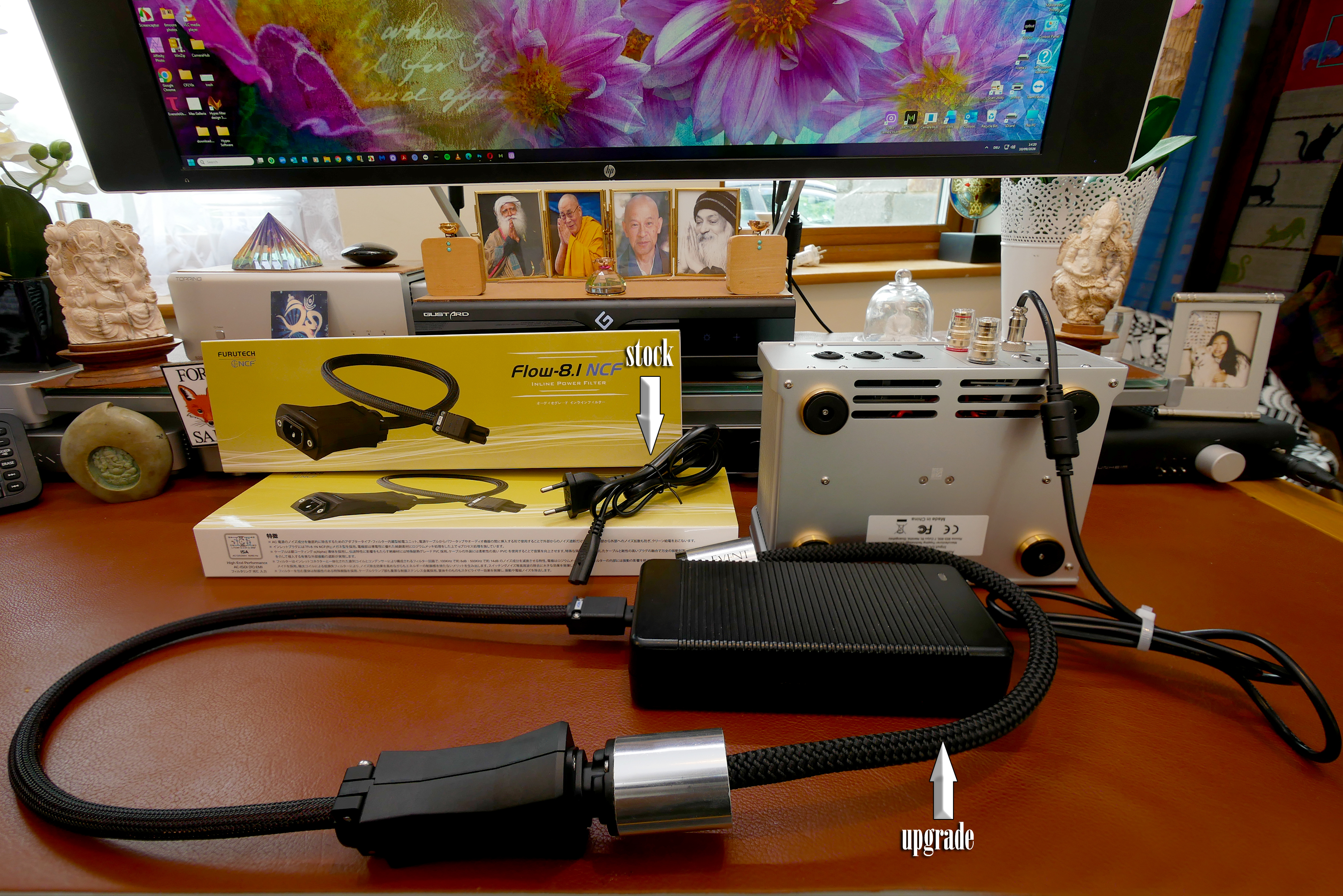
 Fork it. Below we see Topping's stock figure-8 Schuko-terminated cable; a Zu Event cord as stand-in for an upgrade cord; Furutech's packaging for Flow; plus an actual sample on Topping's switching brick. If an image is worth x number of words, this is quite an indictment for using 'proper power delivery' and 'stock Topping cable' in the same sentence. Of course thinking folks know of the hair-thin wire inside safety fuses which many an amplifier power inlet integrates. Now preceding fuses with low-gauge cords can seem silliness squared. It's why more uncompromising designers replace fuses with magnetic circuit breakers. The same thinking folks note that the hardwired umbilical remained unchanged between brick and amp. This simply isn't the place to get into those prickly weeds. Today is on subjective observations. The hard explanations go to the engineers. To show that sitting behind the 8 ball happens even to Marantz, consider their new €900 4-channel MCR 60n streaming integrated for a slice of what John Darko calls FutureFi; not because it'll happen in the future—it's already here—but because it shows where much of our industry is headed. But back to the hear/now of my desktop.
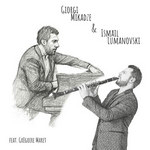 Some reviews take us to school. We learn things we didn't know. Others cover familiar terrain. Unless we somehow skipped first grade, today is déjà vu. The first thing I heard of Flow seating generic UK-terminated cords was stronger lower bass; and greater dynamic crests. Amps with beefier PSU tend to do just that. With a far more capable link to utility power in play, my high-value amps of glossy specs had effectively bulked up their power supplies. That made them act bigger. Hifi 101—but no less delightful for it. As usual, the most obvious changes register first. Noticing the increase in LF amplitude, impact and general substance was today's pre-school stuff which even a yard-bullying cretin would have pegged. It made its presence known already with Swiss sax blower Philippe Chrétien and the cool down-tempo grooves of his 2011 album Champagne. As is true so often, a firmer playback foundation heightens our tunes' black values. That's an automatic saturation and contrast gain. It even came off with small-scale chamber music like Il Duo between Georgian-born pianist Giorgi Mikadze, Makedonian clarinetist Ismail Lumanovski and special Swiss guest Grégoire Maret on harmonica. You can preview its programme with YouTube compression on this concert video. Common sense and experience predict that these immediate gains came mostly from increasing conductive current-carrying mass and lowering impedance of the cabled amp/AC connection. Once one ticks off primary changes from hardware swaps, it's possible to discover a secondary more subtle layer. Would today show anything of that sort? Before we forget our Swiss harmonica hero, how about sneaking in a quick video link from a Lausanne concert with accordionist Vincent Peirani?









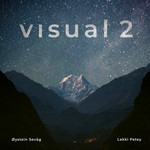
 For musical calories at health-food production values, Øystein Sevåg's œuvre is an always dependable find. His Visual and Visual 2 albums with guitarist Lakki Patey are ultra-minimalist odes to lyricism and an easeful inspection entry into decays, image focus and ambiance. Getting structurally a bit more complex then far more variegated on exotic timbres is Hector Zazou & Swara's In the House of Mirrors, a perennial personal favourite just like his brilliant work with Uzbek singer Sevara Nazarkhan. Led by these two purely instrumental guides, I explored that secondary more subtle layer. What I found were more elucidated overtones as those mathematical multiples of tonal base frequencies which stack above their fundamentals at ever-lower amplitude. From discussions on total harmonic distortion aka THD, most in this hobby will have heard of the 2nd harmonic one octave above its base note; and the 3rd harmonic one octave plus an open fifth above it. But there are far more overtones. "For a violin midrange note like A440 there exist roughly 40-45 mathematically possible harmonics just below 20kHz, with around 10-20 strongly active in the acoustic spectrum."
In basic language, complete recovery of even the finest overtones which often bury in the noise floor produces a 'photorealist' render of a complex instrumental tone. A version not capable of going beyond, say the 8th harmonic would be closer to a sketch. Outlines and size are there; fill and how it influences shape and texture are incomplete. Also, the relative overtone spectrum of an individual instrument isn't static. On a violin like Claude Chalhoub's on Oremus for example, varying bow pressure and draw speed plus vibrato or not will modulate its harmonic distribution. We neither need nor can know what those artistic expressions within the overtone domain should be. We weren't present during the recording. But we can certainly tell the difference between approximate and far more detailed and sophisticated. If we refrain from claiming the latter realistic—how could we possibly know recorded realism?—and instead call it more persuasive or believable, we're not trading in delusion or exaggeration. We simply acknowledge that it's easier for us to believe that a real very particular violin is in the same room with us being made love to by its owner. It's on said score that in its render of well-recorded acoustic instruments, Flow felt more complete; emphasis on 'more' rather than ultimate completion. Experienced audiophiles know. No matter what, with stereo we're dealing in approximations. Illusions. There seems to be no end to finessing our obsession's artifice. It's what keeps the hobby ticking over, manufacturers in the pink. Suffice it to 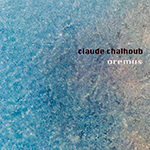 say that Flow with a better cord than Topping's anorexic string moved my nearfield forward along the 'more' axis of persuasiveness informed by deeper subtleties. Nearfield aliens might protest. Surely it takes 'big serious' systems to make such pronouncements. Running five different systems/rooms in parallel, I argue the opposite. The nearfield suffers far fewer distance losses; is demonstrably more room agnostic; and runs its hardware in cruise never bruise mode when satisfying close-up SPL are naturally lower. All of it benefits headfi-reminiscent resolution and linearity. It gets ever harder to match as cubic volumes, listening distances and loudness increase. My final step replaced the generic power cords ~4 x thicker than Topping's with two even girthier Allnic ZL specimens of cold-welded connections, finally two early-gen slinky silver/gold Crystal Cable with Furutech terminations. These Dutchies created still higher focus, clarity and greater temporal elasticity or elegance. Slightly longer decay trails built more overlap with subsequent sounds. This telegraphed pleasing structural pliancy reminiscent of PCM⇒DSD512 conversion. It had the musical proceedings more on the breath even if piano and guitar don't directly involve their operators' lungs like vocals, woodwinds and brasses do.